
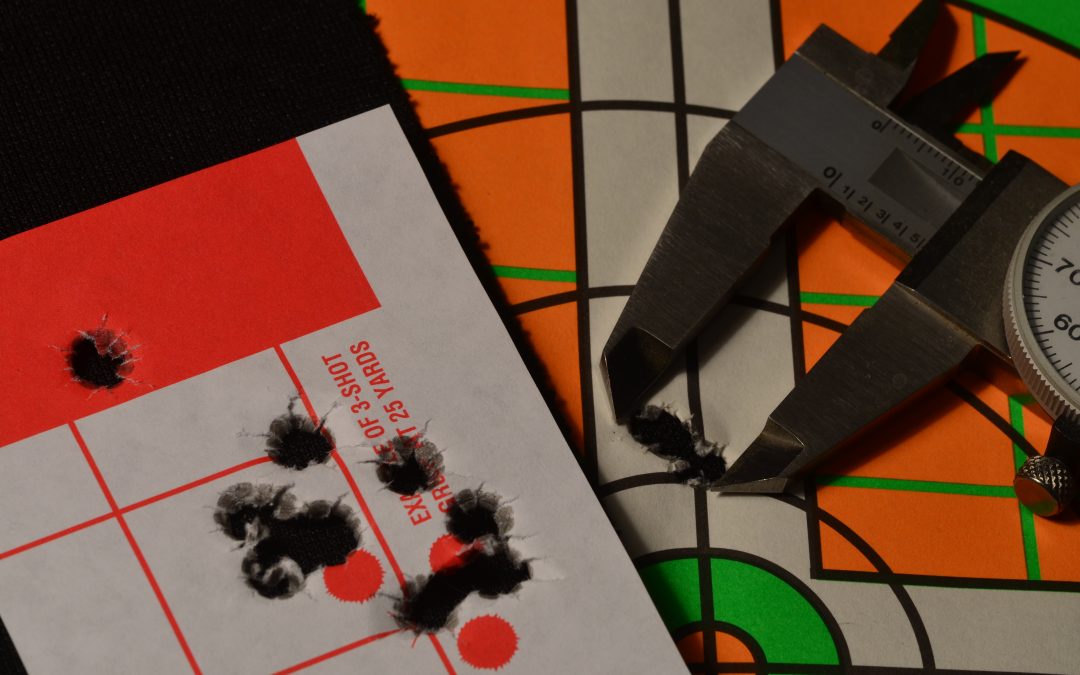
The ten-shot group tells much more about a rifle than even the best three-shot group. The three-shot group here was from a custom Weatherby Mark V (.270 Weatherby), with factory Weatherby ammunition loaded with 150-grain Nosler Partitions. Although it was a consistent one-inch rifle, it never reached those heights again. The ten-shot group indicates a high level of both accuracy and consistency.
By Terry Wieland
The modern standard of accuracy is the three-shot group at 100 yards. Fifty years ago, it was the five-shot group, and a century before that, ten shots. Are we now getting a better picture of a rifle’s capabilities, or is this merely grade inflation, making rifles and ammunition look better than they really are?
This three-shot business generally applies to hunting rifles, and it’s rationalized on the grounds that you rarely fire more than three shots at a big-game animal. Well, maybe so. But the odd time that you do — and believe me, I know — you’ll be grateful for every bit of accuracy you can get.
In fairness, we have also become much more severe in our definition of accuracy. Fifty years ago, a group of 1.5 inches was good, then one inch. Now, the benchmark seems to be a half-inch, or one half-minute of angle.
A single three-shot group, no matter how good, proves absolutely nothing. I once put three shots with a new, custom Weatherby rifle, using factory .270 Weatherby ammunition, into a group that measured .249 inches. While the rifle always shot well, it never approached that rarified level again. It was simply a good, one-inch rifle.
Sometimes, you see a figure for an average of three, three-shot groups. If you’re going to fire nine shots, why not put them all into one group and really find out something? And if you’re going to fire nine, why not ten? Ten shots will tell you a lot more about a rifle than whether it can fluke out one or two tiny groups. In fact, it will tell you everything you need to know about that particular rifle with that particular load.
Recently, I got one of the new Mauser 98s from Mauser to try out. It’s an 8×57 JS, which is a great caliber, but there is one difficulty: There was no top-notch factory ammunition available, and shooting ho-hum stuff would tell me nothing.
To get around this, I loaded some of my most meticulous handloads, using the best bullets I could find from Nosler, Hornady, and Sierra. I took “accuracy” loads from three different loading manuals using four different powders, and started with brand-new Nosler and Hornady brass. I did everything in my power to give the rifle a chance to shine, just like I would trying a new rifle with gilt-edged factory match ammunition.
These were generic loads, not worked up just for this rifle. I then shot a ten-shot group with each load, but a few at a time into each group so there would be no advantage or disadvantage from barrel heating.
What did I learn from all this? The first conclusion is that this is one very accurate hunting rifle. In three trips to the range, for sighting in and so on, the first shots from a cold, clean barrel all went into the center of the group that followed. The best 10-shot group was 1.37 inches, using 180-grain Nosler Ballistic Tips. Another group using Hornady brass and 196-grain Hornady match bullets delivered a group that was exactly one inch for nine shots, and one flyer expanded that to two inches. The worst group of the four was also with Ballistic Tips, and measured 2.7 inches, evenly spread out. Working up and down, I would expect that last group to tighten up considerably.
Since this is a hunting rifle, I’ll start work using hunting bullets, but now I know the rifle is capable of delivering every bit of accuracy that I, as a hunter, am capable of using.
Those ten-shot groups told me everything I need to know about the rifle, and gave me several real starting points to develop some tack drivers with no worrying about whether a particularly good group is merely a fluke. All too often, that’s exactly what they are.