
By Glenn W. Geelhoed
“Can you hear that? That’s Ole Charlie, the most experienced of the hounds, and he only makes that baying sound when the dogs have treed a cat!” Jeff Ford said to me and my PH Charl Watts. “Already?” I asked, incredulous. This time, it happened in the reverse of my usual hunting pattern.
Charl and I had joked, not altogether without serious intent on his end: “Just once, instead of waiting until the very last minute to score, could we do it up front this time to take the pressure off?
“But that way I would miss the hunt! There are days that one has a good hunt, and there are days that one has a good shoot, and they are not always the same day!” I had said. This day, the good shoot preceded the good hunt.
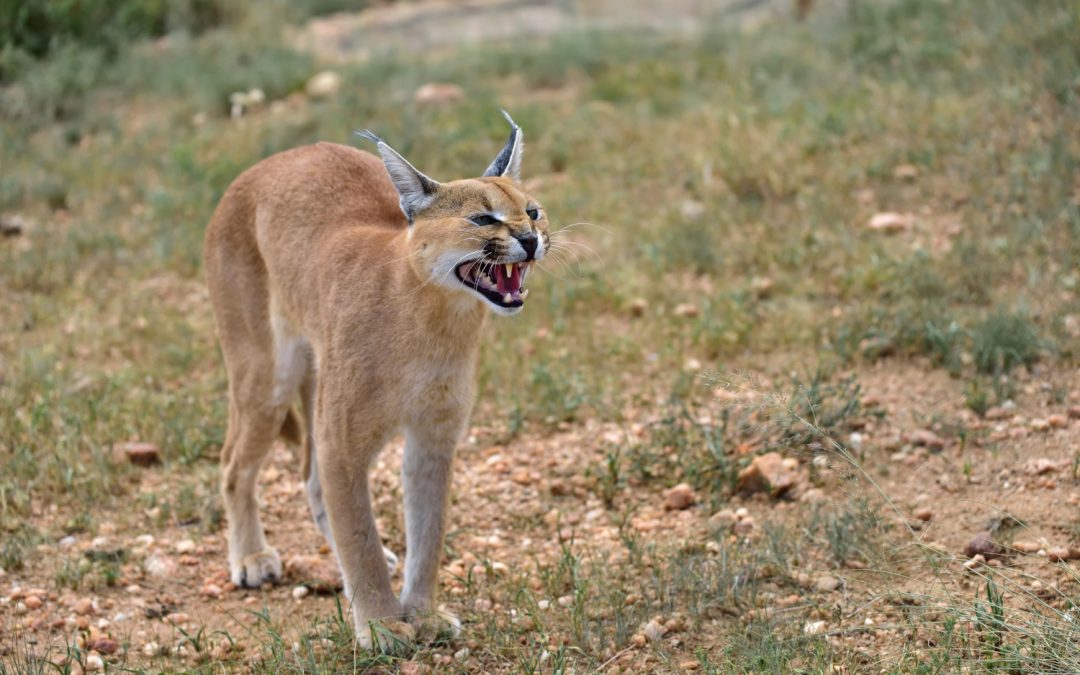
The dawn was ideal, as this coastal area of the Southern Ocean along Eastern Cape Province had had unusual rainfall and was greener and with better morning scent-holding dew than usual. That meant that the three teams of dog handlers had put out the hounds after they had paused at 4:00 a.m. to listen in the dark for the barking of a bushbuck as a warning that danger was near. It could be one of the diurnal predators like the African Crowned Eagle that picks off the newborns of the bushbuck, or nocturnal pack hunters like the jackals. But these predators are nowhere near as efficient as the caracal, a predator with a kill rate of over 95% with its incredible pounces of three to five meters high, snatching flying grouse and taking on almost all newborns of game species and domestic livestock.
The dew held the scent, and the pre-dawn darkness was just glimmering in the east as an orange ball rose over the mountain horizon. The fynbos (the unique regional flora that contains 80% of the species in the continent of Africa) was so dense with various species that I could look in each direction and count a dozen kinds I had never seen before. The volcanic loam was good for raising pineapples, the biggest agricultural industry here.
We were going through Bathurst, a town that looked like a proper English country village with an advertised historic pub named the “Pig and Whistle” established in 1832 – the oldest in the country. I was asking lots of questions about caracal behavior when I heard the walkie-talkie radio crackle. Jeff was talking in the “click language” of Xhosa to Marone, his lifelong childhood friend and hunting playmate on the family farm that was established in 1837. Marone had cut a hot track!
We went to collect Tim, a dog-handler Jeff had brought in from another PH in the year 2000. These are all one family and are treated with utmost respect because they know what they are doing and one can simply turn them loose and know that each will be doing the right thing. We got Tim, who was carrying an old double-barrel shotgun for defense, and a few hounds that stay with him – small groups of the 16-hound pack remain with their respective handlers – and we drove to an abandoned pineapple slope. We eased on down the edge as the sun had not yet crested the mountain at the east, but left a pink glow behind us as we would be going in the opposite direction from the din of bellowing hounds.
Jeff took out the vintage autoloader 12-guage without any explanation except to say that the first shell was ‘triple-A’ and the next one was threes, which made no sense to me as a 00-buck, No. 2 goose shot, and No. 6 birdshot guy. But there was no time to chat, and we hustled off upwind in the direction of the excited hounds. We slipped behind some cactus and yucca and looked through the leaves at a tree with a big cat ten meters up and looking away. Its head was turned to the hounds on the right side of my line of vision. He was 37 meters away and, unaware of our presence, instead was looking down on two of the hounds that had tried to climb the tree and were five meters below him, and slipping off and bawling.
Jeff handed me the 12-guage and said, “Shoot the body and not the head which is facing right.” It was 7:03 a.m. in a glimmer of dawn’s ruby light.
I shot, the cat swayed, and then the front half swung upside down with the rear legs caught in the fork of branches. I was close enough to see that I had shot a big tomcat. After the hounds’ hard effort tracking and treeing, their bloodlust was up, but I was told the handlers were quite ready nearby to pull the dogs off as they would maul the cat.
Tim climbed up the lower branches of the tree in his gum boots and poked with a broken-off branch to dislodge the cat, easing it down into his grasp, and handing it to me without a dog ever getting to it. Charl had my phone and took a video as I turned to him holding the cat with its tufted ears and face toward the camera. It was a five-year-old male with a lot of kills to its credit. Its 14-kilogram heft proved it hadn’t gone hungry.
The hunt was our first, and it was over in four minutes. This contrasted with my last-minute leopard after going without a sighting for 14-days, or the last-minute greater kudu in Limpopo at sunset after a full week of hunting the specific bull. More significantly, Jeff had hunted here with John Maclaurin who had not seen a cat or crossed a track in the first four days of the hunt, so we threatened to send a photo to John with the date changed to 5 September to show we had put in our time on this hunt!
Now that we had experienced the good shoot, we would invest the time and waiting and further scouting to have a good hunt. We went over the fynbos as the sun rose and we could admire the surroundings with the cat in the bag. And I had a whole mount done by Tim Owage of Timoland Taxidermy.
I had flown to South Africa from Kigali, Rwanda, after I had run the Rwenzori Marathon, starting at the Equatorial marker in Kasese, Uganda, running pre-dawn at the 2,850-meter altitude of the Mountains of the Moon. Charl had introduced me to Jeff Ford, who heads the Predator Control in the part of the Eastern Cape near Port Alfred. He is welcomed by all his farming neighbors to range his hounds on their lands because they often lose more than fifty percent of their goats’ kids in this late August springtime in the southern hemisphere. For some farmers who have the elusive blue duiker on their properties, the bigger loss is the two-thirds of the duiker young to caracal and jackals, as the blue duiker is a coveted trophy they hope to conserve.
Charl and I went in pursuit of black-backed jackal and scored, immediately adjacent to a site of a historic calamity: Near the small Eastern Cape village of Martindale, right at the site of our successful jackal hunts, was the renowned tragedy of South African history’s worst rail disaster where one of the goods trucks derailed on the Blaauwkrantz Bridge over the Blaauwkrantz Pass and, with the three carriages and the guard’s van, plunged into the ravine 200 feet (61 metres) below. Of the 55 passengers, 28 were killed and 22 seriously injured. The bridge was rebuilt in 1928.
We climbed the nearby mountain slopes in search of mountain reedbuck, with several days of “good hunts,” but not the same as the “good shoot” with which we had started with a bang. We could enjoy these hunts without pressure, since we already had the cat in the bag.
After a full week of further hunts exploring the fynbos of the Eastern Cape, we got together and did most of what is one of the primary reasons for going hunting – swapping good fireside stories and sharing good meals among great friends, while making plans for the next good hunt/good shoot adventure.