
By Bob Bixby
My wife Pam and I marked our 30th wedding anniversary not with a Caribbean cruise or a European tour, but with nearly five weeks in Southern Africa. It is a place that’s always meant more to us than just a destination. On our 20th anniversary, we renewed our wedding vows in a church overlooking the Indian Ocean. This time, we returned to make more memories.
The trip had three distinct phases. First, we spent time in the Victoria Falls/Livingstone region, exploring Chobe National Park in Botswana and visiting Victoria Falls from both the Zimbabwe and Zambia sides. Then came the heart of the trip, a 14-day hunt with Huntershill Safaris. We wrapped up the trip with a week in Cape Town and the surrounding wine country, a peaceful end to our adventure.
We flew into Victoria Falls then immediately traveled to Botswana. We settled into a quiet resort on the edge of Chobe National Park, right along the river. That first evening, we had dinner outdoors overlooking the water. The food was good, and the setting was unforgettable, hippos grunting in the distance, the sun melted into the river like gold into a fire.
The next morning, we boarded a boat for a game-viewing ride. It felt like stepping into a different world, untouched and raw. Elephants, hippos, crocodiles and buffalo, all going about their business and all indifferent to our presence. That evening, we switched to a land-based game drive and saw four of the Big Five – everything but the leopard. We got close enough to a male lion that we swore we could hear and feel its breath. It was one of those days that reminds you why we came – not just for the animals, but for the feeling of being part of something bigger.
Day two flipped the order: morning drive, evening boat ride. The bush doesn’t follow a schedule, and that’s part of the magic. Every outing revealed something new. We’d previously been to Kruger Park, and while it’s impressive, Chobe felt more personal. Less traffic, fewer tourists. There were moments when it felt like we had the whole park to ourselves.
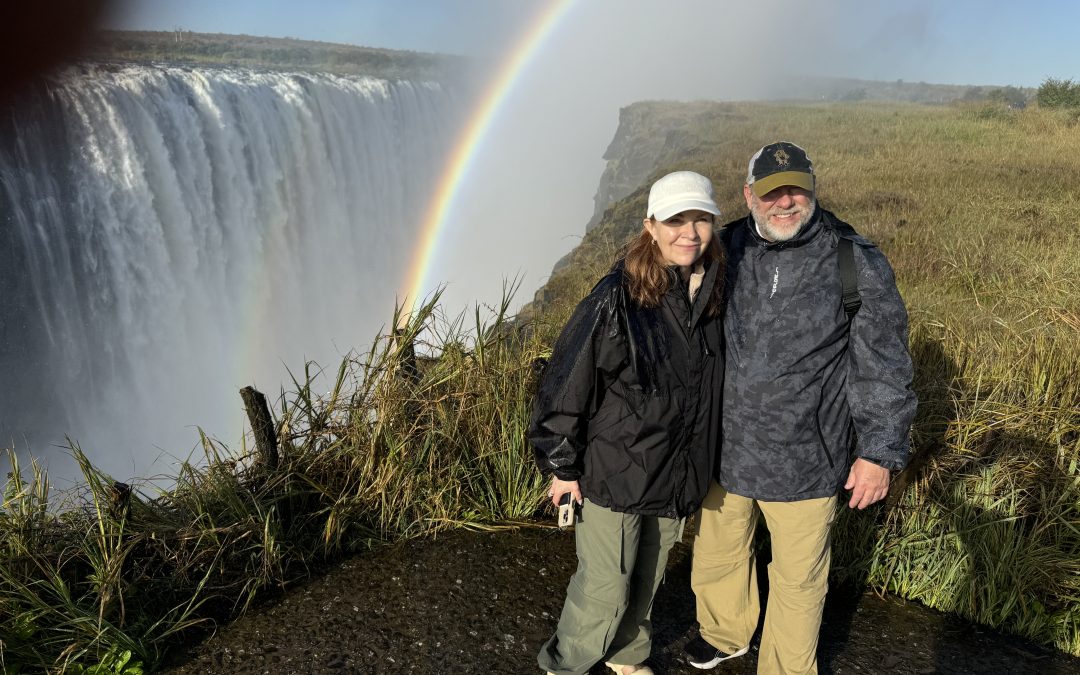
After Chobe, we returned to Victoria Falls and spent five days exploring both sides. The Zambian side had more viewpoints; Zimbabwe had fewer, but arguably the better ones. The falls themselves? Nothing short of incredible. They call it Mosi-oa-Tunya – “The Smoke That Thunders” – and it’s not just a poetic name. It fits. We spent two full days exploring the falls. On our first evening in Victoria Falls, we had dinner at the Lookout Café, perched above the Zambezi near the falls.
On our last day we visited Livingstone, a bit less touristy than Victoria Falls with a lot more of the old-time safari-hunter feel. We had dinner on the Royal Livingstone Express, which travels to Victoria Falls Bridge. That was an amazing end to the first phase of our adventure.
Time in Africa is strange. The days fly by, but the moments seem to stretch. I always wish they’d last longer.
From Victoria Falls, we flew to Johannesburg for an overnight stay, then caught an early flight to East London. That’s where we met our professional hunter, Chris Kriel. Young, sharp, and easygoing, Chris helped us load our gear, which was more than his truck could comfortably hold, and drove us to Huntershill Safaris main camp.
After two days of travel, we were ready to rest. But Africa had other plans. The hunt was about to begin.
We’d spend the first week at Huntershill’s main property, chasing plains game across wide, varied terrain. The main property was split pretty much evenly between bottom flats and rugged mountains. Then we’d move to a more remote and mountainous camp for a different set of species. Each location promised its own challenges, its own stories, and its own rewards.
A few hours after arriving, Chris knocked on our door. “Want to check the rifle?” he asked. This was my fifth safari, but my first without my own rifle. It felt strange, like forgetting to wear my wedding ring. We drove to the range as the light began to fade. It would most likely be the last thing we did that night.
Chris handed me his Remington Model 700 chambered in .300 WSM. It had a Sig Sauer scope and a ballistic app that dialed in windage and distance. I usually bring my .300 Ultra Mag and 7mm Ultra Mag, both Remington and with Swarovski glass, so the setup felt extremely familiar.
One thing was new though, a suppressor. I’d never shot a suppressed rifle before. The first shot at the range told me everything I needed to know. The reduced noise, the softer recoil – it was smooth. Leaving my own rifle behind didn’t feel like a compromise at all.
The rifle was dialed. We were ready. The bush was waiting.
Huntershill has a resident rhino family that roams near the lodge. On the drive back, we took our time, snapping photos and watching the hills. On a previous trip, I’d walked out of my chalet and nearly walked into a group of rhinos. I had to shoo them off like oversized cattle. Africa doesn’t do fences like we do back home, animals here pretty much go where they want.
Dinner was excellent, hearty and simple. We turned in early, tired from travel but excited for what lay ahead. Tomorrow, the hunt would begin. Not just for trophies, but for stories. And that’s what we came for.
The Lechwe, Copper Elegance
The first morning of the hunt started the way it should, early, quiet, and full of possibility. The air was cool, the light just beginning to stretch across the hills, and the bush had that stillness that only comes before the first pursuit. Pam and I had a quick breakfast, and by first light, we were rolling out with Chris, in search of “something.”
My list for this trip was ambitious but flexible: kudu, bushbuck, lechwe, waterbuck, golden wildebeest, black impala, nyala, mountain reedbuck, bontebok, and warthog. I wasn’t chasing numbers, five or six would be my limit. I was going to let the trip play out as to which animals I went after. I wanted animals with stories, not just the best scores.
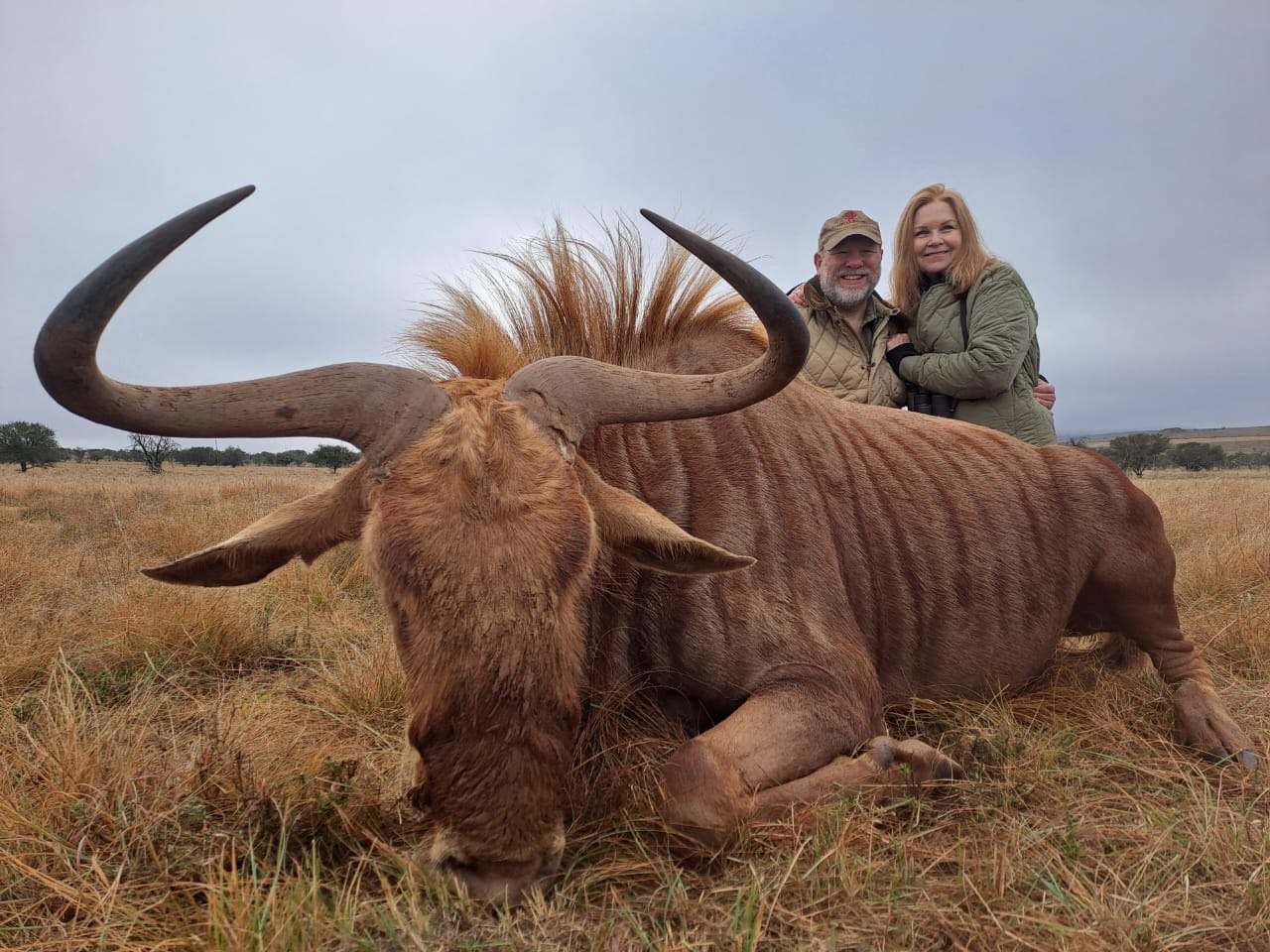
We spotted a herd of golden wildebeest almost immediately. Their color is something else, a rich copper tone with brindled highlights that shimmer in the sun. I’ve always had a soft spot for red tones, maybe because Pam’s hair carries that same fire. But none of the bulls stood out, so we moved on.
A small herd of blue wildebeest crested a hill toward us. One bull looked decent, but I wasn’t interested in another blue wildebeest. Watching wildebeest, the blues and blacks, is always entertaining. They’re the clowns of the savanna, bouncing and bucking for no reason at all. We watched for a while, then pressed on.
A short drive brought us to a herd of Cape buffalo. I wasn’t hunting buffalo on this trip, but I’ve dreamt of that day. There’s a gravity to buffalo, a presence that demands respect. We glassed the hillsides for an hour or so, hoping something else might show, but the bush stayed quiet. It was time to head back for lunch.
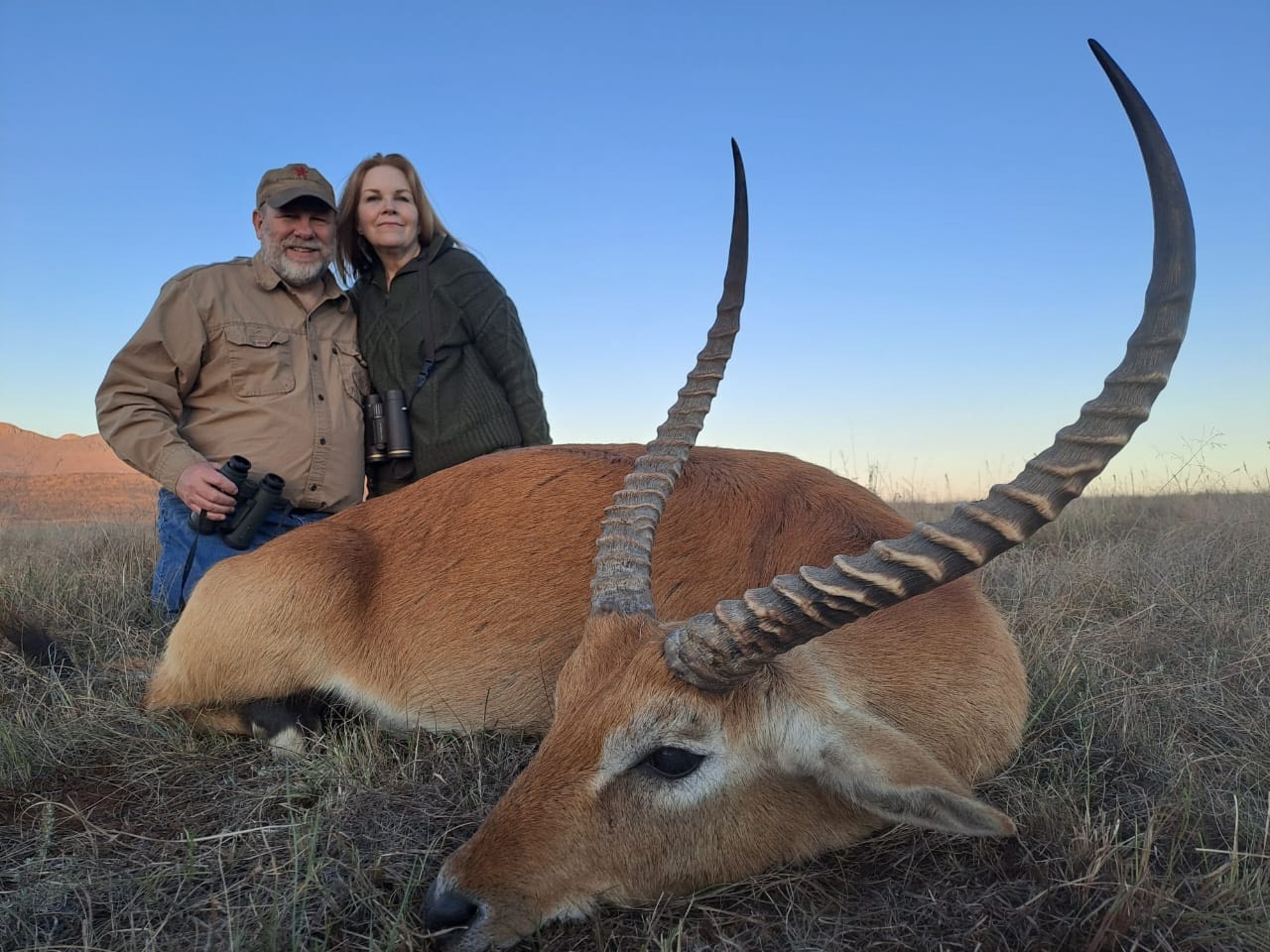
Just a few minutes into the drive, Chris stopped the truck, jumped out, and said one word: “Lechwe.” Across the valley, behind a small kopje, was a bachelor herd of three bulls. Two were shooters, one with the classic symmetry and sweeping hooks, the other with a twisted crooked horn that made him a trophy in his own right. We moved to the near side of the kopje, but the cover was thin. Two more younger bulls approached from behind, and if we moved too soon, they’d bust the whole setup.
We waited. The bulls shifted direction, meandering back the way they came. We circled low, hoping to intercept them. It worked. At about 150 yards, they came into view. Chris asked, “Unique or traditional beauty?” I chose the latter, the fourth bull in line, graceful and balanced.
Chris got a final range and dialed in the scope and had me set up perfectly. I settled behind the sticks and found the bull in the scope. I made sure it was the right lechwe, a mistake I’d make later in the trip. Once confirmed, I placed the reticle just above the front shoulder. Calm breath. Gentle squeeze. The shot broke.
What followed was a sound I’d never heard before in Africa: a soft “thwap,” courtesy of Chris’s suppressed rifle. The rifle felt great, dialed in and my confidence was high.
The bull ran no more than 30 yards. His hide was stunning, a deep chestnut color with a golden sheen, and horns that swept back like an impala’s but longer and more dramatic. One of my top animals, and it was already headed to the salt.
By the time we finished photos, it was well past lunch. We returned to camp for a quiet meal, just the three of us. After a short siesta, we went back out, not to shoot, but to scout. I didn’t want to take everything on my first day. Africa rewards patience, and the best stories are never rushed.
The Golden Wildebeest – the Chestnut Dream
The second day began much like the first. A quick breakfast and the anticipation of something extraordinary happening. We set out towards the area we’d scouted the night before, and almost immediately we were reminded why we were here. A mother rhino and her calf stood just off the road, framed by the morning light. Few things in the bush are more precious than a baby rhino. Maybe a sheep farmer’s newborn lambs.
We watched for nearly twenty minutes, taking photos and soaking in the moment. It’s surreal, really, two teachers from small towns in Iowa, sitting in silence, watching a rhino calf nuzzle its mother. Unbelievable.
We moved on, passing a few small waterbuck bulls just inside the tree line, but nothing worth pursuing. Chris led us to a semi-secluded flat that he knew was a good glassing spot with cover and a couple of flat rocks to sit on. He scanned the landscape with ease, calling out animals like a conductor reading sheet music. I had my Swarovski binoculars up trying to locate anything, but as usual, I couldn’t see a fraction of what he saw. It’s a skill that comes with time, and Chris had it in spades.
We glassed for a couple of hours before moving on to another vantage point. The goal was kudu, ever elusive and majestic, and now at the top of my list as the lechwe was in salt. Chris mentioned a particular bull that had been giving the other PHs a run for their money. Big horns, big body, definitely a shooter. We were after kudu, but if another opportunity presented itself, I wasn’t about to let it pass. There is an old saying, don’t pass up something great to get something good. The list was a guide, not something written in stone, and Africa has a way of offering surprises worth taking.
At the second spot, we saw a lot of game, but nothing extraordinary: giraffe, zebra, impala, springbok, blesbok, blue and black wildebeest. We didn’t see anything I was after until just before lunch. As Africa often does, it delivered at the last moment. A herd of golden wildebeest appeared, distant but promising, and clearly different from the one we’d seen the day before. Chris made a mental note, and we headed back for lunch.
Lunch was full of expectation. No siesta today, just an extra cold drink and a plan. Within 30 minutes of finishing lunch, we were back at it and headed towards a new vantage point, 400–500 yards from the herd of golden wildebeest. Chris broke out the spotting scope and studied the herd with the intensity of someone reading between the lines. After what felt like an eternity, he pulled away with a grin. “There’s a giant in there,” he said. “One that stands out so much bigger, it’s crazy.”
We packed up and began the stalk, weaving through trees and brush, always keeping something between us and the herd. At 250 yards, we hit a dry riverbed, more canyon than creek, and scrambled down and up the walls like two nearly 60-year-olds trying to be 30 again. More likely, two 58-year-olds acting like two 90-year-olds. We laughed, but not loud enough to spook the herd.
At 150 yards, we reached the edge of the field where the wildebeest were grazing. They were in the open, but we had good cover. Chris was right, one bull did stand out, even I could tell. His horns extended what seemed like 6 to 8 inches beyond his ears, a brindled chestnut dream in motion. Only one problem – he wouldn’t stand still.
Chris set up the sticks, and I got on the gun. For at least an hour, I tracked that bull through the scope as he wandered, meandered, and mingled with the herd. My reticle was on him the whole time, but he never gave me a clean shot. Until he did.
He made the one mistake: stepped just far enough from the herd. Chris had already ranged the herd and dialed in the scope for the distance, so all I had to do was to take a calm breath and gently squeeze the trigger. The rifle cracked, then the sound every hunter wants to hear, the thwap. The bull ran 75–100 yards and dropped.
The herd circled and returned to their original spot and watched us, never leaving. The bull, though, ended up much closer to us after he ran. We only had to walk about 50 yards. And the closer we got, the more beautiful he became; red-orange hide, vibrant brindle stripes, and horns that seemed sculpted.
The sun was setting as we took photos. Too late to continue, so we headed back to an excellent dinner and the firepit where I discovered European-style hard apple cider. Nothing like the American version. It is crisp, dry, and dangerously drinkable.
Chasing the Grey Ghost
The next morning, Chris told us we’d be heading to the other farm where we had two days left to chase the bull we’d been hearing about.
Huntershill spans some 60,000 acres, split between flat plains and rugged mountain terrain. We knew the bull wouldn’t be in the low country, so we headed into the hills. The plan was simple: drive to a lookout, glass for an hour or so, move on, and repeat. We saw plenty of game. The kudu were thick, but all too young or female. The only notable sighting was a herd of Watusi cattle winding their way up a mountain trail. Entertaining, but not what we were after.
After a quick lunch, we went back out. Not long into the afternoon hunt, Chris got a call from another PH, Nippy Bridger. He thought he’d seen the bull near where they were hunting warthog. We loaded up and met Nippy who slipped away with Chris to scout the area. Thirty minutes later, they returned; they’d seen the bull cresting the mountain on the far side. We left Nippy and drove around hoping to cut him off before we lost him.
We reached the other side and began glassing, but it seemed the kudu had given us the slip. We continued to scan the area for what seemed like hours but never saw him again. Chris suspected the bull had circled back toward where we’d started. We decided to return the next day.
Morning came early and we headed back to the spot where we’d first met Nippy. Whether by luck or instinct, Chris spotted the bull not long after sunrise. He was moving up out of the shadows, into the warmth of the sun, but still too far for me to judge his size. Chris said he was the best bull seen on the property this year.
The bull moved directly toward us, to around 400 yards. Then he turned left and started moving along the mountain’s side. We quickly packed up and followed, trying to stay close enough for a shot but far enough to remain unseen. We moved three or four times, but never got within 300 yards, and he never gave us an opportunity for a clean shot.
As he neared the crest of a ridge that spilled into a valley, I could sense Chris felt that we were on the verge of losing the kudu.
“Can you run?” he asked.
“Not fast anymore, but yes.”
As soon as the bull crested the ridge, we took off, scrambling uphill, boots slipping on loose stones, hearts pounding not just from exertion but from urgency. Under normal circumstances, running after a kudu isn’t the best plan. But this wasn’t a normal circumstance. This was a chance at a great bull, and we weren’t about to let him vanish into the folds of the mountain without a fight.
When we reached the ridge, the terrain opened into a broad plateau to the left, while to the right it dropped into a deep valley against the mountainside. It could hide a kudu with ease. We glassed quickly, scanning everywhere, but saw no sign of the bull.
Just then, a herd of black wildebeest wandered onto the plateau and began their usual antics. They chased each other in circles, stopped, bolted, and repeated the cycle like children at recess. It was entertaining as they’ve earned their reputation as clowns, but our focus was elsewhere. We were hunting a ghost, and the clock was ticking.
We had to make a choice. The bull had crested the ridge, and now it was anyone’s guess – had he gone left toward the plateau or right into the valley? We chose left. Moving slowly and deliberately, we crept toward the plateau, using every bit of cover we could find. The wildebeest were still clowning in the open, but they hadn’t seen us. We reached the edge and glassed the area.
Just then, Chris caught movement behind us. A group of kudu cows had slipped in quietly, and miraculously, we hadn’t spooked them, considering we were focused entirely on staying hidden from the wildebeest to our left. Chris shifted his attention to the cows. He thought he saw horns. No idea on size, and at that point, we were pretty sure it couldn’t be our bull as we had earlier “decided” he’d gone the other way.
But Africa has a way of rewriting your assumptions, and this hunt was far from over.
The cows had settled into a quiet rhythm, feeding in a patch of brush that gave us clear views as they weaved in and out of one another. Then, almost casually, the bull eased his head out from behind the cover.
At first glance, it looked like a whitetail buck back home curling his lip in what a biologist would call the “Flehmen response”. I just call it curling their upper lip. It’s where an animal will flare his upper lip to better catch a scent. What I saw seemed relatively ordinary, but Chris was puzzled. He’d never seen a kudu behave that way. It wasn’t a scent test, it was something else. Something off. And while we didn’t yet know it, that odd moment would be the first clue to a bull unlike any we’d ever seen.
They had fed down to within 50 yards of us, drifting into a small clearing that gave us a perfect window to study each animal as they moved through the brush. Chris was able to gauge the size of the horns and confirm it was the bull we’d been chasing. He quietly set up the sticks. I got the rifle into position, and Chris dialed the scope for a 50-yard shot.
We were tucked just below an outcrop of the plateau, and the bull had moved ever so slightly down the slope. That small shift was enough to throw off the shot – my crosshairs were no longer on the kudu but instead locked onto the rocks in front of me. It was frustrating, but in Africa the terrain is as much a part of the hunt as the animal itself.
We had to move up onto the plateau, fully exposed to the wildebeest that, until now, hadn’t paid us any mind. As soon as we crested, they bolted across the open like a thunderclap, a thundering herd in full retreat. Thankfully, the kudu remained undisturbed, still feeding, still unaware.
Chris got the sticks up again, this time higher, and we were back to within 50 yards. I settled behind the rifle, and Chris confirmed the distance. I took a calm breath and gently squeezed the trigger. The rifle let off a crack, and almost immediately, I heard the third thwap of the trip – that unmistakable sound of a bullet finding its mark.
The cows scattered in every direction, and the bull bolted, maybe 25, possibly 30 yards further down into the ravine before piling up. I’ve never claimed to be a great shot. If you asked my friends, I hope they’d say I’m at least a competent shot. In this case, I almost wish I’d been a little less competent. Where that kudu dropped was at least 200 yards from the nearest spot the truck could reach, and even that would require the trackers to cut a new trail through the brush just to get us that close. It’s one of those moments where the excitement of the shot is quickly tempered by the reality of terrain.
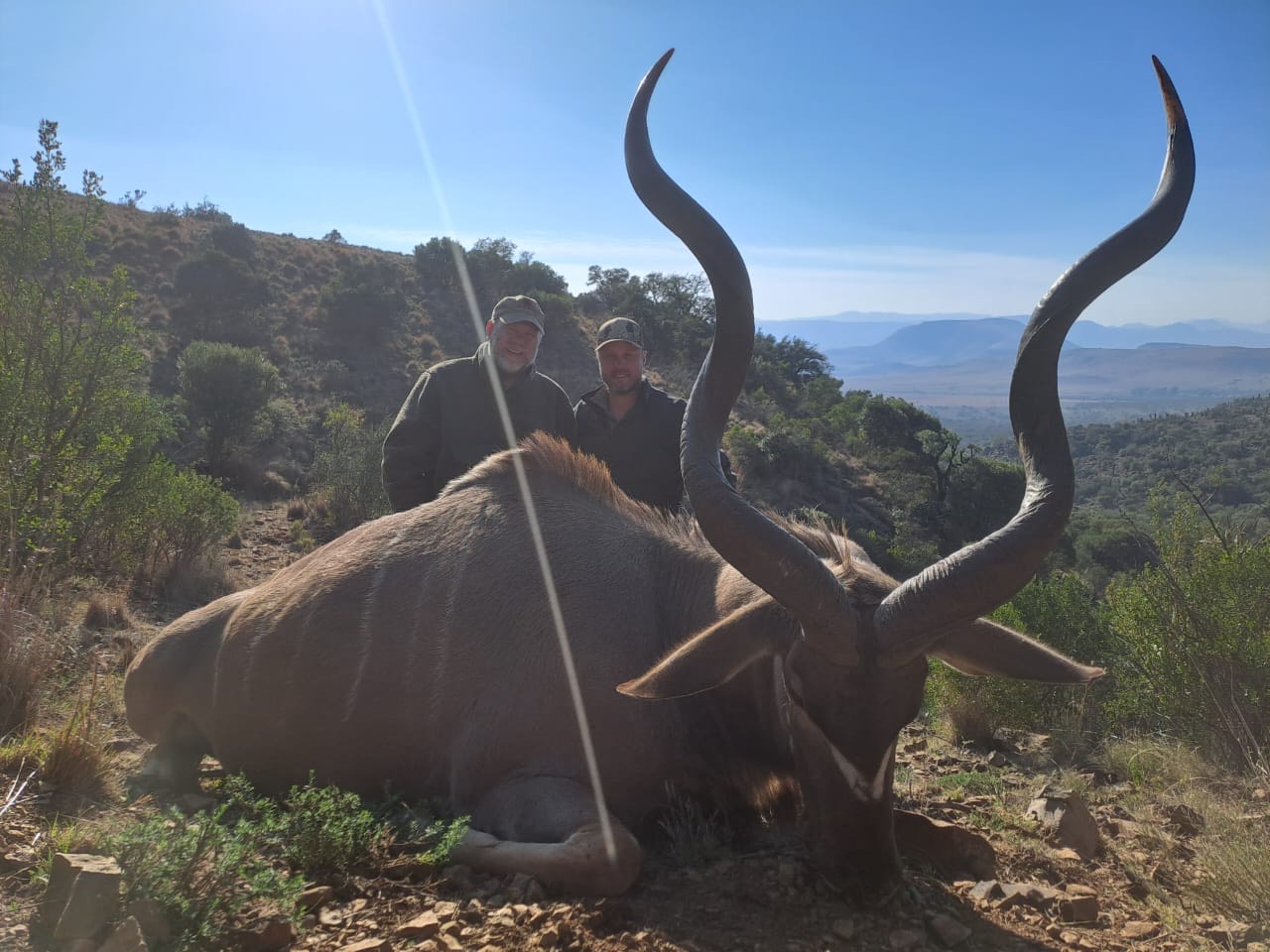
That side of the mountain was steep, brutally steep. It took everything Pam and I had to get down to where the bull lay. But we made it, and there he was. A truly magnificent animal. Kudu have always been my favorite African animal. On each trip, it had been the top priority to hunt. This bull was special, but as we got closer, something wasn’t right.
When we first saw him curling his lip, I’d assumed it was the Flehmen response. But it wasn’t that at all. He’d been attacked, something had torn his upper and lower lips, splitting them into four distinct flaps. It gave him a rough, almost grotesque appearance. An ugly face, no doubt, but what an incredible hunt.
That kudu story was already one for the books, but the real spectacle was just beginning. Nippy and his crew had heard the shot and came over to see the bull everyone had been chasing. He was a fine animal, not a 60-inch Namibian giant, and not a top-ten record book entry either, but he had a beautiful curl, thick bases, and what stood out most to me: six-inch ivory tips. Not the torn lips; it was those tips that made him truly unique to me.
That side of the mountain was steep, and now it was time to pay the price. There was no way we were getting that kudu out intact. The crew didn’t want to skin and quarter him, so they made the call to cut him in half. Then, two trackers hoisted one half each onto their shoulders and started the climb. It was only 200 yards, but when it’s straight up, that distance feels like a mile. This bull was no lightweight either, easily in the five- to six-hundred pounds range. That meant each man was carrying close to 300 pounds uphill, through brush and loose rocks, without complaint.
Watching that kind of grit and strength made me grateful all over again, not just for the hunt, but for the people who make it possible. The whole hunt so far, from the first glassing session to this final shot here at the main property, had been unforgettable. It was lunchtime, and we were hungry, so we loaded up and headed back for our last meal at Huntershill.
After lunch, we made our way to the caves to see the rock art, a quiet detour. The path wasn’t easy, winding through brush and stone, but the reward was worth every step. The bushmen paintings, etched into rock thousands of years ago, stood as silent witnesses to a time long before rifles, before lodges and fire pits. We stood in awe, trying to imagine what life looked like when those figures were drawn. What were they hunting? What stories were they telling?
Africa has a way of making you feel small, and in that moment, we felt it deeply.
After the taxidermy was complete and the mount hung on the wall, the bull still bore the scars of that encounter. The taxidermist did a fine job making him look as normal as possible, but I’ll always remember the truth in his face — the war wounds, the chase, and the moments where he almost got away.

The Old Warrior Bushbuck
The drive to Rocklands was uneventful. The place was known for warthog, waterbuck, and bushbuck, animals from my wish list, and they were in abundance, as well as big herds of buffalo, pods of hippos in two lakes, hartebeest, eland, zebra, and especially giraffe in great numbers. But I wasn’t after any of those. The bushbuck would come from an adjacent farm, one with a river and thick tree cover, their perfect habitat.
The first morning at our new camp, we headed to one of Chris’s favorite lookouts, one of several elevated vantage points surrounding a lowland flat. Each gave a slightly angled view to below us. We set up at the first, overlooking a watering hole. The activity was constant. Several waterbuck came in to drink as the sun rose. A few were tempting, but it was day one, and we were going to be selective. Warthogs came and went, either a lot of them, or the same ones making repeated appearances.
A very nice warthog came in late that morning, and I was hoping Chris would give the nod. He didn’t. “We can do better,” he said. At the time, I wasn’t so sure. A bit of foreshadowing, that would end up being the warthog I would take, and yes, I know for a fact we could have done better.
The tusks were long and thick, at least to my eyes. They would’ve been longer if not for the worn tips, but they held their mass all the way to the blunt ends. He looked like a bruiser, and I was excited. When Chris passed, I was disappointed. He must’ve seen it on my face, because he followed up with a grin: “Don’t worry, he’ll be here every morning. Plan on this one if we’re down to the last day.”
I smiled. That was good enough for now.
That afternoon, we climbed a road up the side of a mountain. On the way, we spotted a proper kudu. He would have been worth chasing if I hadn’t already taken one. We chased him for a while, keeping note of his direction and where he was headed to pass along to the next group. Back on the road, we reached the first stop. More waterbuck. One stood out, horns that swept forward and curved together like a football perched atop his head. Unique, but again, we passed.
We moved from spot to spot, glassing at each before moving to the next. We saw plenty of animals, but nothing that was truly special. By this time it was getting late, so we headed back to camp. Chris prepared our first braai here at Rocklands, including a traditional Afrikaans treat, roosterbrood, on the grill. The meal was incredible.
The next morning, we headed to an adjacent property with a river running through it. Early light brought mist and fog to the lowlands. We walked along the river’s edge, staying on a road just beside the tree line. We spooked several bushbuck, never saw them, but heard them close. We saw others farther out, but nothing worth taking or nothing that presented a shot.
Lunch was a field affair. Chris brought a portable grill, a semi-sphere with a propane tank underneath. He cooked one of the best field lunches I’ve ever had. I do enjoy African game meat.
After lunch, we climbed out and onto the bank, more of a canyon than riverbank, with a 50-foot elevation change. We walked along the rim, glassing down into the trees. We continued walking and glassing until we reached the far end of the property. We considered moving on to a different farm, but Chris made the call to send our tracker, Moses, to the other end to walk back toward us through the bottom, pushing the game in our direction. We set up just above a large clearing about midway along the bank.
It worked. A good ram moved out of the trees, heading toward us. Two problems: he was walking fast, and he was moving toward the side of the canyon. By the time I got on the sticks and found him in the scope, he was almost beneath the bank and about to disappear. He kept moving quickly, almost perfectly parallel to the edge of the riverbank. To keep him in the scope, I had to get up on my toes and point the gun lower. I never felt comfortable enough to take the shot. He slipped away, and I felt that familiar ache of a missed opportunity.
Then, from the far side of the clearing, an old ram fed out into the open, slowly and deliberately. Chris got his spotting scope out. The ram didn’t seem to be in a hurry to go anywhere. Through the glass, you could see he was well past his prime. His horns weren’t terribly long, but they were as thick at the top as they were at the base. He was an old warrior. One eye had been gouged out, the truest definition of a perfect trophy. The only problem: he was feeding 400 yards away.
I’m not a great shot. I’ve made longer and missed shorter. Prone would’ve been ideal, but the terrain wasn’t right. Chris set the sticks, dialed the scope, and I settled in. Calm breath. Gentle squeeze. The rifle cracked. The fourth thwap. He dropped.
We celebrated the shot, though it wasn’t quite as good as I’d hoped. Moses walked over to where the bushbuck lay. When he got close, he started waving his arms like something was wrong. Crap. We made a mad rush to where the ram lay. He was mortally wounded, but not dead yet. He lay still, even with Moses just five paces away. A wounded bushbuck is known to be dangerous, so we approached cautiously.
For whatever reason, he didn’t care that Moses was so close. But when we got to 20 yards, he struggled to his feet and started to lumber away. Not a run or a walk, just a labored, painful effort to escape. Chris handed me his .44 Mag revolver. One shot at 15 yards finished the ram.
We took photos, and then I stepped on what looked like a dandelion in flower. It wasn’t. Thirty barbed spines embedded in my jeans, some through to my calf. It took vice grips to pull them from my boot. A few pierced the skin, painful, irritating. Thankfully, we had pain relief Neosporin to help with the pain… and those Savanna ciders back at the lodge.
Bushbuck now crossed off the list. Seven days remained, and I could be as selective as I wanted. I’d already seen suitable warthog and waterbuck. I was on cloud nine. We returned to the lodge for dinner and a celebratory cigar around the fire. We stayed up later than usual, enjoying the company and the warmth. We planned to sleep in a bit — waterbuck now became the number one priority, unless some incredibly massive warthog stepped up.
Halfway through the trip, four of my target animals were already in the salt. This hunt was shaping up to be one for the ages.
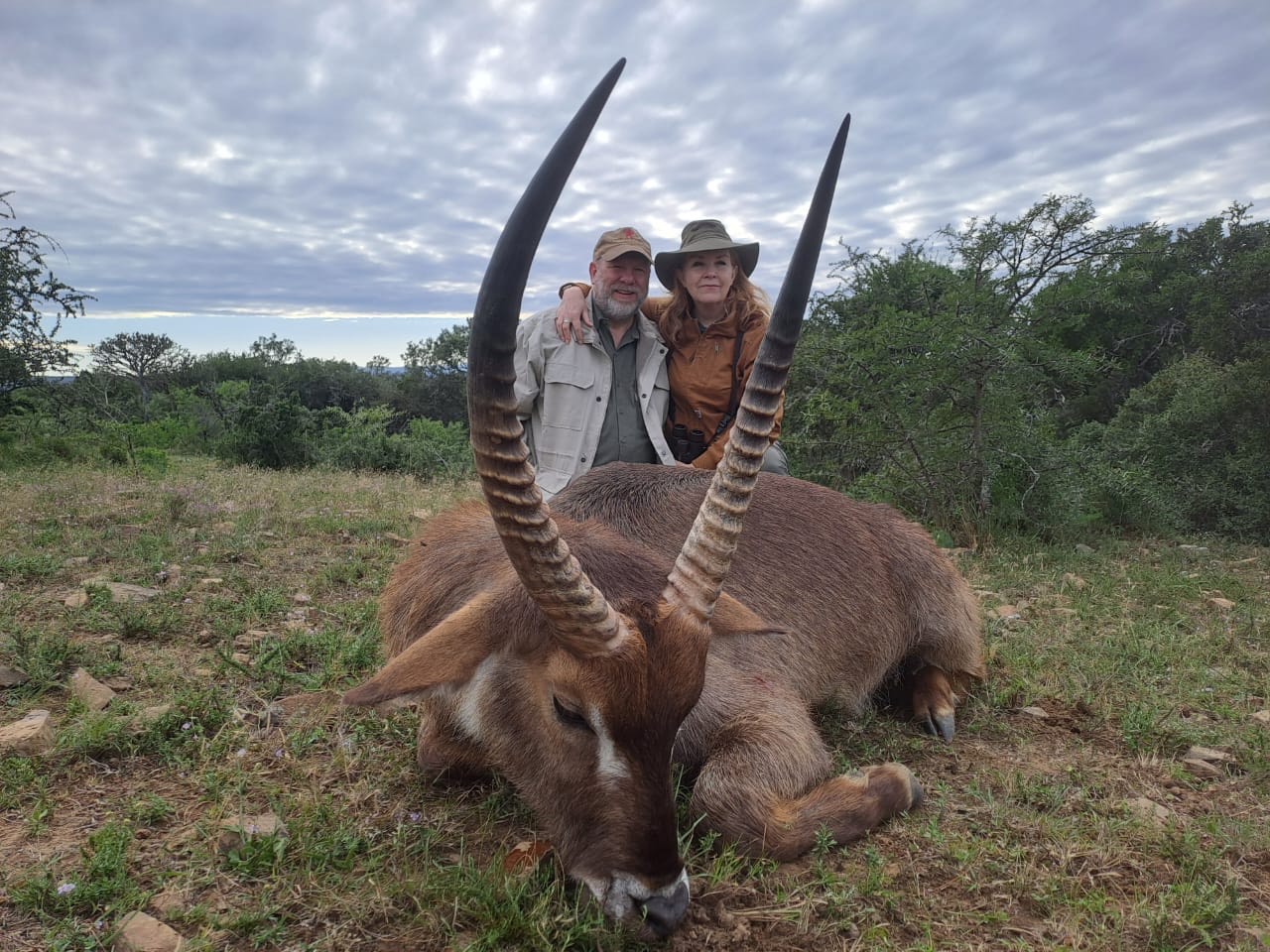
The Waterbuck: the Worst Day of the Trip… Then It Wasn’t
The morning started like the others but would end as one of the most emotionally charged days of the entire trip.
We set out for a new section of the farm, aiming to start high and glass the bottoms as animals fed upward. At the first vantage point, we had a commanding view, though there were still plenty of places for game to move unseen, although that tends to be true everywhere in Africa. We glassed for about an hour, spotting warthogs and a variety of other species, but nothing we were after. We slipped back to the truck and moved on.
The next spot offered even better visibility. Giraffes dotted the landscape, watching us as intently as we watched for game. We stood out to them, no question. They knew something was off.
After nearly two hours of glassing and being silently interrogated by giraffes, Chris spotted a lone waterbuck. Even at 1,000 yards, the spotting scope revealed a promising set of horns. That classic forward sweep, with mass carried all the way to the tips. Not a record-book bull, but exactly the kind I was hoping for.
We made a plan to intercept him. Driving down, we circled ahead, hoping to catch him as he moved up the mountain. We parked on a plateau and began walking with purpose, not rushed, but deliberate. After about 45 minutes, we spotted him again. He was elegant. I’ve always thought waterbuck were regal in the way they hold their heads when they walk. He moved parallel to us, roughly 400 yards away. We closed the distance some while trying to cut him off, but he disappeared over a small rise before we could get into a comfortable shooting distance.
It wasn’t much of a hill, but it was enough to help him vanish on the other side. We moved carefully to the crest, staying low to avoid skylining ourselves. At the top, we had good cover and began glassing. The terrain was a mix of bush and open patches, perfect for hiding. He had vanished.
After 15 minutes of glassing the area, a waterbuck poked his head out from behind a tree. The horns looked right. Chris set up the sticks, and I got into a seated position. He ranged the animal at 100 yards and dialed the scope. As always, he said, “Let me confirm.” After a long look, he said, “OK.”
As soon as I heard the “Oh,” I was already taking my calm breath and gently squeezing the trigger. The rifle cracked, and the now familiar thwap followed. Five for five now on hearing that sound — but instead of excitement, I was working out the “Wait” I’d heard as I finished squeezing the trigger.
Chris had said, “OK,” and then immediately, “Wait!” But it was too late.
The waterbuck dropped straight down at the base of the tree. It didn’t run at all. As we approached, the horns and body seemed to shrink more than usual. It was immediately clear that this wasn’t the bull we’d been chasing. Not a terrible trophy, but not the one we’d worked for.
Chris was mortified. He knew things had gone sideways. It had been too easy. We’d lost the original bull over the rise, then when we got to the top, this one stuck his head out. His body and horns were much smaller, but nearly identical in proportion. Through binoculars, you couldn’t tell the difference in scale. It had to be the same one. At least, that’s what we told ourselves. But the reality on the ground was unmistakable.
We still took photos. Pam and I were pleased, maybe not as excited as we could have been. It was still the biggest waterbuck I’d ever taken, and it was in salt. I had six days left and only one animal remaining, the warthog. I planned to be as selective as possible. That warthog would need dinosaur tusks to earn a shot.
After lunch, Chris left briefly to call Huntershill and explain the mix-up. He returned with good news. We could continue after the original waterbuck.
That afternoon, we returned to the same hill I’d shot from earlier. It didn’t take long to find the bull, farther down, about 250 yards out. We adjusted slightly for a standing shot. Chris ranged him at 225 yards and dialed the scope. I settled in, with the reticle just above the front shoulder.
Calm breath. Gentle squeeze. Crack. Then the sixth thwap.
The bull turned downhill, moved maybe 10 yards, and dropped. No shrinkage this time. He was big at 200 yards and even bigger up close. His horns swept back and hooked forward, with mass carried all the way to the top. Chris said that’s what set him apart.
We took a lot of photos, this time with real excitement. I was in awe. A kudu, lechwe, golden wildebeest, bushbuck, and now a waterbuck. All great trophies, not just in score, but in story as well.
With him loaded, we headed back to camp to enjoy another braai, a few more celebratory cigars, and definitely more ciders. The trip had already exceeded every expectation.
That night after dinner, we settled around the fire. The pit was on the elevated courtyard, about six feet above the ground. This was part of the lodge’s quiet charm. As the flames began to fade and the stories wound down, I noticed two small lights flickering in the bush, maybe 10 or 15 yards from the edge of the deck. They moved, not fixed like lanterns, and I realized it had to be eyes catching the light from the fire.
I quickly stepped into our room, grabbed my flashlight, and returned to the edge of the patio. I aimed the beam toward where I’d last seen the lights, and what I saw took a moment to register.
Standing there, staring back at me, was a mature Cape buffalo bull. Not just close, very close. Five yards away and six feet below me, locked in a silent stare. It wasn’t just the eye contact, it was his presence. He wasn’t looking at me; he was looking through me.
Then the rest came into focus. Behind him, a herd. Fifty, maybe sixty strong. My flashlight caught dozens, maybe hundreds of eyes reflecting back. It was unnerving. I stood there with a cigar in my mouth, a drink in one hand, and the flashlight in the other, sweeping the beam across the herd. The magnitude of it was staggering. And all I could think was: Could they charge the patio? Could they jump?
Time slowed. It might’ve lasted five minutes, but it felt like an hour. A silent standoff. Then, the cigar fell from my mouth. It hit the patio with a soft burst of red sparks, just enough to break the moment. The herd turned, thundered back toward the hills, the sound like a low tornado rolling away.
I’ll remember that forever.
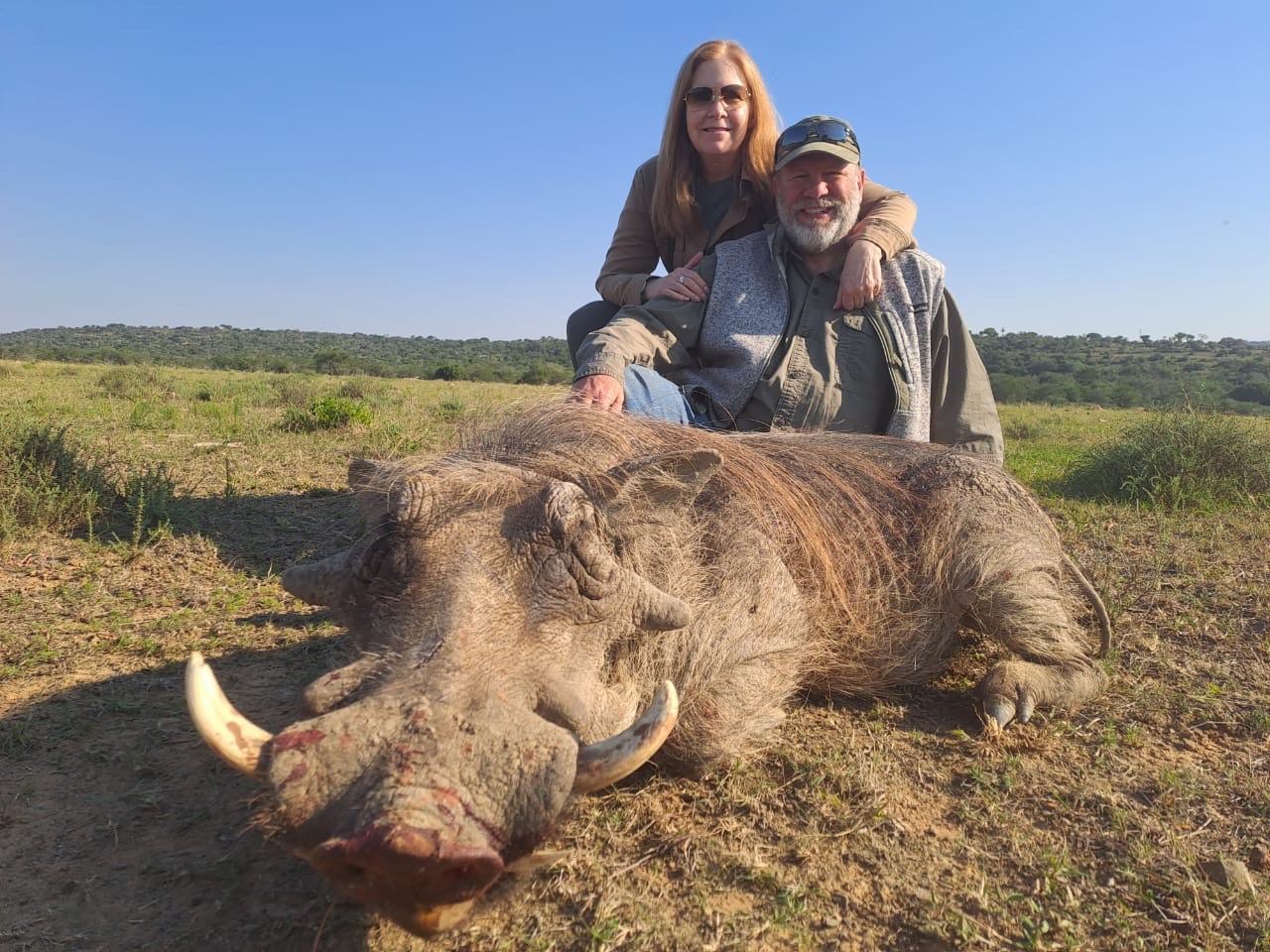
The Warthog That Wasn’t, Then Was
With five full hunting days ahead and only the warthog left on my list, we knew we’d be working for the perfect pig. Chris brought chairs for Pam and me, knowing we’d be spending long hours at fewer spots. It could’ve ended quickly, if I’d done my part.
That next morning, we headed to the last section of the farm we hadn’t yet explored. High ground, good visibility. A big herd of eland greeted us and promptly spooked, running from one end of the property to the other, kicking up everything in between. Fortunately, the interior remained quiet.
We glassed across to the opposite mountain, scanning dense scrub and scattered clearings. For me, spotting game is like finding a needle in a haystack. I was proud when I spotted a few warthogs that usually Chris had already seen, studied, and moved on by the time I found anything. One pig I found looked massive, bigger than the one from day one. But Chris said, “Not big enough to shoot with all our time left.” That’s the hard part, passing on something good in hopes of finding something better.
Later, Chris spotted a true brute. His tusks stuck out and curled up like American football goalposts. Through the spotting scope, they looked like bodybuilder arms flexing from his face. Even with five days left, this one was worth going after.
He was 1,500 yards out. We worked our way down, gaining ground. As we moved closer, we found ourselves moving lower more than closer. At 600 yards, we hit a limit. If we got any closer, we’d lose sight of him. He was still high in the clearing, if we moved any closer, the trees would obstruct our line of sight.
We had to set up there. I laid out jackets and packs to lie on, trying to get comfortable on the decline. The warthog was uphill, and I was lying downhill, struggling to keep him in the scope. It was like trying to look at my eyebrows through the scope, I just couldn’t get comfortable.
My breathing was shallow, labored. Chris noticed. “Relax. Breathe. Squeeze the trigger.” I tried. I wish I could say it was because the pig moved, but the reality was that I never did feel comfortable with the shooting position. I knew it was a monster pig. I got the scope as best I could onto the warthog, took a deep breath, closed my eyes, and pulled the trigger.
Missed.
Chris had been filming. The video showed the bullet passing just under the belly. I wasn’t upset about the miss, I was disappointed in myself for not being able to relax and go through the steps. The rifle and scope were perfect. I hadn’t done what was necessary to make the shot.
We kept after it. Returned to the same spot the remaining days, hoping for another chance. It never came, and I was okay with that. The hunter who came in after me ended up getting that pig. It was a monster, and I was happy for him.
One afternoon, we went for a walkabout, no rifles, just quiet steps. We got close to a herd of buffalo, probably the same one from the fire pit encounter. We found a warthog sow under a tree and filmed our approach. The wind was perfect. We got within five yards of Chris, with Pam in the middle and me at the back filming. Then the wind shifted. She bolted, one moment lying down, the next tail up and gone. So much fun.
On the final morning, we returned to the first vantage point. After a while, that old boar came into view. Chris knew his pattern and moved us to where he’d likely be in 30 minutes. We waited. Giraffes watched us, but the rest of the bush was unaware.
Right on time, the pig walked into the field. About 300 yards out. Chris asked if I was ready. I nodded. He set the sticks. I found the pig in the scope.
One last calm breath. Gentle squeeze. Crack. Then the final thwap.
He ran maybe 30 yards and dropped. We walked out for photos. He didn’t disappoint. Long tusks, worn down with age, but full of character. I was happy. We took plenty of pictures. As the last pictures were being taken, a small amount of dejection crept in as I knew that this meant the hunt part of the trip was over. It is always a bit saddening when the reality hits that we are nearing the end of our time with new friends.
Back at camp, we had an early lunch and made a quick trip into Fort Beaufort and packed for the airport the next day. I’m never ready to stop hunting, but the next chapter was Pam’s, a week in Cape Town. Four nights in the wine region, Franschhoek to be specific, then four more on the Victoria & Alfred Waterfront in Cape Town.
The hunt was over, but the trip continued.

Cape Town, Our New Favorite Place
Franschhoek is a beautiful small town, nestled in the Cape Winelands and framed by the Drakenstein mountains. Its French Huguenot heritage is evident in the architecture and the town’s name. Franschhoek literally means “French Corner” in Dutch. The name honors the refugees who settled there in the late 1600s. The first Huguenots arrived around 1688, fleeing religious persecution and bringing with them their knowledge of winemaking. We visited the Huguenot Memorial Museum and Monument to learn more about their history.
The town’s main street is lined with boutiques and art galleries, and Pam thoroughly enjoyed exploring them. We spent our first day walking the street, slipping in and out of shops, enjoying the relaxed pace.
The next two days were dedicated to the Wine Tram experience, which took us to various vineyards throughout the region. Many trams and buses connect the estates, making it easy to spend full days tasting wines and enjoying meals at some truly remarkable locations. We especially enjoyed the Méthode Cap Classique, or MCC for short, really what most would simply call Champagne.
Though four days may seem long, they passed quickly. We returned to the main street each day, revisiting our favorite shops and soaking in the peaceful atmosphere. It was a welcome contrast to the more rugged and adventurous parts of our trip. Given the choice, we could have stayed forever, but our children and grandchildren were waiting for us back home. We left with far more than we arrived with, even needing to purchase an extra suitcase to carry everything home.
On our final night, we sat by the fire in the courtyard, reflecting on the experience and taking it all in. The next morning we headed to Cape Town to begin the last leg of our journey.
Our friend arrived mid-morning to pick us up. We stopped in Stellenbosch to visit another friend’s leather shop, Els & Co. The shop is a favorite of Pam’s for purses and bags. Coincidentally, they also carry a variety of hunting and safari-related items. We caught up over drinks, toured the workshop, and then visited the store. While Pam shopped, they kept our glasses full, wine for her, freshly brewed beer for me. I picked up a knife and a humidor, and Pam chose two beautiful bags. The owner offered to emboss the bags, giving us time for one more drink before we left in high spirits.
We had lunch at a nice spot in Stellenbosch before continuing to Cape Town. Once we arrived, we checked into our hotel near the Victoria & Alfred Waterfront, got settled, and headed out to explore. The V&A Waterfront includes the Victoria Wharf Shopping Centre and a large surrounding area filled with shops and restaurants. We spent the first day exploring the mall and nearby attractions, ending the evening with a champagne cruise around the bay, a perfect way to capture the moment.
The next day, we visited Table Mountain, perhaps the most iconic attraction in South Africa. We spent the morning hiking trails at the top. The weather was dramatic, strong winds and clouds sweeping up and over the mountain, creating a misty, surreal atmosphere.
That afternoon, Pam went paragliding off Signal Hill. Her flight lasted about 30 minutes, offering stunning views of Table Mountain before landing at the Sea Point Promenade, where we stayed for dinner. Afterward, we returned for another evening cruise.
We enjoyed our morning on Table Mountain so much that we repeated it the next day. It was our final full day in Cape Town, and we wanted to make the most of it. After another morning of hiking at the top, we spent the afternoon shopping at the Waterfront. One last late-night cruise marked the end of our journey, and we returned to pack for the flight home.
Departure from Cape Town International Airport offered one final, breathtaking view of the region, a fitting farewell to a journey that had been unforgettable from start to finish. As I looked out over the landscape, I found myself already thinking ahead, making quiet plans for a return in the summer of 2026.