
By Strang Middleton
SHOOTING FORM
Basically, to shoot long yardages, you need good form. This means your shooting technique must be solid and, with practice, should come to you like putting one foot in front of another. A bowhunter should shoot his bow often enough so that no matter what situation he finds himself in, he will react instinctively every time – kind of like driving. No matter where you stand, what the conditions are, or how excited you are, you come to the same anchor point – relax your front hand and squeeze your trigger.
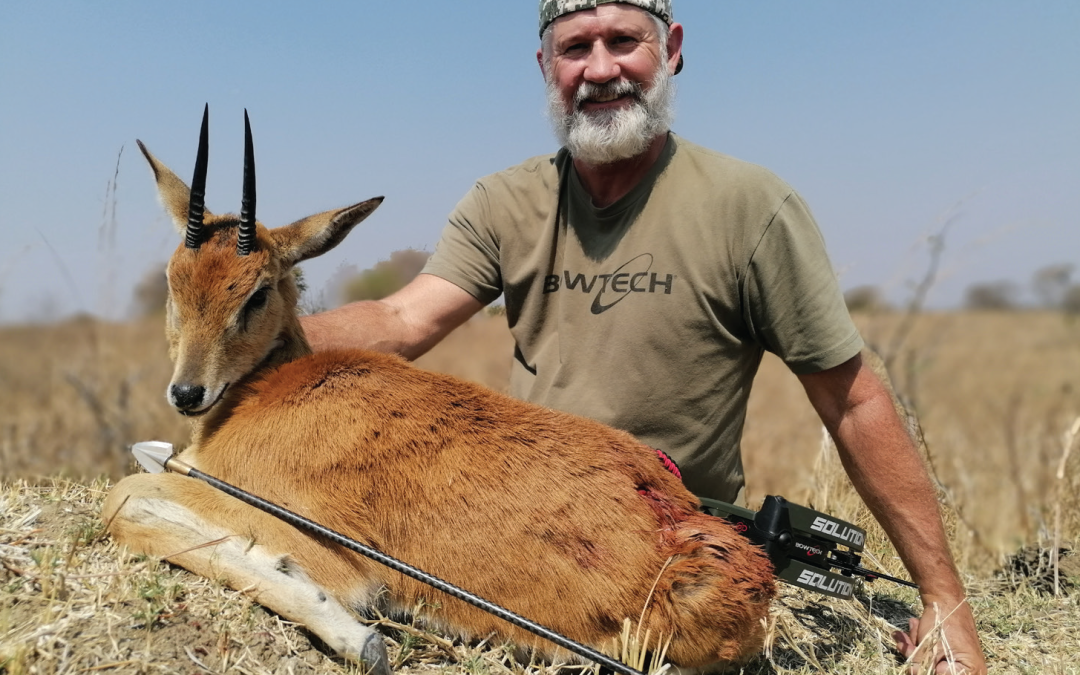
I have a little saying I always run by myself as I prepare to shoot: FPS (Feet Per Second) achieved by adhering to the following important guide: Please see pictures to illustrate these points.
FINGERS – Both hands relaxed, grip and trigger hand (I am a firm believer in a good mechanical release aid) The only finger to move in a shot should be the trigger one with the squeeze. Every other finger and both your hands should be totally relaxed.
PEEP – Line your peep sight up with the ring frame of your pin sight. Most sight guards today are round. This gives you another anchor point as such. Also, pick a spot. (I visualize a beating heart).
SQUEEZE – Take a breath, expel the air, hold on your spot… and gently squeeze the shot off. If you cannot hold it totally steady on your target spot, do not panic! This creates the worst “target panic” out there! Just hold as best you can and squeeze the shot off. You will be amazed how well you do.
These few points along with plenty of practice should develop good form and very tight groups at 20 yards. Use five arrows. If you are worried about wrecking them by shooting arrows already in the target butt, move to 30 yards then 40 yards and so on. I practice at 60 yards all the time. I like to put all five arrows in a paper plate consistently from 60 to 100 yards. Always put a center spot the size of a golf ball on your paper plate to give you a spot to focus on the target.
I have converted many short-range shooters into some long-range hunters in this way. Remember you need a bow that carries the energy all the way down range. We must always be fair to the quarry we chase and use equipment that is more than capable of killing it cleanly and as quickly as possible. Today’s bows in the 310fps+ range are all capable of good energy.
Shoot, enjoy it, and be confident in your ability and the performance of your bow – this is critical to achieve a long shot. If none of this works, find someone who shoots long, ask their advice and to watch you shoot, and take it from there. There are a good many archers today shooting successfully at long ranges.
Once I shot an impala ram from 112 yards. The ram lurched forward, looked around, and carried on feeding. He collapsed a few seconds later with absolutely no idea what had happened, not to mention the rest of his herd. An amazing feeling! I believe rifle hunters would compare that to something like making a 700- yard shot. Once you make a good, clean, long shot, you will be hooked and it makes your closer shots that much easier. It is also a great advantage if you ever have to follow up a wounded animal.
SMALL ANTELOPE
These little guys range impressively from the tiny, royal antelope to the blue duiker, the oribi, to the Vaal rhebok. There are dozens of different species of small antelope found across Africa. From the savannas to the mountains, the coastal areas to the rain forests to the deserts, each terrain has its endemic species. These little animals are not hard to kill but are some of the toughest little critters to get a shot at. Any hunter going after Africa’s little antelopes with a bow must be ready for a bunch of hard work, determination, and improvisation.
The basic equipment needed for the little guys is a bow that you can draw and hold comfortably in ANY position, whether it be sitting, kneeling, squatting, leaning, or tree standing. You want a fast carbon arrow coming out of this. Bows with a short axle-to-axle length are better for the thick bush hunts you are likely to encounter.
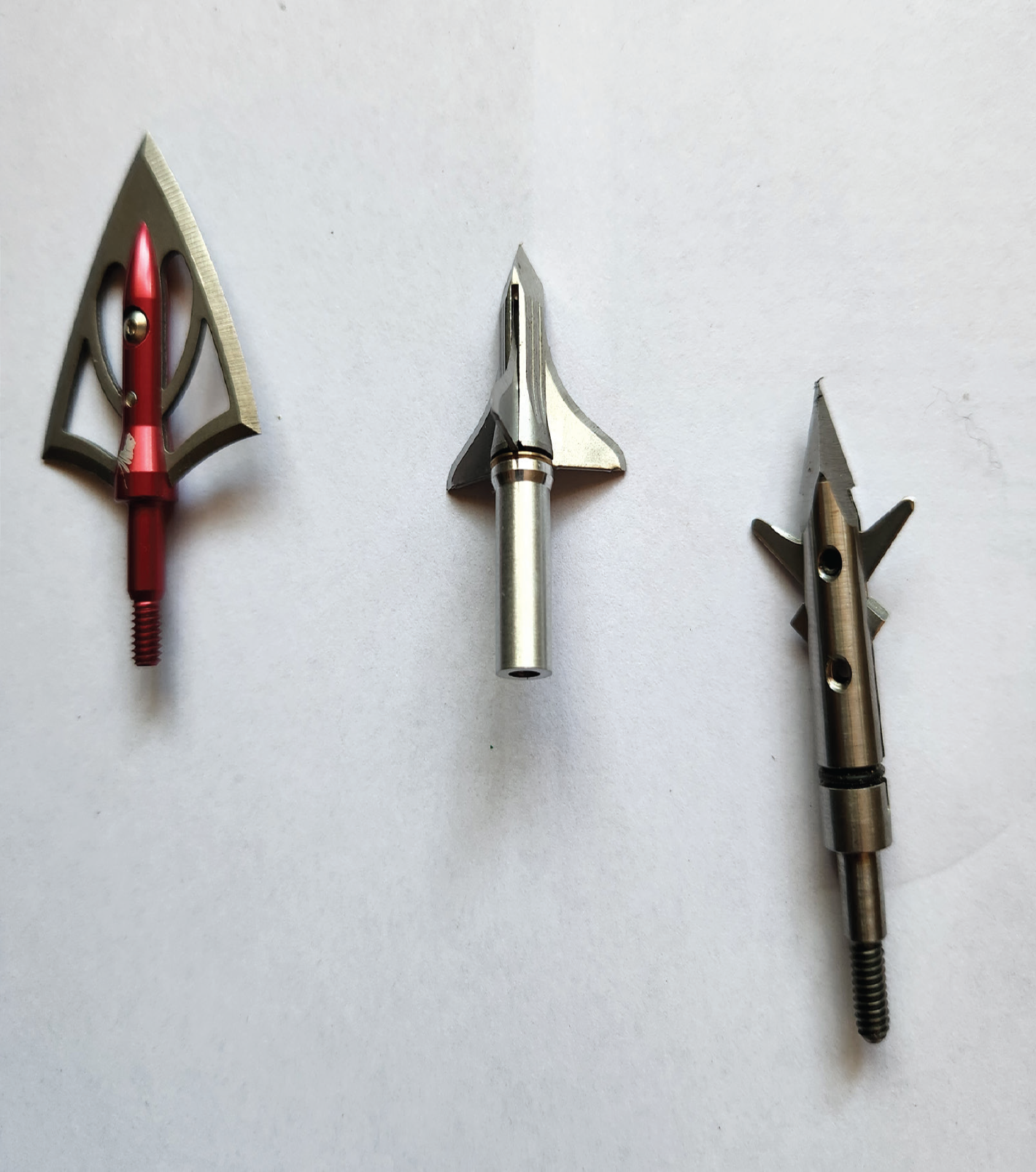
My preferred style of broadheads…
2 blade silver flame xl
3 blade shuttle T lock
2 blade Sevr titanium
Choose a broadhead that works for you that will get an arrow flying its best for your rig. You must be able to “thread the needle” which means shooting through any window you are given no matter how tight! Bear in mind that often the little antelopes are in heavy cover or grass, so be sure you are happy to shoot through some stuff with your arrow. This is very possible with a good broadhead, if what you are shooting through is up close to the animal, not 10 yards or more in front! If it is too far in front, your arrow will deflect to cause a miss or, worse still, wound the animal. I love using Silver Flame 2xls made by Alaska archery. They are strong, cut big holes and fly great. Whether grass or light shrub, my arrow gets through to my target.
A good sight with pins that are bright are essential – also pins from 20 to 60 yards are important. I use a pendulum sight which is better for the longer shots but can be tough when you have a little animal that won’t stay in one place. This is a personal choice.
I stick with one pin as it makes me focus better than having a mass of pins in my field of view. Like many hunters, if you find yourself tending to “flock shoot” your pins – in other words, put all the pins on the animal and let the arrow fly, change to a single pin sight, and eliminate that problem fast!
There are so many excellent bowhunting products out there so I will only cover what equipment I have found to work for me in a chapter later in the book. The archery manufacturers of the world have provided us with many wonderful gizmos and toys to last us a lifetime! We owe them a great deal for the great advances they have made in making our bowhunting adventures that much easier.
Most small antelopes live in thick cover, with scent, hearing and hiding being their top defense from predators. I hunted a Sharpe’s grysbok for five years before I took one. I never hunted waterholes for them but sat at their middens where they go and poop regularly to mark territory boundaries. Hunting them like this takes lots of time – days of evening and morning hunts. Everything must be perfect with the wind being the most important.
Getting into some scent kit and being as high in a tree as possible always helps. When I got my male, I had a tree stand imprint on my backside! When he finally came in, the buck fever was out of this world and a real job to control! The grysbok is a tiny animal and shooting down from a tree was tough, but practice made perfect, and my little buck did not go far! A good broadhead placed solidly anywhere in center mass of these small animals really works.
An easier way to hunt many of these little animals is at night with a light. Make sure it is legal where you do it and practice shooting at a target with a light – it is different! Aligning your peep is hard but vital at night. Sights with a glow-in-the-dark frame are a good idea. Always be sure to use a range finder too. Things always seem a lot further at night.
Alternative means of hunting are walk and stalk, blinds or stands at waterholes, and calling, which is amazing to experience if you have a caller that knows his stuff.
Your PH should know what works best in the area he is guiding you.
I once hunted thick riverine, coastal forest for blue duiker with a friend. We had a tracker with us who would set up, much like when elk hunting, and call these duikers in. So often the duikers would come in so fast that we only had a fleeting glance. Shots were really tough, and we ended up taking all the pins off his sight except one – set at 20 yards. When the duikers would come flitting through, he would judge, compensate, and let fly! Many vines, branches, logs and twigs were broken before he finally made contact with his little blue duiker. Those trackers who call have an amazing talent to bring in small antelope.
In contrast, species like oribi, steenbok and Vaal rhebok live mainly in vast open areas with sight and speed being their number one defense mechanisms. I know of very few hunters who have taken Vaal rhebok, found in South Africa, with a bow. Rhebok typically live in open, often hilly to mountainous areas. The few I am aware of have been shot on driven hunts and from using a pop-up blind and a decoy.
When I helped on one particular hunt, many of the mountains had flat tops where the rhebok lived. By positioning hunters on well-used routes on the top of a mountain and driving the length of the plateau with beaters, it offered shots to a few guys. Very often, the rhebok would stop as it was about to descend from the top. If a hunter was smart, ready, and aware, he would get his ram like this.
I sat with one guy and we set up behind a big rock. We heard the rhebok coming our way and prepared ourselves. I was filming. The females came past at a trot about 20 yards from us and, as we watched, the ram came flying over our rock and headed to a screeching halt 40 yards from us, and my hunter let fly! I think the excitement was too much – the arrow sailed over the animal’s back by about two feet! This was about our fifth drive, so a tough one to swallow. Sadly, he never got his rhebok.
Another hunter got a stuffed decoy and set it up in a ram’s territory. He set up a pop-up blind about 50 yards away and would get in there before sun-up and spend the day there. Sure enough, after a few days, the group of rhebok showed up and the dominant ram came straight in to check out the decoy. The hunter got his rhebok. Great plan, but access to decoys is very limited!
Oribi are always a great challenge and highly sought after. These little animals really like wide open spaces and are difficult to get. The best way to hunt them is by spot and stalk in the late evening and early mornings. Oribi love burnt areas, so start here if there are any around. I know one place where I hunt that sets up their oribi hunters well. Every year, they will control-burn strips of grass about 150 yards wide through areas of high grass. When the new, green shoots of the grass come through, the oribi go to these like bees to nectar. To hunt them, we simply cruise the edge of the burns until a good oribi is spotted in the distance. You can then set yourself up with the wind and use all the high unburnt grass to stalk your ram. Often shots are in the 40-yard range but prepare yourself to shoot out to 70 yards for the little guys, and really prepare for string jumping – they are fast! Not always, but when they do jump, you normally miss them.
The common duiker is probably the one little antelope that is seen most in Southern Africa. Because they are small, don’t underestimate little guys. I know of one hunter who shot a common duiker far back and high. The duiker collapsed and the hunter went to cut the little animal’s throat to finish him off. Before he knew it, the ram had swung round and sunk both his horns four inches into the man’s thigh! Had the duiker’s aim been higher and had he got the man’s femoral artery, it could have been a much worse story. There are several known cases of domesticated duiker having killed people by piercing the femoral.
Every Southern African country has its “own” specific tiny animals. They all offer fun hunting and a challenge for any hunter.
Next month, we’ll look at swamp antelope and medium-sized animals.