
By Dennis Schumacher
The group of eland were clustered behind a grove of trees deep in the bush of northern Cameroon, thirty sets of eyes arrayed in a circle looking outward for any perceived threat. I swatted at the mopane bees circling my face and diving into my ears. Gadal, the lead tracker whispered, “Don’t move!” Even though we were still 250 yards from the group, their sharp eyes could identify any movement that did not normally belong in their environment. The eland turned and began to move away. The three of us inched forward in single file while their attention was distracted. I held onto the shirt back of Patrick Dahlan, the professional hunter, while he held on to Gadal’s shirt as we moved slowly in single file, hunched over and placing each foot in the footprint of the one ahead. It occurred to me just how skilled these two men ahead of me were. It was Day 5 of our Lord Derby Eland hunt.
The moment was not lost on me as my mind went back to my friend and mentor, Sauro Albertini who, one day in the late 1980s, showed me a picture of a giant eland he had taken in the C.A.R. Since that day, I had my mind set on taking a giant eland, or Lord Derby eland as they are known. Cameroon is now the premier place to hunt these magnificent creatures, and I had signed on with Faro East Safaris for this hunt in 2024. Now, in early 2026, it was happening!
Over the intervening time while preparing for the trip to Cameroon, I watched every YouTube video and read every account of Lord Derby eland hunting I could find. One theme was constant: it was a physically and mentally punishing hunt. This is what I wanted, not some easy walk in the park. I had started preparing months before: diet, exercise, working in my new boots, and walking miles each day. Then the unexpected happened. While mowing the pasture on my tractor, the mis-adjusted seat bottomed out when the tractor hit a deep rut, and I felt something go wrong in my lower back. Almost instantly my right leg went numb. Within a few days I was in serious pain with sciatica and loss of function in my right quad.
What followed was mentally torturing as I went to several doctors, got medicated, went through spine decompression therapy, and spent many pain-filled nights sleeping in a recliner. Should I cancel the hunt? Although unable to continue long-distance walking, I was steadily improving and through good pain management, got back to a reasonable level of mobility. In the YouTube videos I had watched, I saw other big old Texas boys who could hardly walk manage to bag an eland, and I determined not to let this setback change my plans; not the least because I had just turned 70 and there was no assurance that if I cancelled, I would ever be able to make it happen in the future.
Three days after Christmas 2025, I travelled from Houston to Paris where I met my brother Dale who was coming along as an observer (and main guy to pull me out of dry riverbeds). He had arrived from Washington DC and we then travelled together to Douala arriving late in the evening. The most difficult part of the entire journey then took place in the airport in Douala, where we cleared customs and had my Whitworth .375 H&H Magnum and the 50 rounds of ammo I had brought along inspected at least four times by different authorities. Every person we encountered in Cameroon was polite and kind. However, after a long trip, the tedious and bureaucratic processes were very tiring, and the heat and humidity in the airport building was stifling. We had paid for a meet-and-greet service provided by Isles & Voyage travel agency in France to clear us through the formalities and transport us to our lodging. They were very efficient and helpful, and I would not recommend trying to do all this oneself. Our agent Bruno was excellent and eventually we were deposited at our hotel, La Falaise, in Douala, which was very nice and well-appointed with good air-conditioning.
The next morning, we were treated to a magnificent breakfast in the hotel, buffet style with enough varieties of delicious food and pastries to last us all day. Then it was off to the airport again, to go through the same process we had gone through the night before, inspecting the gun repeatedly as if I had possibly changed the serial number in my hotel room overnight!
Finally, we were on the commuter airplane to Ngaoundere in the northern part of the country. We were pleasantly surprised by the dry, cool weather in the north, where the elevation was just under 2,000 feet, and although the sun was hot in the daytime, there was always a cool breeze. Nights in early January could get down to the mid-50s Fahrenheit, which suited us just fine!
In Ngaoundere we were met by Bakari, the representative of Faro East Safaris and, after having to inspect the gun once again, we were loaded into their Toyota for the trip to camp. First however, we were treated to a tour of Ngaoundere as Bakari rounded up various supplies for camp, including two drums of diesel fuel. Having lived in Africa before, this seemed completely normal to me, but for the uninitiated it is often difficult to understand that when living in the bush, you must bring everything with you, including your own infrastructure. Every nut and bolt, sack of cement, kilo of flour, stick of butter, must be brought in. The trip to camp was three and a half hours over very rough roads; the last 17 kilometers was an almost impossible dirt track.
The camp is picturesque, situated on a hill overlooking a valley with a mayo (stream) just below. Basic, but clean and functional, the rooms were large with running hot and cold water and individual toilets and showers. Air conditioners had been fitted in the rooms but were subject to the available power in the solar batteries or when the generator was running which was around three to four hours a day. I had AC in my room about four hours per day, which I rationed to an hour for siesta when we were in camp, and the rest in evening when going to bed. By midnight it was cool enough to sleep without AC.
The central part of the camp consisted of a lodge-style open concept building with a thatch roof where we took our meals at a table set up in the breezeway. Also under cover was a seating area with a view over the valley for evening drinks and socializing while further down was the “cigar lounge” – easy chairs arranged around a fire pit. We spent a lot of time there; the bar was well stocked and the beer was cold!
The African staff were amazing, catering to our every need. I could not believe how the camp cook, working in a small 12×12 foot out-kitchen could whip up such fabulous French cuisine that we enjoyed the entire time we were there. Patrick had asked us our food preferences in advance, and I made sure he knew we were up for French cuisine, although he was fully prepared to give us traditional Texas cuisine too, such as ribs, burgers, and Tex Mex.
We enjoyed such dishes as Moroccan couscous with mutton, guinea fowl in peanut sauce, and many meat dishes made from local game meat and, of course, my favorite steak frites made with eland, or kob steaks. One night we had spit-roasted warthog. All was delicious, and followed by incredible fancy desserts, including banana flambé, crêpes, or homemade ice cream on chocolate mousse cake made in camp.
When we arrived in camp after our three-day journey, we indulged in a welcome drink of cold beer and then headed straight down to the air strip to sight in the gun. It was apparent that no time would be lost, as we were told we would be getting up at five in the morning to hit the tracks! That night at dinner, I told Patrick, the owner of Faro East and professional hunter, that I was able to walk, but not fast; I was able to run, but only for short distances; however, I was able to see well and shoot straight! He took me at my word and tested me to the limit.
Block 5 in Cameroon consists of a hunting concession of around 300,000 acres of virgin bush bounded on the north side by high blue-green mountains, and on the south and west by other concessions. The beauty of the savanna is astounding, and there is no sign of people, fences, or civilization, other than the public road that splits the concession between the north and south sections. The nearest village is 17 kilometers away. Wildlife abounds including eland, kob, roan, buffalo, waterbuck, hartebeest, duikers, small antelope, hyenas, lions, leopards, elephant, and many other small species. The birdlife was also incredible with many beautiful tropical and savanna bird species. Listening to the bird sounds early in the morning and in the evening was a special treat.
That first day, we rode some of the 500 kilometers of well-maintained roads in the concession looking for eland tracks from the back of the Land Cruiser. When we found tracks, we got down and inspected them and decided to follow them on foot. Watching the trackers divine the nature of the tracks was a wonder to behold. They can tell the age, sex, and type of animal from any track, how old the track is, and in which direction it went, whether in a herd or alone. It was one of my favorite parts of the entire safari to watch them work, true professionals through and through.
The terrain is the most difficult part of the hunt in my opinion. Rough, uneven, and covered in mounds of dried, hard balls of dirt created by underground worm; it was like walking on clumps of marbles that had been glued together. Good footwear is essential. The rains were late last year, finishing in September, so in many areas the grass was still too green to burn. This complicated the hunt due to large areas of unburnt high grass. When walking through these areas, it was essential to watch our footing. It being early in the season, the eland were still not grouped, with many of the good bulls still solitary. This led to a lot of walking and much territory to cover to find a good bull. It was three days before I saw my first eland!
Day after day we followed tracks only to be frustrated by the lack of a good bull or by groups that traversed the boundary into the neighboring concession, or groups that were just too fast for me to keep up with the trackers. To save time, we had lunch in the bush. Patrick had packed a small table and three chairs in the Land Cruiser, and we had our lunches packed in a cool box, and we ate under the shade of a tree. Usually there was a good breeze to help keep the tsetse flies and mopane bees to a minimum. I had been told to pack Avon Skin-So-Soft to deter these pests but found that another product that I brought called “No Natz” performed better and was made from natural plant oils and botanicals.
In the evenings on the way back to camp we hunted for guinea fowl and partridges and generally enjoyed looking at the scenery and wildlife. There were opportunities to shoot other game, but I was focused on the Lord Derby eland and nothing would deter that goal! The annual Harmattan was just starting, and the sunsets were magnificent with the orange ball of the sun hanging above the bush making for lovely photographs. My spirit soared during these times just for being in the wilds of Africa. It was especially poignant to have my brother Dale with me enjoying these moments since we had grown up in West Africa together and this was like a trip home for us. Relaxing in the cigar lounge after dinner and telling tall tales around the fire while we rested our weary legs was a balm for the soul.
Now on Day 5 as we moved from tree to tree to termite mound for cover, we slowly reduced the distance between us and the group of eland. The stalk took around 45 minutes until we were within 80 yards of the group. Obscured as they were by the bush, it was no easy task to pick out the best bull. There were two in the group. However, the larger and older one was at the back, so we had to wait, not moving. Gadal and Patrick continued to glass the group. This moment had played through my mind repeatedly for months in the lead-up to the hunt. Would I get a good shot? Would my shot be true? How would it play out?
Finally, after what seemed like an eternity, Patrick suddenly whispered, “He’s moving, he’s coming to the front.” A couple of minutes later he pointed and asked me if I saw him. What I saw was an eland bull’s shoulder and part of his rib cage framed between two trees at around 80 yards. Patrick said, “That’s him, take him if you can.” I could just see a part of the black mane of a mature bull between the trees, and that was enough to convince me. The .375 roared, there was a positive “thump” and chaos erupted. My eland turned and followed the herd over the hill and out of sight.
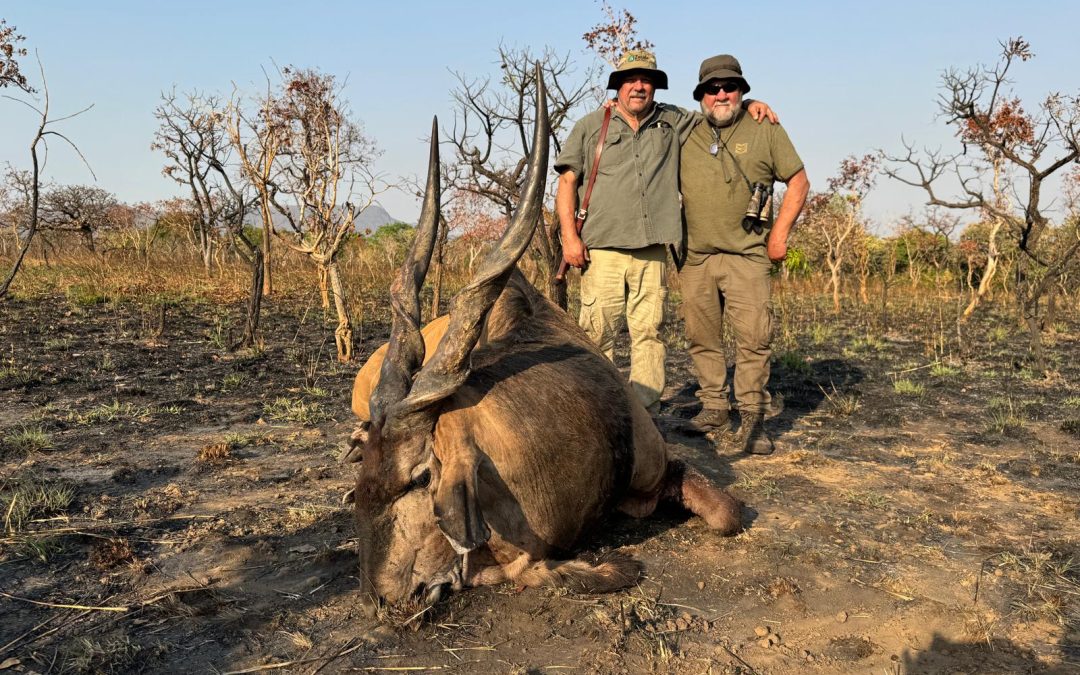
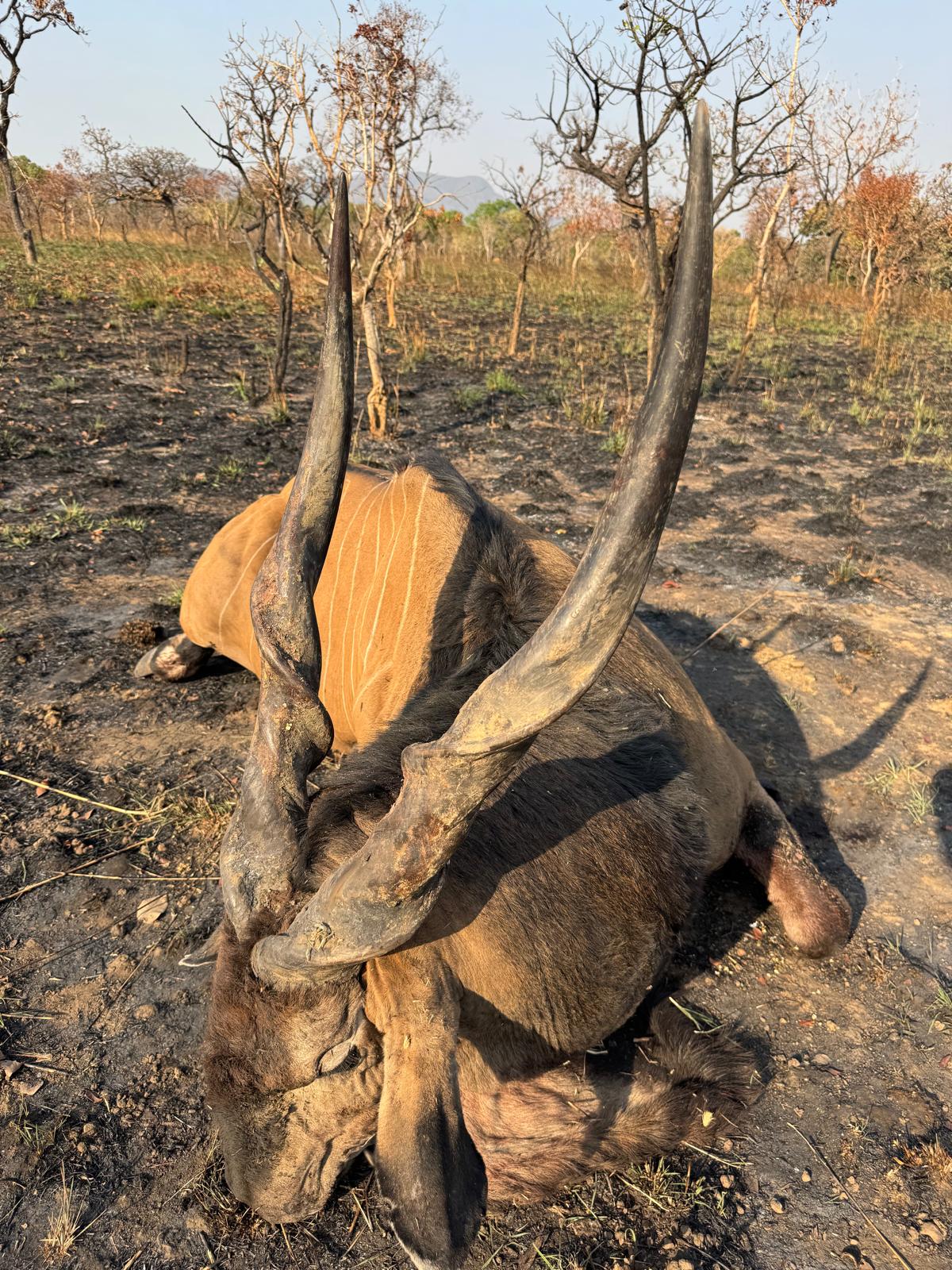
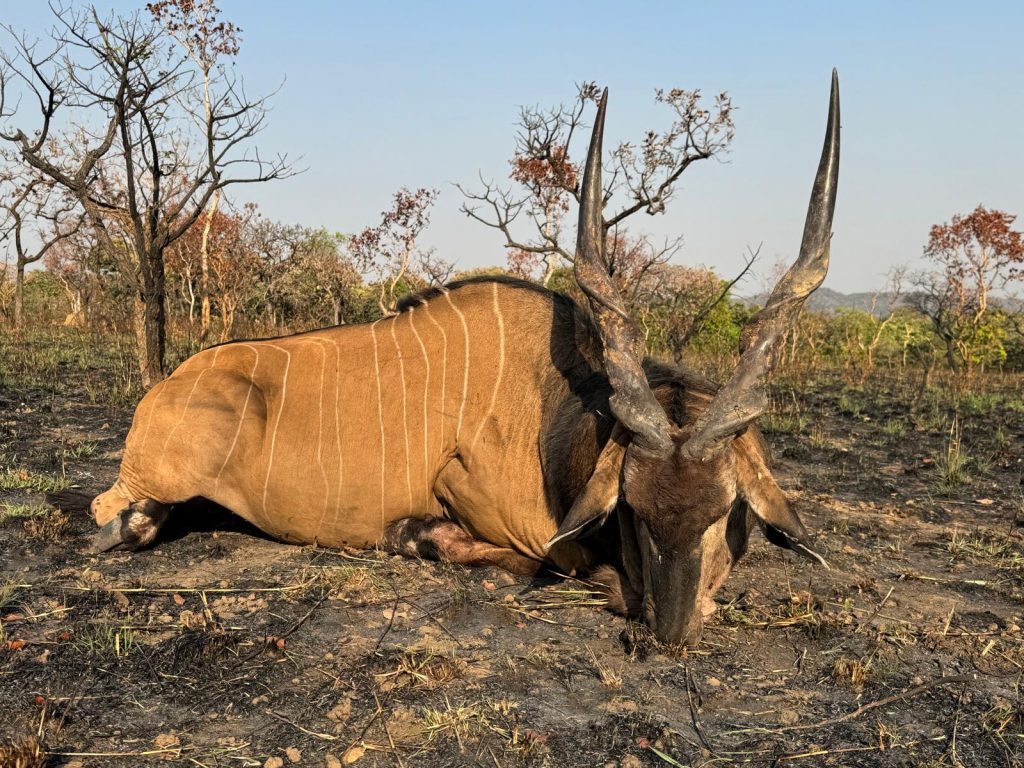
Gadal and Patrick took off running, following the herd, and I followed as best as my gimpy leg would allow. At the top of the hill Gadal set up the sticks again and motioned for me to hurry up and come take a second shot. The eland was standing alone about 50 yards down range and clearly was mortally wounded, but my second shot put him down immediately. When we walked up to him, relief flooded me, combined with joy, excitement, and wonder at the sight of this huge beast with its incredible horns. The other members of the party soon caught up
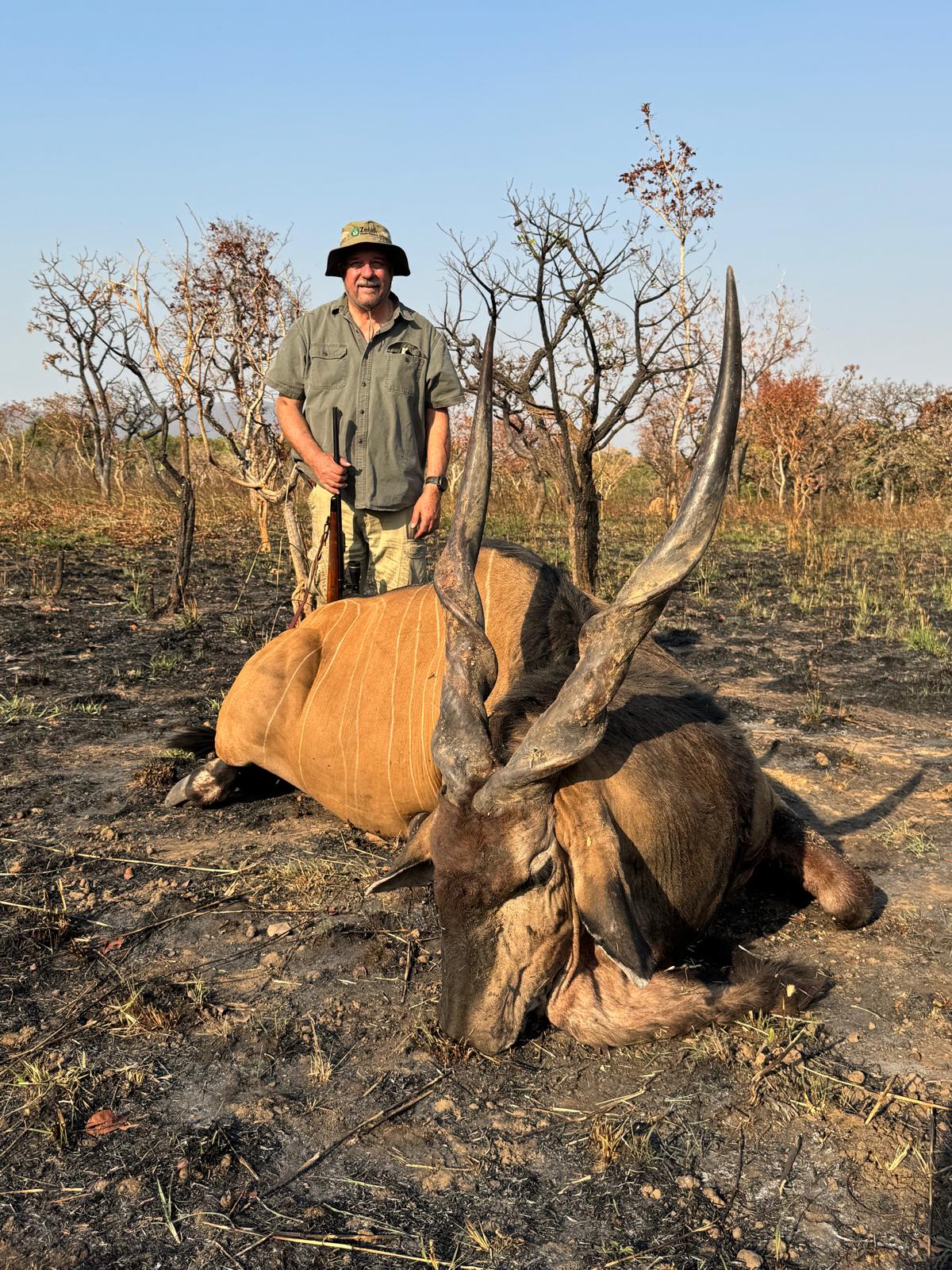
with us and there was dancing and rejoicing. I joined in with the dancing and hand shaking and back slapping, while some of the trackers and porters cut branches of trees and danced around waving them in excitement for a few minutes.
It was done.