
By Hendrik White
I recently read a book by Wilbur Smith called Assegai. In a nutshell, it’s about Leon Courtney, a professional hunter and his adventures. During his tenure as professional hunter, he guided none other than Theodore Rooseveldt and his son. They hunted for weeks on end. They shot a plethora of game, big and small. The book describes incredible hunting stories where the hunter takes his time, pursues his quarry for days on end and eventually – the moment all hunters dream about – the culmination of days of blood, sweat, and tears for the perfect opportunity, the perfect shot.
This was not that.
In today’s world, the luxury of time is, well, a luxury. And to be honest, a luxury I can scarcely afford. Most of us don’t have the time anymore to take a couple of weeks for our very own safari. Make no mistake, though, when the opportunity came along to go hunting, I grabbed it with both hands. Even though it was only for a weekend and nearly 500 km away, and very, very late in the hunting season – September.
This hunt was different in that I wasnt the one who was going to be pulling the trigger. My little sister had been gifted an impala ram for her birthday. Having recently shot with my .30-06, she wanted to hunt it with “boeta se geweer”. This is what merited me the invitation to go hunt with her on a picturesque farm north of Louis Trichardt.
Time was flying and before I knew it, it’s the Monday, the week before the hunt. I had nothing prepared. I had recently worked up a load and decided that I was going to just load a couple of rounds using said load and we’d be off to the races. Well, that was until I was gifted a box of 180 grain Nosler E-Tips by my hunting and reloading mentor – I simply had to try them. So I hastily loaded up a few loads Monday evening, using a combination of Gordons Reloading Tool and QuickLoad. I drove to Irene Arms the Tuesday during my lunch hour to go test the loads. Lucky me! The first load was right on the node with the group size increasing slightly as i veered away from the node.
Wednesday evening, I loaded up the balance of the E-tips. Thursday evening, I was packed and ready to leave Friday morning at 04:00 am – I would be driving to Polokwane, working there until the afternoon when we would leave for the hunt.
We arrived at about 21:00 on the incredibly beautiful, albeit dark, farm. As we idle through the “tweespoor” road, we admire the massive Boababs scattered among the Mopanie littered bush. The sight of red, sandy earth combined with the green, fluttering leaves of Mopanie makes me forget about time just for a short while. I snapped back to reality as we near the farmhouse. We had to hurry to get the fire going as we had to still braai up some delicious beef short rib and garlic bread and of course, start the donkey so we could have a shower before settling in and falling asleep to the tranquil bushveld’s night noises. As flames of our fire started to dwindle, we confirmed a couple of final arrangements for the day’s hunt ahead. “You can shoot two impala rams, our host said.” “Please try and do so early, as tomorrow’s temperatures are in the high thirties and we need to get the carcasses hanging in the cold room asap”. “Dankie oom,” I replied.
My main goal for the hunt was to get my little sister onto an impala ram, but I would lie if I said I wasn’t excited that maybe I could also have the opportunity to take a ram. As I started falling asleep, the thought of the searing heat lingered with me – “what if we take too long to get the carcass gutted and it goes off?” “What if there isn’t enough time for the carcass to cool down enough for transport? “Again – time is the enemy.
05:00 am Saturday, the alarm I set on my mobile rings, I am quick to stop it as I was already awake, too excited to sleep. I quickly grab a coffee, and we hastily make our way to the shooting range – a final zero check. My father had also brought his .243 Winchester Sako L579 with. It used to belong to his father and still had the “ancient” 4×32 Nikko Sterling as optic. Since little sis insists on using my .30-06, I carried the .243, just in case I got an opportunity. It is a fantastic little rifle, perfect for carrying in the bush – lightweight, well balanced and the low magnification scope aided in this regard. And the 100grain PMP factory ammo made for a decent punch in the bushveld (although some may argue).
Little sis however, was carrying a bit heavier – the .30-06 is a Husqvarna 640 built on an FN commercial 98 action with quite a heavy contour 24” barrel. It has a lightweight scope on though – Leupold VX Freedom 3-9×40 Duplex CDS.
After we checked zero on the rifles, we followed our guide (required by rules – as there were also buffalo on the farm) as we started off checking for spoor near the watering holes.
We found some tracks and started making our way through the dense bush. It was tough going, especially for little sis. Not only was it already 27 degrees Celsius at 06:00 am, but walk and stalk style of hunting is a first for her – having only ever hunted from a hide or a vehicle. As you might know, walk-and-stalk hunting is a totally different beast.
As we zigzag through the mopanie trees, we finally see them. There are 3 rams in the herd, 2 younger rams and one very old ram. He does not have the biggest set of horns, but they are old and worn. As I look at little sis, I see those telltale signs of buck fever. She takes rest against a tree, aims. Bark! The herd melts away in the thick bush. We slowly follow, sneaking from tree to tree to hide our silhouette and also try and hide from the scorching sun. The Impala seems to be just one step ahead of us. Each time we get our sights on them, either the ram is behind a tree or brush, or there are ewes directly behind him. We followed the herd until about 12:30. The heat was now almost unbearable, I had a quick look at my cellphone – 38 degrees. Yep, it was time for a lunch break.
We started the journey back to the farmhouse. Usually, you would have a nice lunch, take a dip in the pool, tell some hunting stories and then much later in the afternoon go for a walk again. However, like I mentioned – time was against us, the longer we take to get our quarry, the less time the carcass will have to cool. We had to get going again.
To try and win some time, we decided to take the cruiser and spot the herd, where after we would put a stalk on them. We jumped on the back of the cruiser, ready to go, sunscreen applied, rehydrated – but still hot. Through the deafening cicada we can barely hear the well-known sound of starter fighting against a flat battery. Not now ! I thought to myself, we are already running out of time. A couple of precious minutes later we managed to switch batteries from another vehicle. The hunt is back on.
Time ticks away so quickly, we spot a couple of wildebeest, a small herd of kudu cows, some warthogs. But no Impala. We try and shift on the back of the cruiser to try and hide our legs and arms under our shadows – however the African sun is way too clever for this and I can feel my calves baking.
Finally, we spot them. We jump from the bakkie and start our stalk. Trying to ignore the flies buzzing around our faces, we dare not wave them away in fear of the impala seeing us. This time there isn’t much cover to rest against for little sis when we saw the ram. She rested the rifle on the guide’s shoulder, me standing behind her to film it. Before she could take the shot, the wind direction switches and we are made. The ram’s bark is followed by a clattering of hooves as they make their way over a koppie.
This was our chance to get ahead of them, I gestured to the driver to quickly drive around the koppie so we could intercept them. I knew it was a gamble, because if they had heard us go around, they might be spooked the other way.
As luck would have it, we intercepted them perfectly, however – when we got stalking again on the other side, we had no idea if it worked yet, as we couldn’t see them when we drove around.
We took a game trail in the direction of where we guessed they would be coming down. As we sat for a few seconds listening, I suddenly see little sis and the guide slowly pointing and getting ready. She again slowly put the rifle on his shoulder as he starts covering his ears. She slowly racks the bolt just like I showed her – getting a round in the chamber.
The next 3 seconds seemed like 30 – the only time during the past week I felt time went slowly.
Bang Flop! She jumps up in excitement and starts making her way to her quarry. A high lung and spine shot instantly killed the ram.
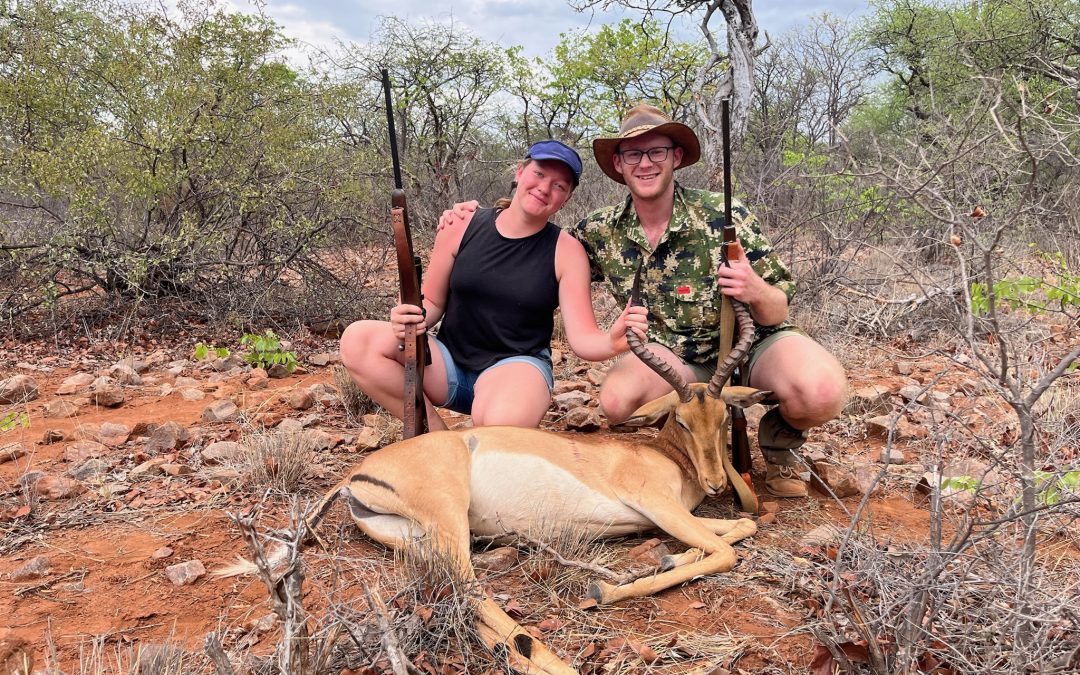
With smiles all around we grabbed a couple of pictures together. Immensely proud not only with the E-tip’s performance but especially proud of little sis. She had done it, her first stalked animal. A very special hunt indeed. I looked at the clock on my phone – 17:30. We carried the ram to the nearest road and then drove to the cold room.
We quickly gutted and skinned the ram, as out of the blue a massive thunderstorm was approaching the speed at which only a bushveld storm can. The temperature dropped drastically with the howling wind and scattered raindrops. We recognised this type of storm, the rainy season has started – and with a vengeance. It was going to rain like this for the coming days.
As we tried moving the carcass to the cold room, we noticed that it was hot inside. Upon closer inspection, some of the wiring had been chewed by mice, and the cold room was out of action! We now had no choice, we had to hope that the evening air along with the stormy wind cooled by the rain, passing through the shade netting which covered the sides of the butchering area, would be cool enough to get the carcass’ temperature out of the danger zone.
I realized then and there that this whole time, the timing was perfect, had we shot the animal earlier, it would have been too hot and it would have definitely spoiled. Had the rain not come at this exact time, and, for example, a day later, the same thing would’ve happened. But luckily for us, and our freezers at home, the Impala carcass cooled down enough to be transported. It was cold and miserable all the way to Polokwane where we the carcass was processed by a butcher.
Timing isn’t always what we want it to be, but sometimes it’s what we need it to be.