Into The Thorns

Chapter Fourteen


The Family

Part 2


George Sibanda

When I used to visit the Landreys at Matetsi during the school holidays, one of the young “picannins” who sometimes got dragged along on our adventures was a son of the Denda Safaris “mechanic”. I put inverted commas around the word mechanic because as amazingly skilled as some of these bush mechanics were, they had little, if any, formal mechanical training. This young fellow’s name was George Sibanda. He did not attend school, instead, he helped his father in the Denda Safari garages at Matetsi, and later graduated to “spanner boy,” drawing a very meagre salary.


Anybody who has lived in the wilderness will know the true value of “bush mechanics”, and there is no short cut to being a bush mechanic – you have to first do the time as “spanner boy”.


When I returned to hunt at Denda in 1983 as a licensed professional, I bumped into George who was no longer a skinny boy, but a strong, happy young man but still spanner boy at Denda.


In 1985 when we started our own safari company, I employed a cook from Victoria Falls, named Edward Mathe. Edward had only been with us a few months when he asked me if I knew George Sibanda. I did not recall the name but when Edward mentioned where he worked I remembered him. Edward told me that George’s father said that George was ready to go out and find a job – he could “spanner boy” at Denda no more. We agreed to give him a try, and Edward sent a message up to Victoria Falls, and in due course he arrived.


This man turned out to be the best worker we ever had. Peter Sebele was a tracker, a specialist. His work situation was different to all our other employees. When there was a safari underway, he worked. When there was no safari, he went home. But George was a worker. He was a mechanic, driver, gun bearer, Number Two tracker, and general handy man. In due course he obtained his driver’s license and he became an excellent welder too. He was honest, reliable, and even tempered. He is dead now. He has been dead five years, and I miss him terribly.


Even though he could not read or write, he was a clever, gifted individual. One of those people who can patiently sit and take a gearbox apart, study it, and know how it works. He had the dogged patience necessary to lie in the hot sand underneath an ailing Land Cruiser far out in the bush, mopane flies swarming around his eyes, and make that truck well again. I cannot count the times on safari where I said to myself “Thank God we’ve got this man”.


Like Peter, George became part of the family. When he married we knew his kids. When they were sick, they went to our doctor – when they were in need, they received our help. In fact George’s second wife was the daughter of our maid who worked for us for fifteen years before she passed away. As George became more skilled, and more reliable, without our really consciously noticing it, he absorbed more of the duties which I used to have to carry out, many of which I hated. He had maturity and self-confidence – surprising in one who is illiterate.


We found ourselves passing duties on to him which basically gave more free time to me. He would drive several hours to National Parks offices and collect game scouts, or deliver ivory or collect permits. He would go with one helper to town to purchase fuel, or groceries or hardware. Much later, when we started operating in Tanzania in 1995, George would share the driving with me on that tedious five-day journey between Bulawayo and Arusha.


George loved his work. He was not much of a tracker – in fact when Peter became tired on the trail it was usually I who took over from him – but George contributed to the success of the hunt in so many other ways. He was always ready to try something different, something out of the ordinary, and it seemed that he was always the one who came up with valuable information from the locals. George spoke Shona, English, Sindebele, Kalanga, Lozwi and Mnambia fluently. When we began operating in Tanzania he quickly picked up enough Swahili to get by and later, when I went into business in Mocambique he wasted no time in learning a smattering of Portuguese. A gifted man indeed.


George had worked for us for about thirteen years when he was helping me build a trading store for Peter out at Peter’s home near Tsholotsho. Whilst we were engaged in this task I realised that George, even though he had not yet given us the years that Peter had, was a big part of our business, and had given us sterling service. I asked him if he would like to own a store at his home near Victoria Falls. Initially he said yes, but a few weeks later he said that he would prefer it if we could help him purchase a car. We promptly gave him an old Toyota Hilux which had given us more hard safari service than Peter and George combined! A few weeks later, when George drove into my yard in a snazzy little Renault town car I asked him whose it was. “It’s mine” he replied. He had done a little work on the old Toyota, sold it, bought a much newer, more fuel-efficient runabout, and had some cash left over! After a little thought about the whole thing, I wasn’t really surprised.


When we finally phased our business into total leopard hunting, George became virtually indispensable. He was mature enough, keen enough, and reliable enough for me to be able to send him off with one helper, fuel, baits, and a long-range radio into remote areas, in order to find large unhunted male leopards. And find them he did.


I remember clearly, even today, five years after his death, watching him drive up the steep incline into the mountain camp trying his best to act bored and nonchalant as he reported his findings. Translated from Sindebele, our conversation would go something like this.


“I see you George.”


“I see you also, Baba.”


“If you have come all the way back to camp, it means that you have encountered some problem, or it could mean that you have found the sign of a large leopard.”


Delaying the finale as much as he could he would announce tiredly “I have had some problems with the radio – which is why I did not speak with you yesterday. I have looked into the piece which you use to speak, and I have seen some wires loose there. But I have not tried to fix it.”


“George. You have come all the way here, a three-hour drive, to tell me that the radio is broken? Why did you not go to Mr. AJ’s house and ask to use his phone?”


Now he would be battling to suppress his grin. George had prominent top front teeth with a large gap between them, and he had an infectious open laugh to boot. He would reach into his top pocket, but I already knew what was in there. With great ceremony followed by suppressed laughter, and egged on by the watching staff, he would hand me the two sticks representing the length and width of the front track of a supercat.


“This leopard fed on my bait last night” he would announce. (I liked the “my”) “He ate much meat. I cleared a shooting lane before placing the bait, and there is a good position for the blind.”


Sometimes George positioned the blind site in a spot slightly different than the place I would have chosen but most times he had it dead on. He was an observant man and very seldom had to be shown something twice. He took great pride, and I believe pleasure, in being able to successfully coerce leopard onto bait. He was content in the satisfaction of knowing that he was doing his job well.


When 2002 came around, George, like forty percent of all Zimbabweans, must have been carrying the AIDS virus. A bout of malaria left him emaciated, and his painstakingly slow recovery had us worried. We took him for tests and the news was the worst. Unlike Peter at a later stage, George never really seemed to accept, or believe that with good food and antiretroviral drugs he could still live a good life. It was upsetting to see such a once strong, alert, willing person, try to tackle his job with his tank on empty.


I was on safari in Tanzania when my wife told me via the radio that things had taken a dive for George. He was on a hunt at Marula with our friend Neil Lindsay when he “went crazy”. Neil said that his sense of balance had deserted him and he had a wild look in his eye and he was talking gibberish.


My wife went out to Marula with her friend’s son along to help, and she brought George back to town. She said that journey was heartbreaking. She put him in hospital in Bulawayo but the care and attention he received there was so poor that we put him in a cottage at our home, and hired a nurse to attend to him. His mind cleared, but maybe sitting there helplessly in the morning sun, like an old man with nothing to do, sapped his spirit as much as the hospital did. George’s wife died in July and I believe he saw the end coming. I was out in the bush when my wife decided he was just too ill and we could not give him the medical attention he needed, and he was admitted to the infectious disease’s hospital. I came back from safari and sat with him at the hospital trying my best to convince him not to give up, but he died of meningitis in August.


We drove his body up to Victoria Falls and we attended the funeral, where I was asked to speak. But I could not. All I could see was George’s happy face, his gap-tooth smile, the countless fires we had shared, the camps we had built, and the mishaps, adventures and triumphs we had seen during seventeen years of safari together.


I promised myself that one day I will return to George’s grave and there I will place a headstone:


‘George Sibanda. Born 3rd June 1963 Died 23 August 2002. Honest, brave, gifted, a much loved man who never shirked a job. Rest in peace.’


Bee Ngwenya

In 1989 we returned to the Matobo Hills, and began construction on the camp at the southern end of AJ’s property on the Ingwezi river. It was a beautiful, tranquil place tucked in against a big koppie, right on the edge of the Ingwezi which was mostly just white sand for most of the year. Giant acacia albida trees shaded the spot.


The bush telegraph directed a stream of men from the neighbouring communal lands to our camp. They were looking for work and we hired about a dozen of them.


Homesickness, drinking problems, wanderlust and poor work, resulting in firing, thinned these people out and kept bringing in new faces. One of the few who survived right from the beginning was a fellow named Bee Ngwenya. I had very little to do with Bee in those early days. I was running the big game concession up at Matetsi in the far northwest of the country and a fellow named Gerald Oosthuizen was building the Ingwezi Camp. Gerald gradually took Bee under his wing when he began exploring the area and cutting hunting roads, and as it turned out, Bee knew the place quite well. It was obvious that he had been actively poaching these ranches on and off for some years. He knew most of the waterholes and just about all of the overgrown bush roads. His knowledge was valuable and he was an asset to Gerald, and of course to our operation.


Bee knew nothing about safaris, leopard hunting or trophy hunting, but he was a hunter none-the-less, and he was quick to learn. Gerald took some beautiful big leopard in those early days and it was a learning curve for both Bee and Gerald.


When we pulled out of the Matetsi concession and decided to expand the operation at Marula, I began to do more of the leopard hunts myself. I had Peter as my number one tracker and George as my right-hand man, so there was no real need for Bee as part of my own hunting staff. But he was extremely useful in helping other professional hunters who were unfamiliar with the area. Bee was always keen. In all the years we have known him that is the one trait in his character that stands out – his eagerness and his keenness to take on a task, no matter how daunting or unpleasant, nor how far that task may be.


As Bee’s safari experience grew, so his tracking ability improved. He had many opportunities to work with Peter and this gave him the confidence he needed to step into the role of genuine safari tracker.


With the decline of Peter’s health and the demise of George, we found ourselves more and more reliant on Bee. Although he never possessed the mechanical aptitude that George had, he developed into a very good reliable driver and he took on the leopard baiting duties with enthusiasm and, surprisingly, with good success.


The highlight of Bee’s safari is when he has baited a large leopard and, just like George used to, hands over the measuring sticks to me with great ceremony, beaming from ear to ear. Excited, pleased, and proud.


Bee is a great character at our leopard parties. Sometimes the staff will stage a play after the singing where they act out the whole hunt. Bee always takes the part of myself and he takes the opportunity to portray my character, especially my bad qualities, mercilessly. He pretends that the staff have made stupid mistakes when building the blind or hanging the bait, and he remembers every insulting phrase or curse word I have used in all the years he has known me, and he uses them to berate the others. It is hilarious. He is a pretty wild dancer too and he stamps up a good dust storm during the festivities.


In my years as a soldier and as a professional hunter, I have not come across many native Africans who are proficient riflemen. But Bee is one. I commenced teaching Peter, George and Bee to shoot at around the same time, but Bee progressed a lot more quickly than the other two. This was an added bonus for me when sending him on baiting duties because he could hunt and kill impala, and shoot bait cattle without having to return to camp for bait meat.


Like his mentors, Peter and George, Bee is not loud, obnoxious, unreliable or a troublemaker. He is a pleasant, keen talented hunter and he has a good future ahead of him in the safari industry. The guard is changing, but I feel certain that Bee Ngwenya will forge his own special place in safari life in the western Matobo, and I am proud to be able to say that we were able to start him on that path.


Luka Maphosa

In 1989 after finalising a deal with the incumbent concessionaire on Matetsi Unit Two, we commenced operations in that well known big game area. The concessionaire, Innocent Dube, already had several of his own staff in place at the camp near the Guyu River, and one of these was a cook named Luka Maphosa. At that time Maphosa was about 27 years old. He was a hardworking individual who got along with everybody, and like Bee Ngwenya, no task was too much to ask of him. Maphosa’s cooking skills, however, were of the very basic garden variety. If Maphosa were a car, he would be the go forward never-give-up Land Rover. But he would not be the Porsche or the Maserati. But that was fine with me. Hard working and good natured would always take my vote way ahead of brilliant-but-temperamental.


We did our darndest to decrease the weight of Maphosa’s bread rolls and add a bit of zest to his stew. We tried like hell to imagine the moisture still in the roast. But the food stayed the same. Medium, okay, Land Rover food. I’ve never been one for fancy starters and four-course safari meals. I am usually just too damned tired once we return to camp. I suppose it is a failing of sorts. I’ve hunted in many safari camps where the vittles laid on would not be out of place in the Ritz. They were wonderful. But unfortunately not in my camp. But I liked Maphosa and he liked us and for eighteen years very few of my clients have ever complained about the food. I go to bed at night with a full, happy belly and I would say that just about all of my clients have too. When we left Unit Two in 1995 Maphosa came with us, much to the chagrin of Innocent Dube. In safari camps there is usually an order of rank, or structure of hierarchy. Of course not all operations are the same, but most have a similar arrangement. Sometimes there is a native camp manager who is top dog amongst the safari staff – especially up in the East African hunting areas – but in many operations this post is also held by the chief cook.


In our outfit the most respected and senior man has been Peter, but he has always eschewed any managerial “head man” type roles – he just does not need or want the extra responsibilities. So Peter, George and Maphosa have evolved purely by circumstance, into “head staff’ in our company and Maphosa I think, enjoys that role a lot more than the other two do.


Luka Maphosa has been a faithful hard-working part of our safari life for many years and I hope he remains with us for many more.


In our years of running safaris in four different countries we have worked with many natives, and it’s not my intention to bore everyone to death by giving the life story of each one of them. We have seen so many amazing, funny, good, and often bad, incidents over the years with our staff and other peoples’ staff, that I could fill another book recounting them. But I cannot resist briefly mentioning just a few.


Graham’s tracker, Tshani, is a tall gangly unkempt individual who loves to show off in front of the other staff. He also loves strong drink, and at one of our leopard parties up at the mountain camp one of the clients offered Tshani some whisky. “Hot stuff’ as Tshani calls it.


Tshani answered “Yes, please Suh!” He then commenced downing whiskies chased with beer, becoming louder every minute, regaling all the other workers with his many adventures and tales of derring-do. Needless to say he was unable to present himself for hunting the next morning, and Graham set off without him.


That night, Tshani had still not returned and nobody at the camp, or at Graham’s ranch headquarters, knew where he was. The next evening, forty-eight hours after the leopard party, Tshani presented himself for duties. His eyes were blood red and his woolly hair and scraggly beard were matted with grass and dirt. He had also lost his shoes. White mucus crusted his eyes, nose and lips.


“Where have you been?” Graham asked him.


“I have been in the bush Bwana,” he replied, “the drink.”


He stood there like we were all supposed to know exactly what had happened.


“Where are your shoes?” was Graham’s next question.


“I do not know Bwana, I cannot find them. First I lost my shoes, then I lost myself, but now I am back.”


His simple explanation coupled with the simple look on his bemused face was too much for Graham and I and we just cracked up.


When I was still hunting for our friends the Landreys up at Matetsi, Kim returned late one evening from the lion blind. They did not have the lion but they did have a funny story.


Between camp and the blind Kim and his client came across a large waterbuck bull which the client shot. They loaded the trophy and continued on to where they had the lion feeding. Kim parked the vehicle about a mile downwind from the bait, and he and the client walked quietly to the blind, leaving the tracker in the car. The francolins fossicked around getting ready to roost. The first hyena called. Lion hour approached quickly.


But on this particular day the lion decided not to approach Kim’s bait via the elephant trail that it had been using for the previous two days. It decided to use the road which had fresh droplets of blood on it – the waterbuck blood which had seeped out from the back of the Land Cruiser! Kim’s tracker was asleep up on the hunting seat when a thud and a snuffling noise, coupled with the squeak of the sagging Land Cruiser springs woke him. He looked down – three feet away at the tailgate, a huge full-maned lion was standing there with its front feet up on the truck, its giant fluffy dark head monstrous in the twilight as it found the source of the blood.


The lion saw the tracker move and grunted in surprise, dropping back down onto the ground where it began to growl ominously. Time to go. The tracker leapt out of the Land Cruiser and he must have streaked through that mopane woodland as if on fire.


Kim and his hunter, oblivious of the goings on back at the vehicle, sat quietly in the blind being eaten by mosquitoes. Finally they had had enough and walked back to the road. The lion by this time had moved off. Kim was puzzled as to the whereabouts of the tracker. He whistled for him a few times but received no answer. Maybe, for some reason, he had gone back to camp, but that was unlikely. It was a long walk in the dark, with all sorts of nasties wandering around the bush. Kim started the vehicle, turned it around, and suddenly heard a shout. He turned the car off and then he heard the shout again from the high branches of a mopane tree about fifty yards away. “What are you doing there?” Kim asked the tracker “Why do you not answer when I call you?”


The tracker told Kim about his unpleasant meeting with the lion and he said that he did not want to answer for fear that the beast was still nearby. He refused to come down until Kim drove the vehicle near to the tree: He then sprang straight from the branches down into the truck. From that day on he refused to wait in an open Land Cruiser at night. A Land Cruiser with cab and doors was fine.


We were sitting around the fire down at our Bubye River camp in the southern lowveld enjoying our drinks waiting for the cook’s call for supper. We were trying out a new “town” cook who had assured us that he could cope with safari life in the bush.


I heard George’s hysterical laughter up near the kitchen, followed by Peter’s muffled chortling, so I wandered over to see what the occasion was. George was sitting on a box by the kitchen fire with his hand to his mouth, doubled over with suppressed laughter. The new cook, however, was not wrapped up in fits of mirth and was going about his business with a bemused frown.


“What’s the joke George?” I asked, and to the cook, “Come on Joseph, we’re all still waiting for our snacks!” This sent George into renewed spasms and he rolled about with Peter following suit.


Finally when he could speak, he answered, “The new cook says he doesn’t want this job Bwana” more laughter.


“Why?”


“He came back from speaking to you at the lounge and told us that you had told him to ‘hurry up and bring the snakes!’ – now he says he doesn’t want to go out in the bush to find the snakes you want, he says he is scared of snakes!”


At this they rolled about in more laughter while I just stood there with my beer in my hand contemplating Africa.


Snakes, Snacks.


I shook my head. Was it possible that this fellow really believed that I wanted him to go out into the bush at night and collect snakes?! Needless to say, he never made it.

Into the Thorns is now available at Good Books in the Woods

www.goodbooksinthewoods.com

jay@goodbooksinthewoods.com

One for the Road

By Terry Wieland


Old-Time Wisdom


In his book, African Rifles and Cartridges, John “Pondoro” Taylor often mentioned “cheap Continental magazine rifles,” and his comments were usually disparaging.  Taylor set great store by reliability, not only of the rifles he used, but the cartridges and bullets they employed.


The two major names in “Continental magazine rifles” were Mauser of Germany, and Mannlicher-Schönauer of Austria.  No one could knock either on the grounds of workmanship or materials; they were legendary then, and they’re legendary now.  Where Taylor did have a point was with Mauser sporters (or sporterized military rifles) chambered for some eminently forgettable cartridges.


Today, most hunters have never heard of the 10.75×68 Mauser or the 11.2×60 Mauser.  There were several, mostly rimless, in the 9mm to 11.5mm range (.358 to .44 or .45, roughly.)  In the case of the Mauser, many appeared in East Africa between 1919 and 1939, built on surplus military actions, and produced in one- and two-man shops across Germany.  These were most likely the rifles Taylor had in mind.


In the years after the Great War, the British gun trade was struggling and the German trade was desperate.  Tanganyika, of course, had been a German colony until 1919, with many European settlers.  Once it joined Kenya and Uganda in what came to be known as British East Africa, the greatest big-game hunting region in the world, it was natural that German gunmakers would look there for new markets.  And, with ex-military Mausers readily available, those naturally became the basis for building inexpensive hunting rifles.


If you look at the cartridges themselves, there is nothing much wrong with them except bullet construction.  Often, the bullets were flimsy, flew apart, and didn’t penetrate.  This was not true of all, but there was enough to lend the rifles a nasty reputation.


John Taylor himself was not anti-Mauser, by any means.  His Rhodesian friend, Fletcher Jamieson, owned a .500 Jeffery on a Mauser action, which Taylor used and like very much.  If a Mauser-actioned rifle came with the name Rigby, Jeffery, or Holland & Holland on the barrel, it immediately got Taylor’s vote.


This is where it becomes very tangled, because all the actions in those days were made by Mauser at Oberndorf.  Firms like Rigby and Jeffery used them to build some pretty flossy rifles.  So what do you call them, a Jeffery or a Mauser?


And the cartridges?  The .500 Jeffery is actually the 12.5×70 Schuler, designed in the 1920s by the firm of August Schuler to create an elephant round that could be chambered in a standard military Mauseer 98.  W.J. Jeffery adopted it and renamed it, yet when Taylor was writing, and praising the cartridge at length, the only ammunition available came from Germany.  Conversely, the .404 Jeffery was probably a Jeffery design, but it was adopted by Mauser as a standard chambering, and renamed the 10.75×73.


As you can see, there was considerable cross-over and adoption of each others’ designs.  The great London gunmakers had nothing but respect for Mauser Oberndorf, and the compliment was heartily returned.  Both probably considered the periods 1914-18 and 1939-45 as highly inconvenient impediments to trade.


After 1946, the supply of Oberndorf-made Mauser 98 bolt-action rifles dried up, although other manufacturers stepped in to produce Mauser actions, and sometimes entire rifles.  The London trade built rifles on whatever they could get — the Enfield P-14 and P-17, Brevex Magnum Mausers from France, Czech Mausers from Brno, Santa Barbara actions from Spain.  Even with Rigby or Holland & Holland engraved on the barrel, however, these never carried the cachet of, say, a .416 Rigby, made in St. James’s Street, on an Oberndorf magnum action.


Since the war, a lot has happened with both Mauser and its first and greatest associate in London, John Rigby & Co.  The Mauser factory was razed in 1946 on orders of the French occupation forces, and its name and trademark passed through various hands before, in 2000, becoming part of Michael Luke’s Blaser conglomerate based in Isny im Allgäu.  Rigby also changed hands, and was moved to the U.S in 1997.  There it became the centre of varying levels of fraud and ignominy before being purchased in 2012 and moved back to London.  The purchaser was the Blaser group, which put Rigby under the management of Marc Newton with a mandate to return the Rigby name to glory.


One way to do this was to resume manufacture of the famous Mauser 98 action, so that Rigby could once again built its .416s on an action with the Mauser banner on the ring, and make its traditional stalking rifles in .275 Rigby (the name Rigby bestowed on the 7×57 Mauser when it adopted it in the early 1900s.)


Since 1946, the various owners of the Mauser name steadfastly refused to make any of the company’s most famous (and, in my opinion, by far the best and greatest) product:  The turnbolt 98.  Even after it took up residence in Isny, making the 98 once again was not on its immediate list of projects.  As far as I know, it was not until the Rigby acquisition that it began seriously looking at it.  Whether it was Marc Newton who persuaded Mauser, or whether that was the secret plan all along, hardly matters.


Around 2010, Mauser had taken a hesitant step towards making a 98 again.  Using a magnum 98 clone produced by Prechtl, Mauser made a few .416s, but with a price tag of $40,000, I don’t imagine they sold many.  Then they acquired Rigby and, in a surprise move two years ago, Mauser announced it would once again make the magnum action, supply it to Rigby, and also make entire rifles in Isny.  Now, they have added the standard-length action to the line.  In London Rigby is using it to make its Highland stalking rifle in .275 Rigby, while in Isny, Mauser is chambering it in the venerable 7×57, 8×57 JS, 9.3×62, .308 Winchester, and .30-06.


Whatever John Taylor might think of these, he could never call them cheap.  The standard model in the less expensive “Expert” grade lists for $9,100.


All of these calibres are familiar to Americans except, perhaps, the 9.3×62.  This is an old and highly respected big-game cartridge in Europe.  It was designed in 1905, and became a standard Mauser chambering.  Even John Taylor thought quite highly of it, with the right bullets, and today ammunition is loaded by Norma, among others, in a wide variety of bullet weights and types.


Now, for the first time in many years, a hunter can go to Africa with a complete battery bearing the Mauser banner — a .416 Rigby for the big stuff, a 7×57 for plains game, and a 9.3×62 for in between.

* * *


It’s a funny thing, but in 1956 when Winchester introduced the .458 Winchester Magnum, and hired East African professional David Ommanney to tout the rifle for them, all predictions were that this was the end of the line for the big nitro-express cartridges, for the magnificent double rifles that fired them, and for all those “archaic” rounds like the .404 Jeffery.  The .416 Rigby was consigned to the trash bin, and even the .375 Holland & Holland was put on the list of threatened species.


It’s now 60 years later, and look what’s happened:  The .416 Rigby came roaring back, and has become a standard chambering; the .375 H&H is stronger than ever; there is a very vigorous market in double rifles, both old and new.  Many of the nitro express cartridges are being made by Kynamco, loaded with Woodleigh bullets from Australia.  The Mauser 98 — an action that is now 120 years old — is still the most popular bolt-action basis for a dangerous-game or plains-game rifle.


Anyone who buys a new Mauser, however, is not merely wallowing in nostalgia.  There is still no better, more reliable, or versatile action on which to build a rifle, whether you’re culling wildebeeste or pursuing pachyderms.


Through the 1960s, African Rifles and Cartridges and even John Taylor himself were disparaged.  As an ivory poacher, Taylor did not command the reverence of professionals like Sid Downey or W.D.M. Bell.  He died in 1955, and his books, Big Game and Big Game Rifles (1948) and African Rifles and Cartridges (1948) went out of print.  It seemed to be the end for everything.


As it turned out, the books were reprinted, first by Trophy Room Books and The Gun Room Press, respectively, and Taylor’s reputation was gradually rehabilitated.  Today, anyone interested in the history of African hunting and the actual performance of rifles, and of bullets on big game, should read Taylor.  His earlier, smaller book, Big Game and Big Game Rifles, is unfairly neglected, in my view.  I bought it from Ray Riling Arms Books in 1966, for $6.  I was absorbed by it then, and still go back to it now when I want to recapture some of the magic.


What the old-timers learned and knew is still worth learning, and well worth knowing.   Many years ago, boxing writer A.J. Liebling wrote in the New Yorker, quoting Heywood Broun, an even earlier writer, “After all, the old masters did know something.  There is still a kick in style, and tradition carries a nasty wallop.”  It seems that every new generation of boxers needs to learn this, and while Liebling and Broun were both writing about boxing, it could just as well have been big game and big-game rifles.


A Nambian Safari

By Larry Collins


My Namibian safari was the best vacation/hunting trip my wife Pat and I have ever taken.


We left Atlanta, with the usual long flight via Joburg to Windhoek where, after collecting luggage, we met my PH, Dirk de Bod, at the Firearm Check-Out office. He collected our firearms and luggage, and we were soon in his SUV on our way to his hunting area.


On arrival, we went to our tent and unpacked. When I say tent, it was more like a luxurious one-bedroom apartment. Apart from the king-sized bed, large bathroom with a big shower and usual furniture, there was a safe, small refrigerator, and an air conditioner.


After unpacking, we walked to the hunting lodge for drinks and sat around the fire pit until supper and talked hunting.


Dirk asked what my point of aim would be, and when I told him I normally tried to make a heart shot, he said he had trouble with American hunters shooting too low and recommended aiming three or four inches higher than the heart shot, toward the center of the lungs. I told him I had Leupold VX6HD 4×24 Rifle Scope with a custom CDS Ranging dial, and he offered to set it for me before the shoot. We had supper and we were tired from the trip, so we called it a day.


The next morning we woke to find the temperature had dropped below freezing overnight and dressed in layers accordingly, then walked down to the lodge for breakfast.


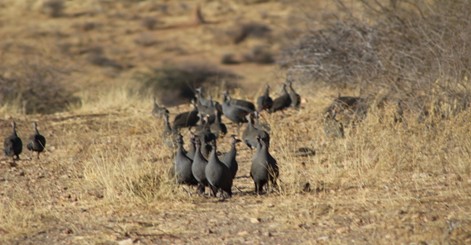
For the morning hunt, Dirk, the two trackers, the two tracking dogs, Pat, and myself loaded into a Toyota truck with a shooting bench over the cab built into the bed of the truck. We drove for about two hours and saw giraffes, guinea fowl, and other animals. I was feeling a little uncomfortable and found I had an upset stomach. For lunch the others had sandwiches while my lunch was an Imodium!

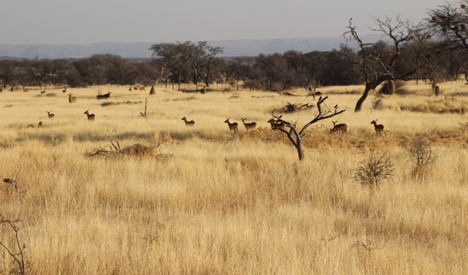
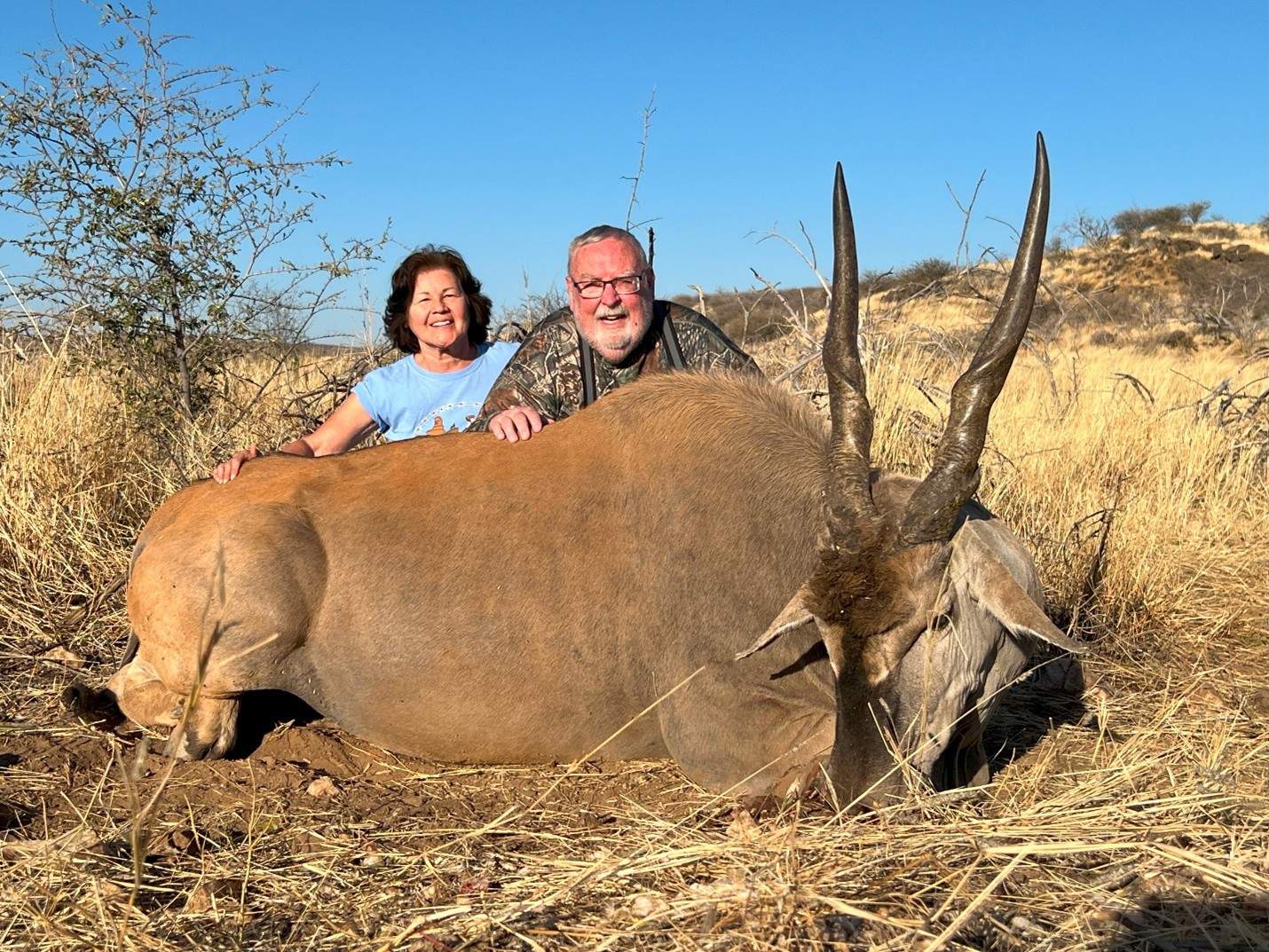
On the afternoon hunt we saw many animals including giraffe, zebra, waterbuck and gemsbok.  At about 5:00 p.m. Dirk spotted three Cape eland, and the oldest was a shooter. We tracked them up a wide canyon and the two younger bulls moved to the right side of the canyon; the older one moved to the left.  I had still not seen them at that point, but we walked in single file up the canyon about 800 meters.  Dirk set up the shooting sticks and said the animal would be coming out from behind a set of bushes on the left about 120 meters in front of us. I got set, Dirk steadied me on the sticks, and about 15 seconds later the eland came out and stopped broadside to us, his fatal mistake.  I squeezed the trigger, and he took off running over a small knoll. The shot was good. The tracking dogs heard the shot and came running past. About three seconds later I heard a sound I hadn’t heard since I was a teenager squirrel-hunting with my uncle’s dogs: 

“Yap, Yap, Yap, Yap, Yap.”  I knew what it meant.  We walked over and there was a nice Cape eland bull about 50 meters from where I shot him, about 1800 pounds according to Dirk. I got extra credit for dropping him about 10 feet from a road!  I was on an adrenaline high. Dirk and the trackers loaded him in the back of the truck and strapped him in.


We returned to the hunting lodge for drinks around the fire pit, hunting tales, and another three-course meal. But Dirk’s future daughter-in-law, Anka, made a “from scratch” tomato soup that was perfect for me. 


The next day after toast and coffee for me, we loaded into the Toyota. We saw several animals not on my list – gemsbok cows with horns bigger than the bulls, groups of kudu cows, then Dirk and the trackers spotted a sable bull at about 250 meters out. Dirk stopped, I got out, a tracker handed me the rifle.  Dirk adjusted the CDS dial on the scope, and I adjusted the parallax dial to match. I squeezed the trigger.  Nothing happened. I had forgotten to release the safety. I moved the safety to “Fire”.  Yanked the trigger.  Missed the shot. We went to check but found no animal, no blood, no nothing.


For the afternoon hunt, we sat in a raised blind and saw a few animals but no shooter bulls. Later we had another great evening at the lodge.

The next day was as before, and one of Dirk’s friends, Ace, joined us for the hunt. We saw several kudu, three sable that were not shooters, and finally saw a sable bull standing in the brush 300 meters behind us to our right. I got set up but it was still a little awkward. We watched him through the brush for 15-20 minutes.  He finally moved into a clearing and we set the dials on the scope at 300 meters.  I changed the power setting on my scope to 12 and got him in my crosshairs. I tried to concentrate on my breathing and control my excitement. I aimed to the middle of his lungs, squeezed the trigger, and he went down like he had been poleaxed. I had hit him in the spine.  Dirk fired two more shots to be sure. The right horn measured 47 inches and the left horn 46 inches.


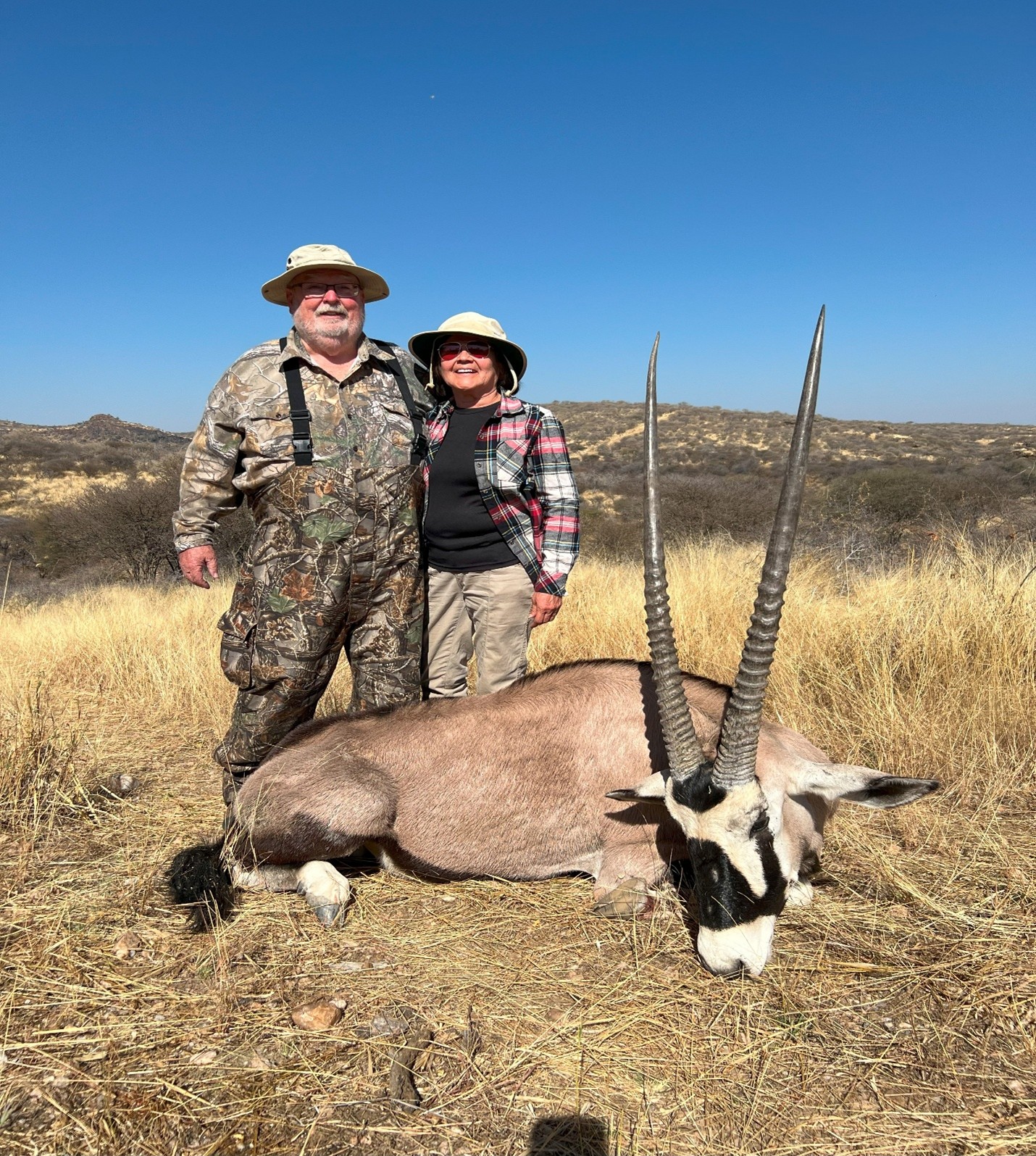
On the next day we finally found a lone gemsbok bull on a fence line about 225 yards away, heading into the brush.  We got set up and waited about a minute till he came back out moving away from us along the fence line.  Dirk adjusted my scope to 250 meters.  I adjusted the parallax dial to match.  The gemsbok finally stopped and looked back over his left shoulder. I put the crosshairs on a quartering away shot and squeezed the trigger.  He dropped like a rock.  Horns – 39 inches.


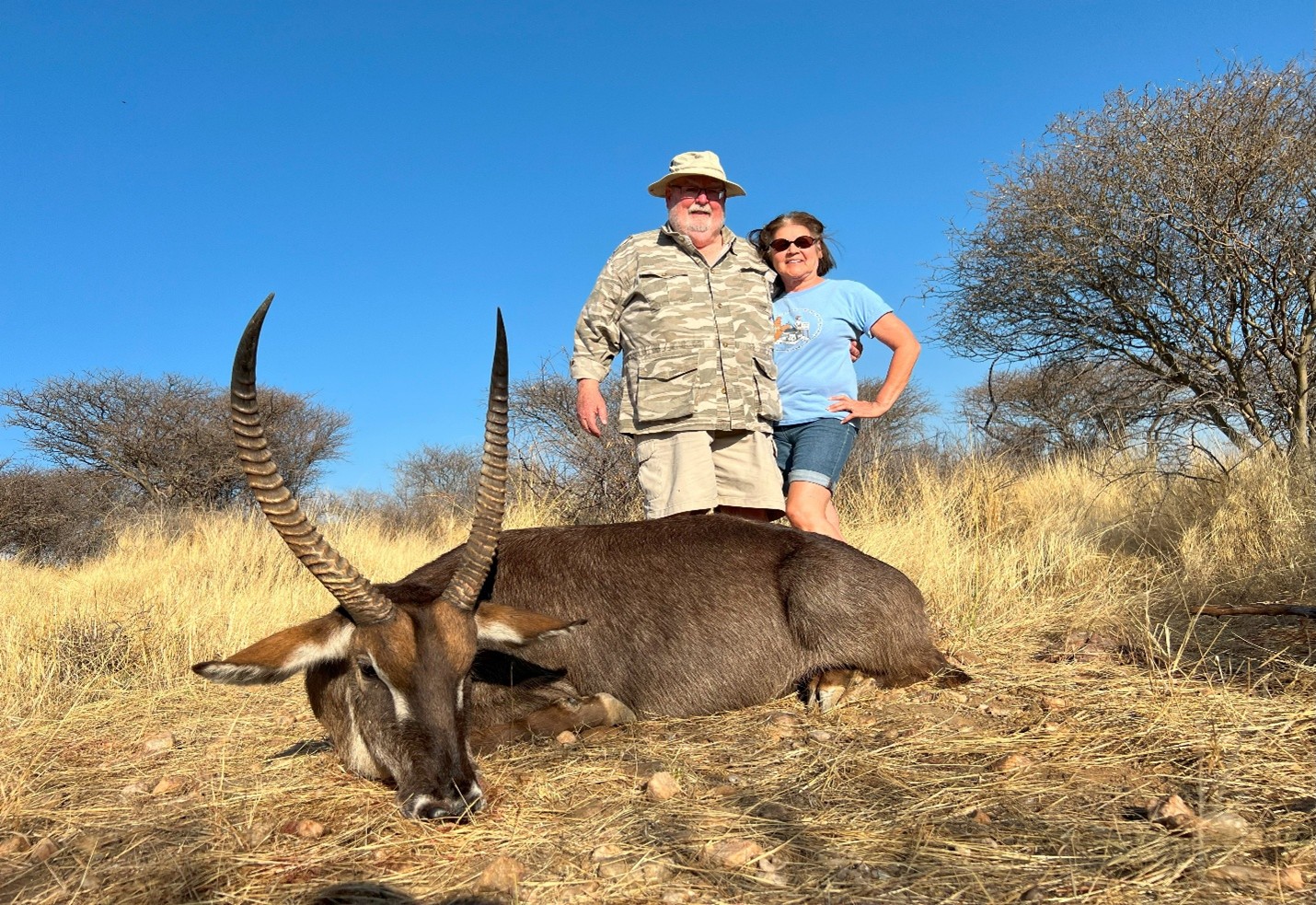
After lunch, on our afternoon hunt we saw several groups of gemsbok, kudu, wildebeest, and impala cows.  Finally, Dirk spotted an impressive waterbuck bull.  We chased him for over an hour, maneuvering around the dense 2,000-acre hillside thicket he was hiding in till he finally stopped in a bush about 100 yards downhill from us.  With Dirk’s help, I prepared

to fire.  I squeezed the trigger and the bull disappeared. Dirk figured where the bull had gone. He took my gun and he, the trackers and the dogs went after the animal.  About seven minutes later I heard the dogs start barking. The bull had traveled about 100 yards and was standing in a bush.  Dirk fired a finishing shot and we returned to the lodge for another pleasant evening.


The following day we bade farewell to Ace, then worked our way back through hills and valleys, sighting several herds of animals as many as 50 each – gemsbok, impala, kudu, roan, sable, waterbuck, wildebeest, and hartebeest, cows and bulls. We did not find the old kudu bull we were looking for and decided to try again in the afternoon.

We saw lots of everything, but nothing worth shooting, so returned for our sundowners and supper.


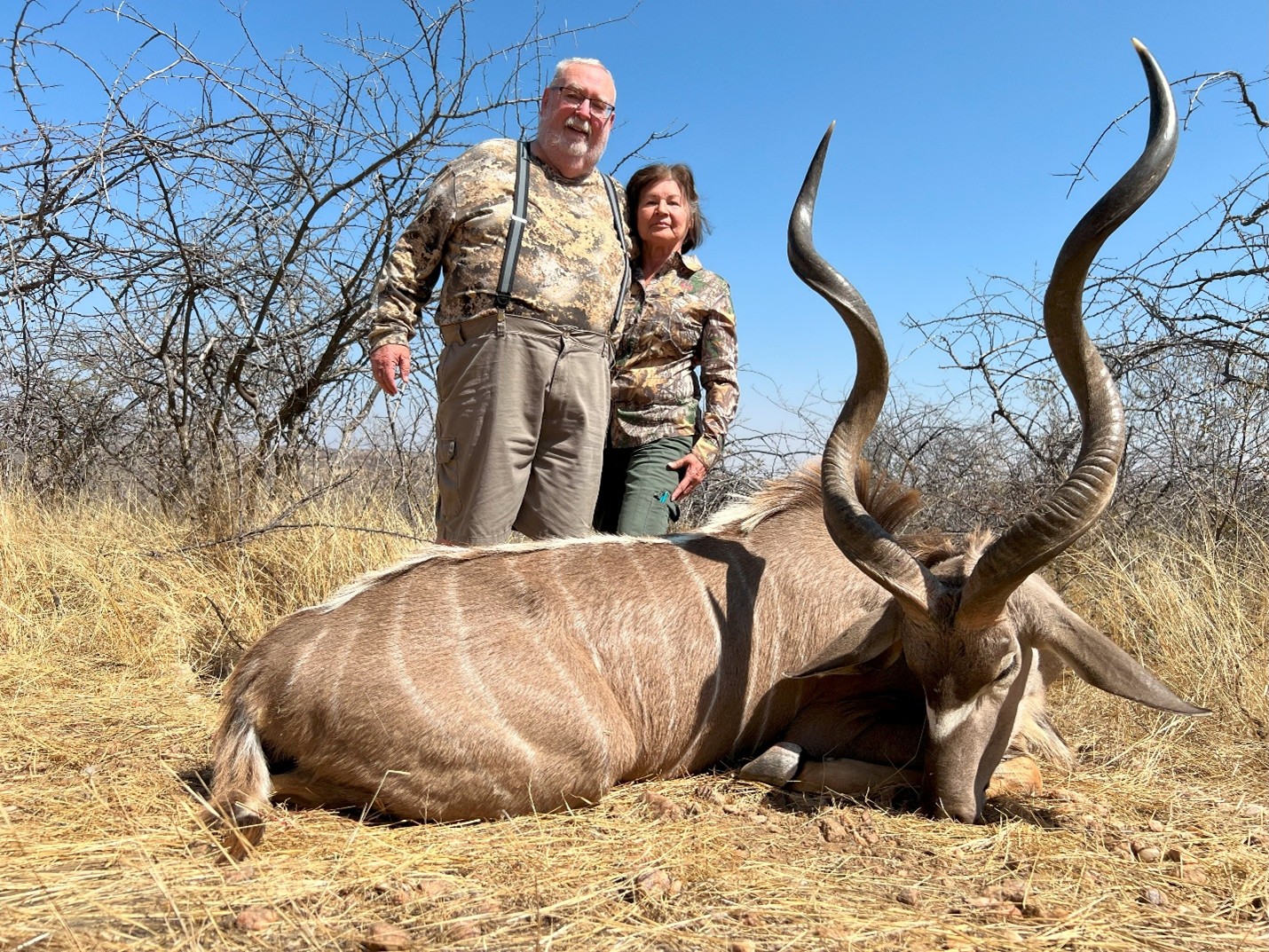
Before the next day’s hunt we traveled to the utility area and helped load some meat for workers and drove around the 10 sections adjacent to the utility area for several hours.  We saw four groups of kudu bulls and in the last group, one of the trackers noticed something in the brush. It was an old kudu bull standing dead still in the shadows of a bush, difficult to see.  He was 100 meters away, and Dirk got me on him, a shooter.  At first, I only saw a silhouette that looked like an animal. He was facing the base of the bush he was standing under and his horns looked like a tree branch. Dirk said, “Take him.”  The bull looked back over his right shoulder. I saw the “V” of his horns and as he took a step to the right and presented his shoulder, I took the shot.  He ran off less than 50 yards.  Dirk started after the bull with his dogs. He didn’t take my rifle along; he knew the kudu was down. There was a small problem, though. The animal was piled up in the middle of a bunch of catclaw bushes.  Dirk got on the radio and called in reinforcements to help hack the kudu out of the brush.

On the way to the lodge for lunch we went for some guinea fowl with my Benelli SBE shotgun. We drove up on a group of about 100 birds. I pointed to the middle of the group and fired once and got 10 birds. Pot shot.


On the afternoon hunt we drove through the “Nursery” where Dirk had hundreds of breeding stock to supply the rest of the ranch with huntable trophy animals.  Then we drove around the ranch shooting guinea fowl. I fired a total of eight shots, and we came away with a total of 25 birds.


After the hunt, we returned for drinks at the Fire Pit, and another wonderful meal of eland steaks.


On the way to the lodge for lunch we went for some guinea fowl with my Benelli SBE shotgun. We drove up on a group of about 100 birds. I pointed to the middle of the group and fired once and got 10 birds. Pot shot.


On the afternoon hunt e drove through the “Nursery” where Dirk had hundreds of breeding stock living there supplying the rest of the ranch with huntable trophy animals.  Then we drove around the ranch shooting guinea fowl. I fired eight shots, and we came away with 25 birds.


After the hunt, we returned for more drinks at the fire pit, and another wonderful meal with eland steaks.

It was the end of the hunt. Dirk drove us to his Beach House at Long Beach.  We went shopping, had lunch at Swakopmund, and visited the Kristall Gallery. The next day we went sightseeing at Walvis Bay.


The following morning we drove to Omaruru Game Lodge for a tour of the ranch and Pat got to pet some elephants and a rhino.


On our last day we drove to Ingwe Wildlife Art shop to discuss taxidermy where I met Silke Bean, and afterward, Dirk dropped us off at the Airport.


It was such a amazing safari full of wonderful memories.

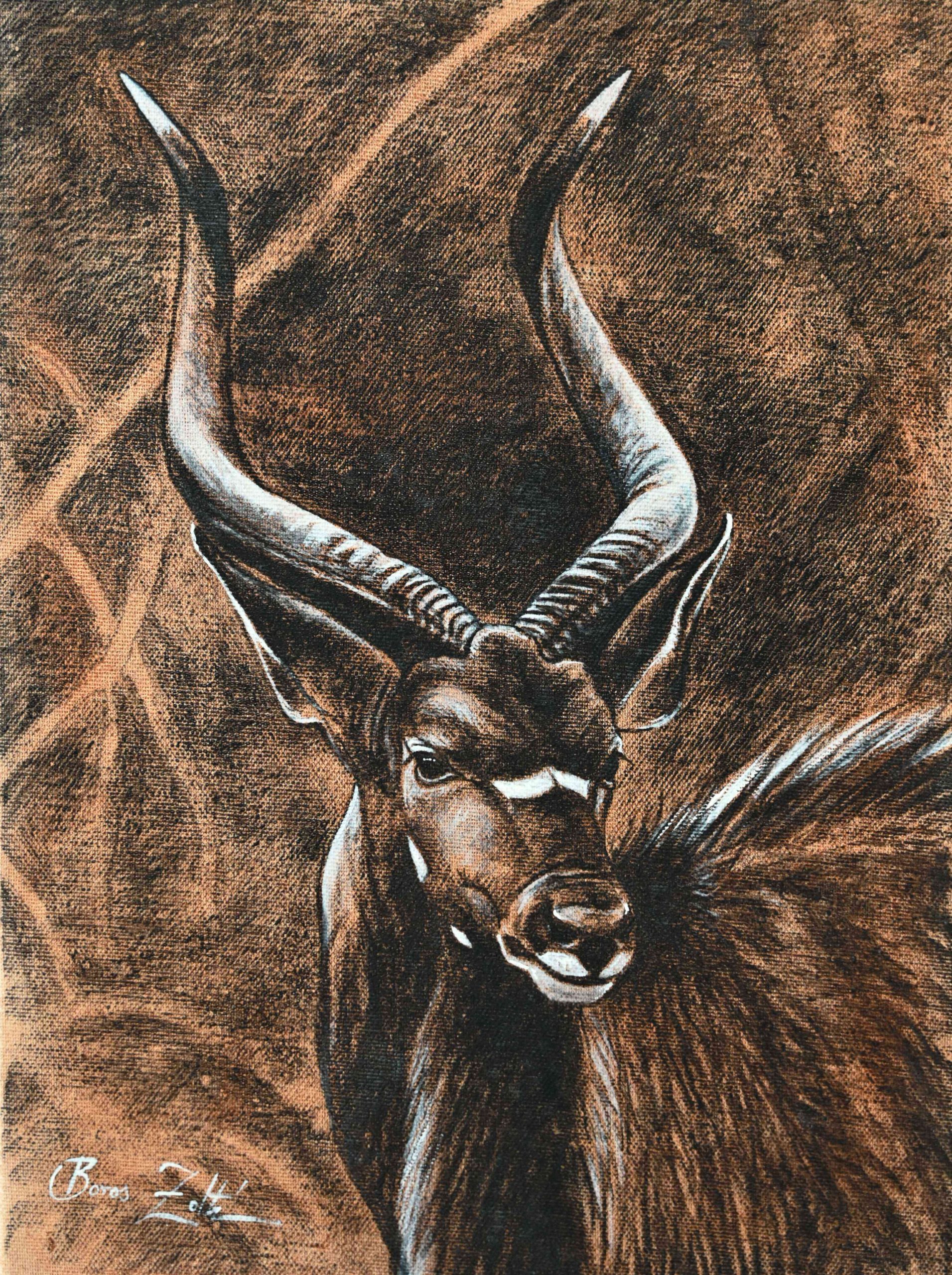
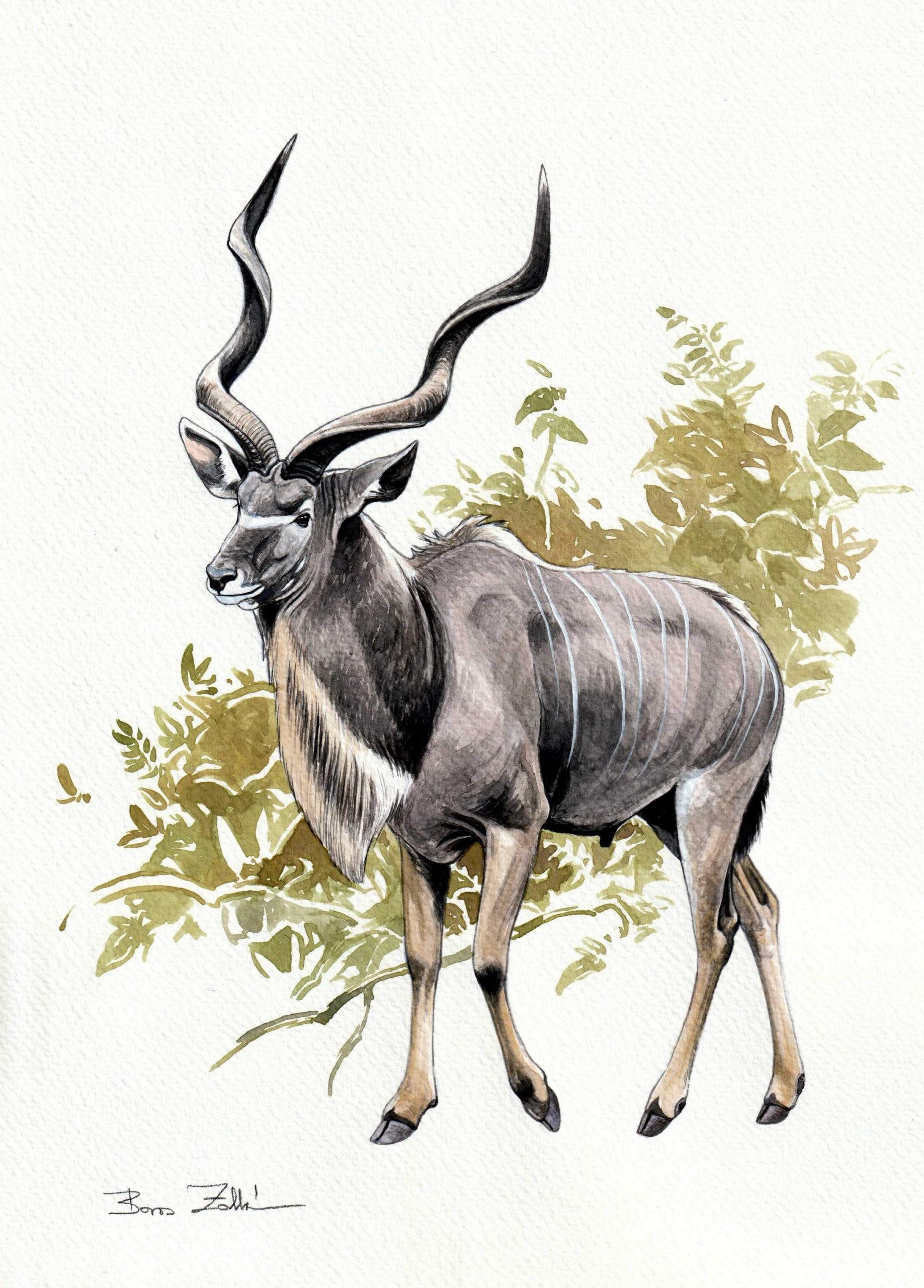
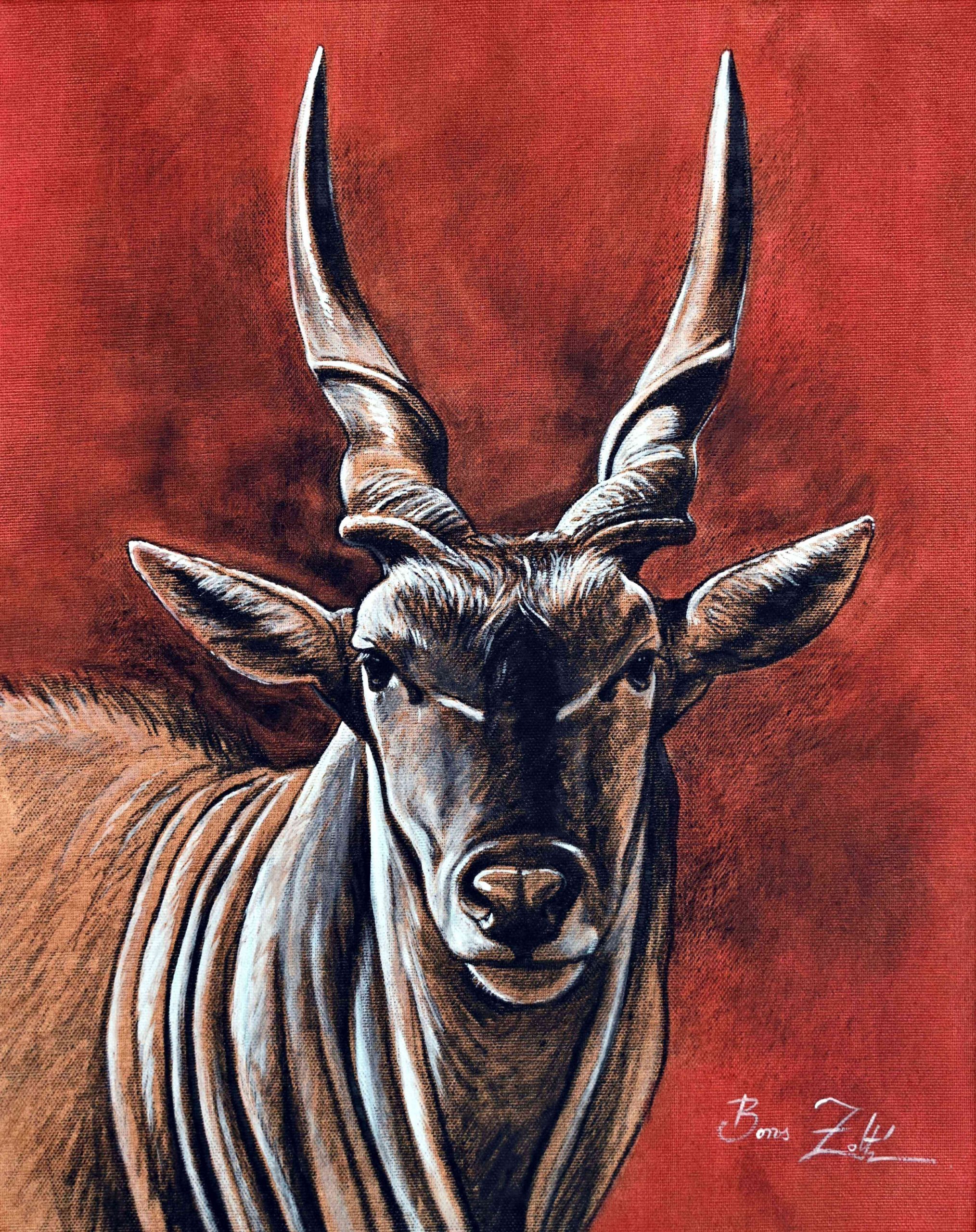
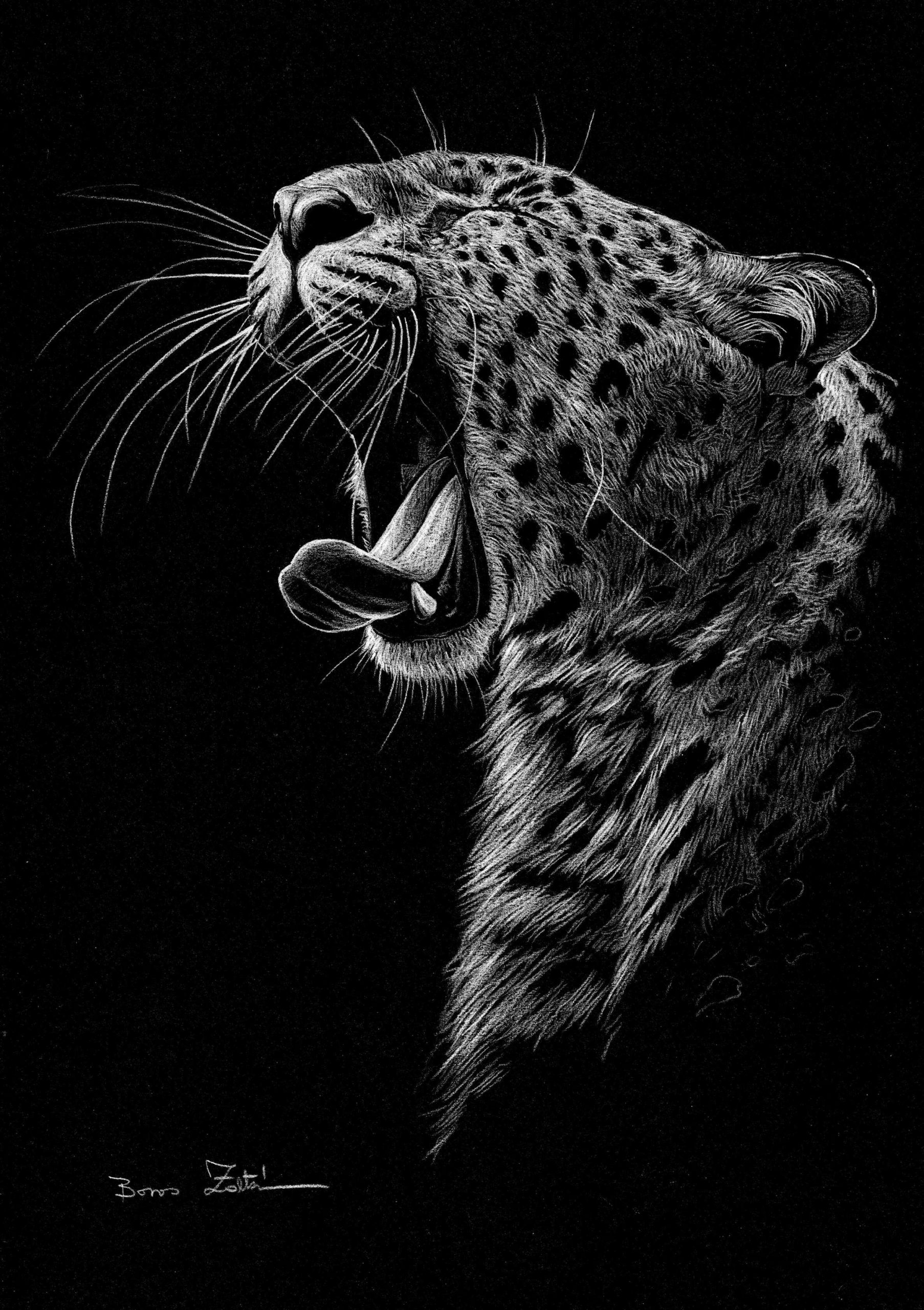
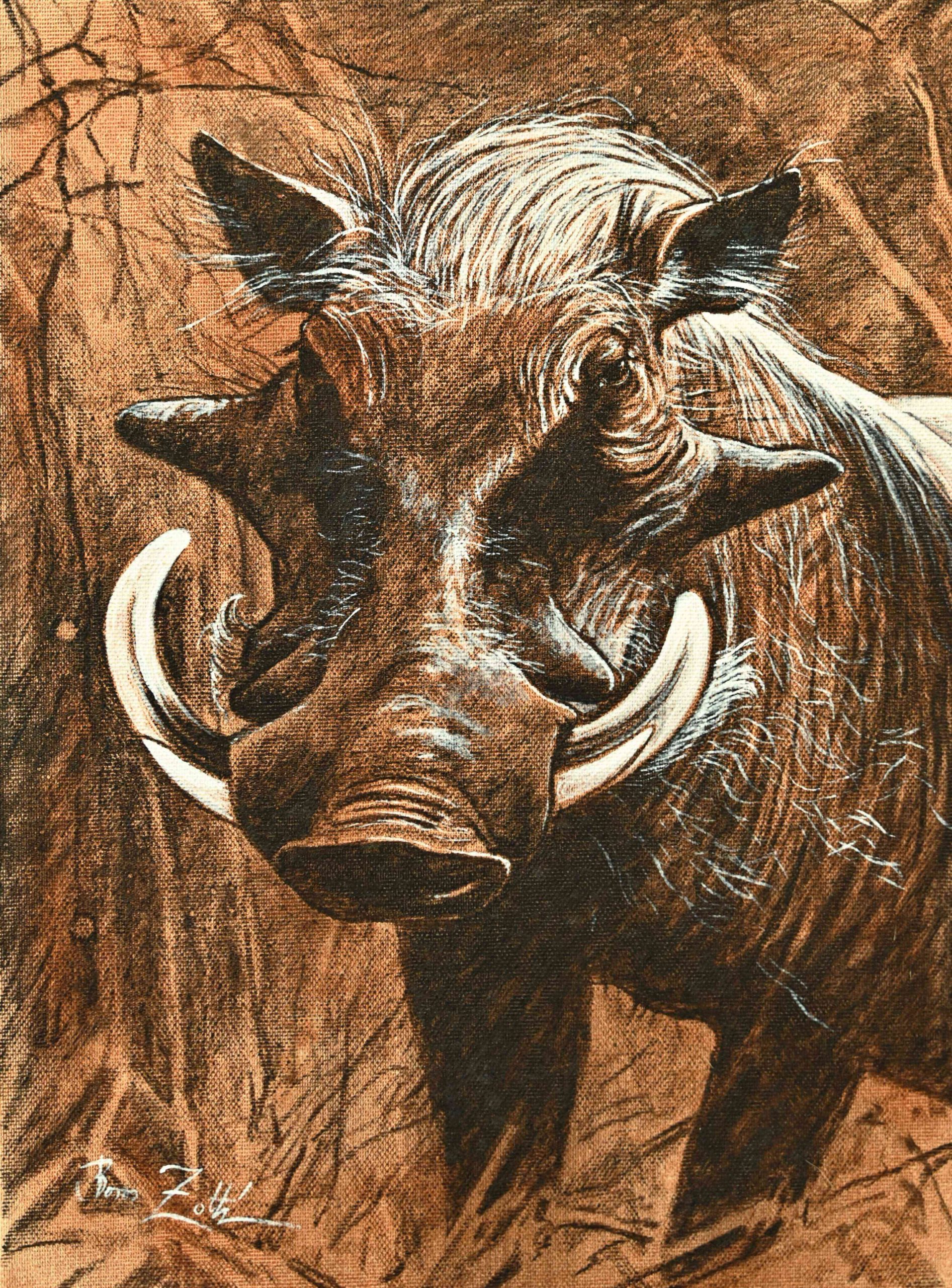
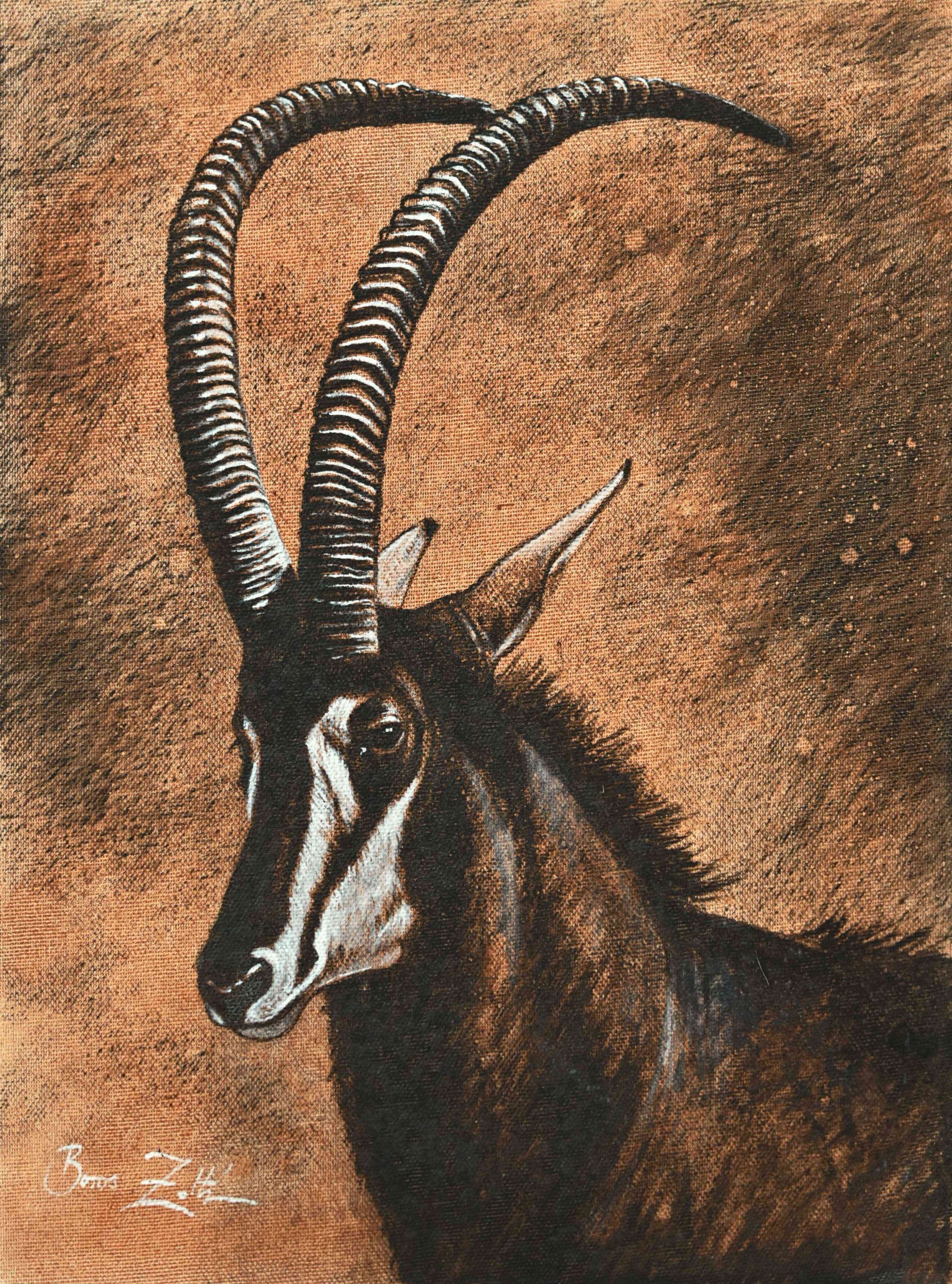
Wildlife Artist: Zoltan Boros

Zoltan Boros was born in Szabadka, Hungary in 1976. Nature and animals fascinated him since his early childhood. Zoltan began drawing at a young age, developing his talent by drawing the local wildlife. Later, he began to paint with oils and watercolors and continued to draw using graphite pencils and chalk. After grammar school, Zoltan attended the Agricultural University of Gödöllő. There, he received a degree as a Certificated Agricultural Engineer of Environmental Management with a major in Wildlife Management.


Zoltan spends as much time as possible in the outdoors, observing nature and the behavior of animals in their natural environments. Through his art, Zoltan is able to capture the uniqueness of his subjects, and the situations of their existence. 

His time in nature stirs his imagination, and his creations reflect a close relationship with his subjects and their habitats. “The movements of animals, the breath of ancient nature, original state, those are the things that I want to introduce with my artwork,” he says.


Zoltan has received international recognition for his wildlife art, with pieces appearing in exhibitions around the globe. These include the Weatherby Auction in Reno, Nevada, Holt’s Auction in London, and exhibitions in Spain, Germany, Austria, Canada, the Netherlands, and his native Hungary. In 2020 he got one of the most prestigious awards (Mr. Peter Balogh Grand Prize for Art) for his wildlife art in Hungary.


Find him on www.borosart.hu, or connect on Facebook and Instagram.


Enjoy a selection of Zolton’s African animal portraits.

For more artwork, click here.

What Makes a Trophy Buffalo

By Ken Moody


The subject of what constitutes a trophy Cape Buffalo is one that causes me great irritation. There is a contingent of hunters who firmly believe that for a buffalo to be considered a ‘trophy,’ it must be at least 15 years old, a day away from death, and sport a scrumcap on top of its head. These are the keyboard warriors who chastise, belittle, and criticize every photo posted that doesn’t depict a buff up to their nonsensical standards. These are also the very same hypocrites that will shoot a mature whitetail buck or elk in the rut, even though the animal is still of breeding age. These guys really don’t know what they’re talking about, but somewhere along the line, have listened to some disgruntled professional hunter who likely only hunts a handful of buffalo each season, bemoan and cry about all the breeding age buffalo bulls being killed. Trust me, these guys aren’t buffalo gurus, they simply like to appear to be.


The bottom line is this…the MAJORITY of Cape Buffalo killed on safaris will be mature bulls of eight-plus years in age, possess reasonably hard bosses, and likely still be capable of breeding. This is a fact and anyone stating otherwise doesn’t know buffalo hunting. Here’s another fact. There is absolutely nothing wrong with shooting a mature bull regardless of its age.


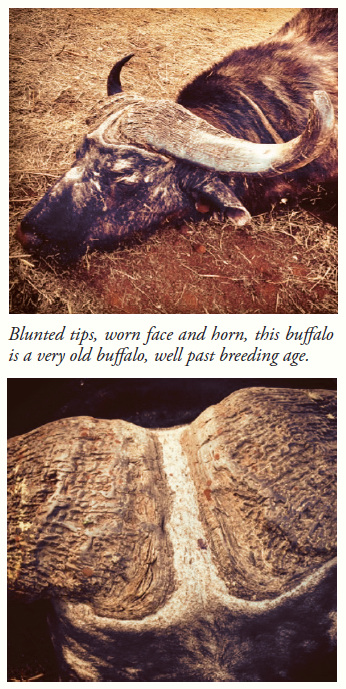
‘Hard bossed’ is another misnomer that is not fully understood by the uninitiated. Some mistakenly believe that a hard boss is one that is solid completely across the top of the buffalo’s head, with no gap or hairline present. While this horn configuration represents the ultimate in Cape Buffalo, horn density and growth are primarily a result of genetics, not age.


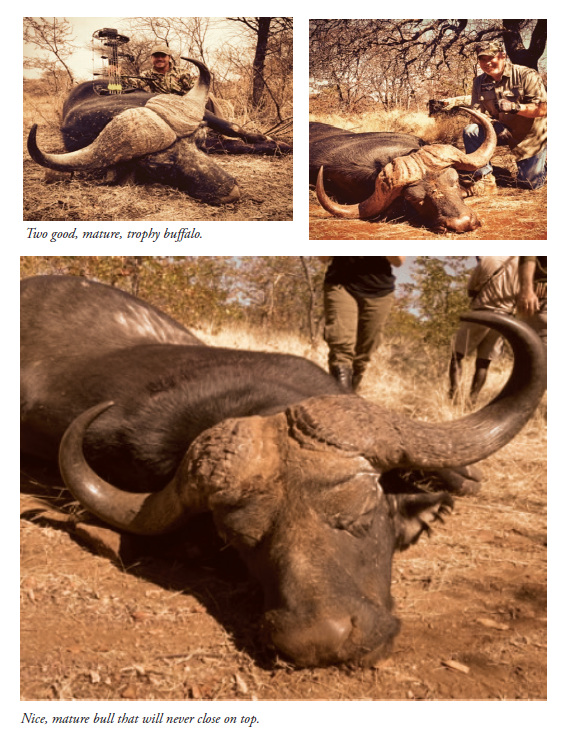
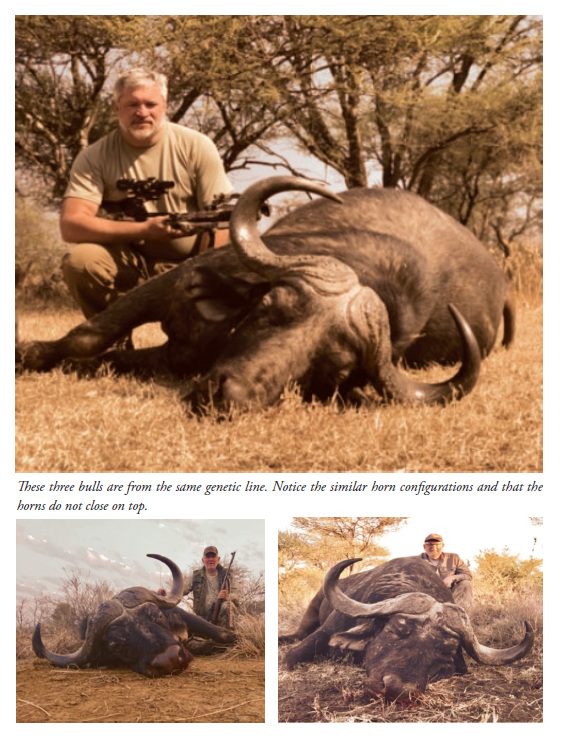
Many buffalo bulls and their offspring will never fully close on top of the horn and always have a gap between them, sometimes with a thin line of hair showing. These are not immature bulls, per se, but bulls genetically predisposed to grow horns the same way, generation after generation. Other considerations when discussing trophy buffalo are client preferences and likes. Some clients prefer to hunt the oldest buffalo that can be found regardless of horn size, while others insist on hunting for a bull with great drops and width. These are generally 10- to 12-year-old bulls that are fully mature and in their prime, but not yet past the point at which horn deterioration occurs. The professional guiding these clients is not there to satisfy his own ego, but to hunt for buffalo consistent with the wants of the client, though advising the client on area production, genetics, and what to expect is advisable. In my many years of operating a safari company, I’ve found that most clients just want a great hunt with a good buffalo bagged at the end of it. For me, that means a mature buffalo bull regardless of age

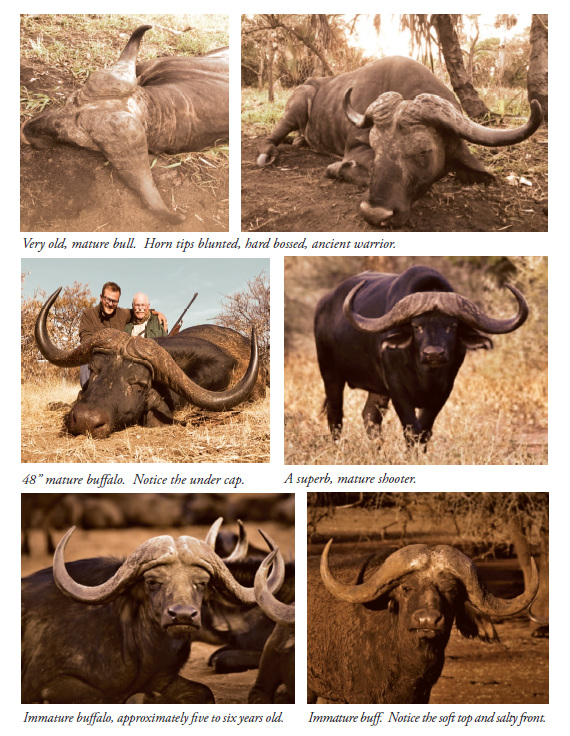
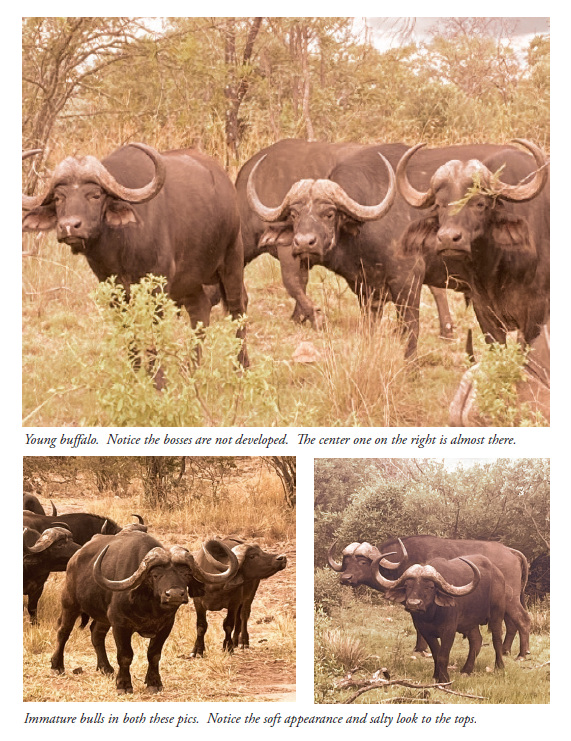
 It generally takes eight to nine years for a buffalo bull to grow a hard boss. A hard boss can be defined as horns that are solid in the front and on top, with or without a gap between them. There may be a softer under cap which is visible, but there should not be the soft, salty looking, two fingers or greater growth on the front or top of the horns. Bulls displaying these traits are immature buffalo and should not be shot, in my opinion. Other traits of older, mature bulls are an obvious dewlap hanging down under the chin and neck, a large, box-like head, and the classic Roman nose. The following photos depict both mature and immature buffalo bulls.


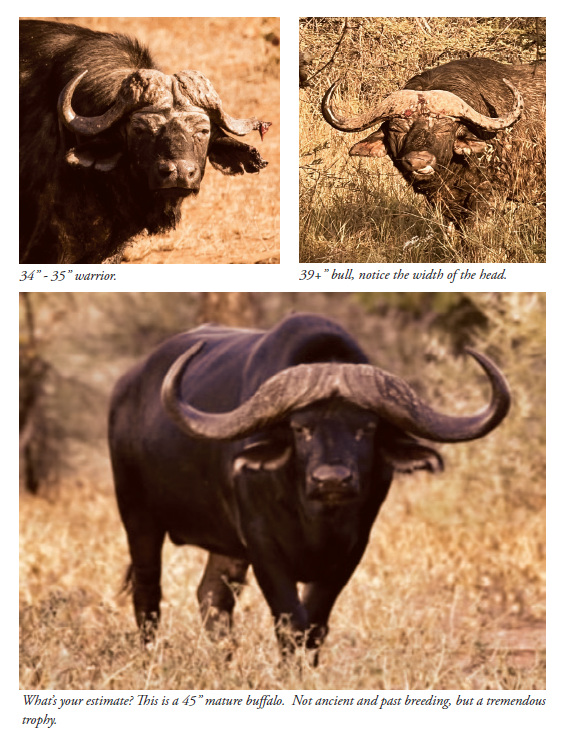
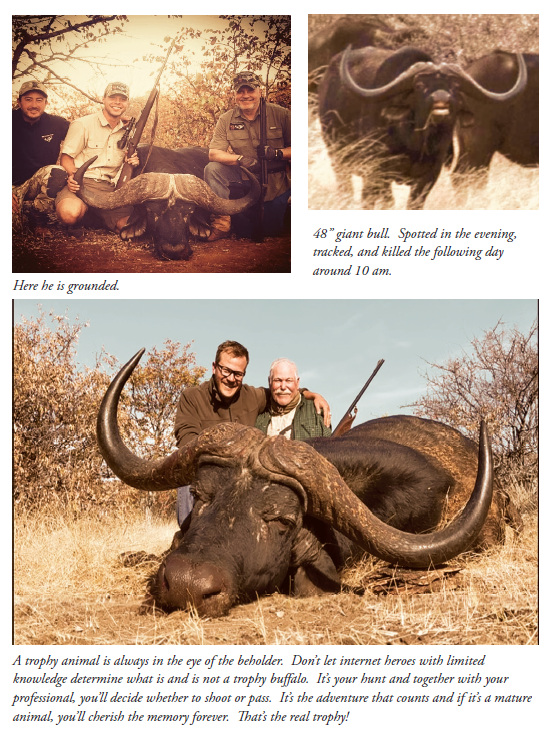
Trophy assessment is best left up to the professional, but all clients should confer with their hunting outfit and discuss the trophy quality present in the areas to be hunted. Each will have a prevalent horn type present in the buffalo due to the genetics within the herds hunted. With regards to horn width, 40” has always been considered the ‘holy grail’ amongst trophy buff alo hunters, but any mature bull sporting horns 36” or wider is a good buffalo. When assessing in the fi eld, a good rule of thumb is to use the width of the buffalo’s ears as a guide. Generally, the ears will extend around 35” in width from the head, total distance between both ear tips. Other factors such as head size come into play, but the above is an easy way to make a general assessment. If the horns are a hand width wider than the ears, you’re likely looking at a 40” buffalo, but a smaller head buffalo may be 39”, so rely on your professional for the ultimate assessment.

Bulletproof – 30 Years Hunting Cape Buffalo is a beautiful, full color, exciting read from Ken Moody. It contains good information regarding hunting cape buffalo and many adventure stories throughout its chapters.


“Thirty years of hunting ‘Black Death’ has provided me with many lessons and encounters and while I didn’t want to do an encyclopedia on the subject, I have created 136 pages of informative content that makes for an easy weekend read,” says Ken.


Purchase price is $25, which includes shipping to anywhere in the US. You can pay via Venmo at Ken Moody Safaris or PayPal @kenmoody111.  Please provide your shipping details with the order. If you’d prefer to send a check, send $25 to:
Ken Moody Safaris
POB 1510
Jamestown, TN 38556

Into The Thorns

Chapter Fourteen


The Family

Part 1


In our years of running safaris in four different countries we have worked with many natives, and it is not my intention to bore everyone to death by giving the life story of each one of them. We have seen so many amazing, funny, good, and often bad, incidents over the years with our staff and other peoples’ staff, that I could fill another book recounting them. I cannot resist briefly mentioning just a few.


Peter Sebele

Early in 1981, Don Price instructed me to find a suitable site and erect a hunting camp on a huge ranch called Seafield Estates on which he had acquired the hunting rights. This ranch was situated almost midway between Nyamandhlovu and Tsholotsho, north west of Bulawayo. The ranch was almost oblong, shoebox in shape, the two long sides being on the east and the west. The lower third of this oblong consisted of acacia woodland carpeted with good thick grass, and towards the top of this segment the ground turned into low undulating mounds, not big enough to be called hills. These mounds butted up to an unusual feature – an east west line of basalt, an igneous extrusion, formed a sort of barrier between this lower third of the ranch and the northern two thirds. This basalt ridge was about twelve to twenty feet high and at the top it levelled into the ‘gusu’ or teak forest typical of northern Matabeleland. This gusu forest was almost completely flat. It had no features at all, no rivers, no hills – just acres and acres of tall, park-like teak, kiaat, msasa and mugondi trees. Underfoot was fine sand which made tracking easy and walking difficult. Because of the stark contrast in terrain and vegetation different kinds of game frequented these two sections of the ranch.


When Don Price commenced safari operations on Seafield Estates buffalo were still plentiful on private land, this was prior to the government’s policy of culling all buffalo that lived in beef areas, which commenced in 1985. These animals spent most of their time up in the gusu forest. Most of them would not drink every day; they would usually skip a day, drinking every second night. I suppose this was because of the poaching pressure and I’m sure that they felt more secure in the thickets of the gusu, and therefore avoided the open area near the river as much as possible. When they did drink, they would make their way southwards, down off of the basalt ridge and onto the open low pebble hills and then into the camel thorn and Mopane grassland. Here they used to graze, still moving slowly south, until they reached the Khami River. Once they had satisfied their two-day thirst, they grazed their way north again, arriving back in the forest in the early hours of the morning.


Once I had the camp built and had a chance to explore the area, it became clear that the only way that we would be able to come up on these buffalo would be to follow their spoor up into the forest. In the dry winter months the gusu forest can be very noisy walking. The sand is littered with curled Julbernardia globiflora pods, dead sticks and dry leaves. This was going to  test us, that was clear.


When I first arrived at Seafield I put the word out that I was looking forsomebody who could track. One of the young fellows who I had already taken on as a general worker, named Fanwell, announced that he himself was the man that I was seeking! Problem solved. Don arrived with the first clients, and early on their first morning they took the road separating the forest from the low river area, looking for buffalo tracks. Within the hour, Don and the hunters were following my brand new tracker north into the gusu. It seemed that a group of buffalo bulls had drunk during the night and were now heading back into the sanctuary of the thick stuff. It was a long sweaty walk. Mopane flies clouded everybody’s ears and eyes, and the sun swelled by the minute. By ten o’clock it was an unpleasant day. The gusu sand saps leg power and the Mopane flies suck away both your sweat and your sanity. After a while you do not care if you stand on the globiflora pods and they crackle underfoot, and soon after that you do not care about buffalo either.


Don called for a rest at a shady spot. Buffalo droppings lay nearby, and on closer inspection they appeared to be fresh. Spirits perked and after a short rest and a long cold drink of water, the hunters once again took up the spoor. They had not progressed more than fifteen minutes when Don stopped, frowning, cocking his head. His heart fell into his boots and his temper rose into his hat. You could hear it clearly now, the incongruous musical clank, clank-clonk, tang, tang of cowbells! Don knew immediately what had happened. For the last five hours they had been following cattle which had strayed out of the communal land to the west. He was furious. My new tracker, one day into the job, immediately joined the ranks of the unemployed and was soundly berated.


Three thirsty hours later, I greeted the despondent weary group back at my camp and was called in for a “meeting” with Don. It seemed he was unhappy and we would have to find a new tracker.


I went around to the skinning shed area and sat down with the recently unemployed Fanwell and some of the other staff. Safari was new to these guys, they could not understand how it all worked, but the one thing they did understand was that the Americans did not come all the way over here with their funny voices and big hats to follow cattle around the forest, that was for sure. Something had to be done.


First of all I assured Fanwell that as soon as the Boss left, I would reinstate him. Not as tracker, he should understand, but he would go back to fetching, carrying and brush cutting. He was pleased, and made an announcement, “I know a man, a friend, who is a good tracker – he is a hunter, I will go tonight to speak with him. If he is home, and if he is willing, I will be here with himas the sun rises.”


Of course I knew that if this fellow was a hunter, he was also a poacher, but I could not have cared less about that then. We needed a good tracker and we needed him quickly. True to his word, Fanwell arrived at the camp early the next morning with a man of about thirty-two years of age accompanying him. This fellow was introduced to me as “Sebele”. Africans usually have a first name and a surname, or family name, just as Europeans do, but when addressing one another they use only the surname. Sebele’s first name was Peter. He was a small man of about five feet seven, and slightly built. Most  poachers I had come across were lithe and strong looking, their musculaturetight and rounded by hours and hours of working and walking in the bush, but this man displayed none of that rugged strength which I had expected and he seemed mild-mannered too. Mr. Sebele had brought with him fourteen multi-coloured yapping, fighting cur-dogs. We were going hunting, were we not? He kicked some of the dogs absent-mindedly in the ribs and the noise quietened down.


Don came over with a sceptical frown and asked what was going on. We explained what had transpired, then he briefly questioned Peter, loaded up the clients, and departed. The fourteen yapping dogs created havoc when their boss climbed into the back of the Land Rover without them, and led by a tall white greyhound-looking thing called Tracey, they galloped off after the vehicle. The vehicle stopped, more rib-kicks were issued and the Land Rover roared off once more leaving the dogs in the dust.


Along the basalt ridge road Peter stopped the vehicle every time he noticed tracks crossing up into the forest. Buffalo. Yesterday. More driving. Stop. Eland bull, last night. Further they went. Stop. Sorry, cattle, this morning. Don was becoming worried. Tap-tap on the roof. Stop. Peter got down, walked a few paces on more tracks, picked up something, and dropped it. “Five buffalo bulls passed this way early this morning” he said. The hunt commenced. Two hours later, buffalo bulls, five of them, were caught unawares, when they were still grazing. Both clients connected with beautiful well-bossed gnarly old bulls, and this time, a happy group arrived back at the camp.


Peter collected his promised money, shouldered some of the buffalo guts and called his dogs which had returned earlier to camp. He was ready for the four-mile walk back to his home in the communal land across the Gwaai River when I stopped him.


In Sindebele I said to him “Sebele, thank you for the job you did today”.


He smiled shyly, and said “Eeehhh”. I continued – “I am looking for a tracker,

I would like you to come to work for me.”


He put the guts down in the grass and once again let go a halfhearted kick at the head of one of his brown curs which was sniffing the meat. It skittered off like a large rat, teeth bared. “I am not seeking a job” he said “I am busy at my home; I am preparing fields for planting”.


“Sebele”, I said, “Let’s not play games. You are a hunter, (I thought I had better leave out the word poacher) these fourteen dogs do not cut bush and they do not plough land. They also eat meat. You know that I have spoken with the people here; they have told me that you are well respected in the area as a hunter. I am offering you a good job as a hunter, a tracker, you will not do menial labour, this I promise you, this is a man’s work”.


We hummed and hawed a bit longer and Sebele made a decision. “I will come tomorrow. I will help you for the next hunt you mention, then we will talk again”.


“Leave the dogs,” I said, and he smiled again and said “Eeehhh”.


That was twenty-six years ago. As I write this, I can sit here now, and say that the relationship, the times, I have shared with this man over all those years takes up a very large segment of my life. It is difficult to articulate. My life is richer, and more complete because of knowing this man, and learning from him. He has been a part of our time here. I knew him when I was twenty-one – I was a different person then, to the one I am now, at forty-seven. So is he. My children knew him from birth, and we all in our different ways, appreciate, and treasure the part he has played in our lives.


A stupid, common misconception that the majority of white people have, – and I fell into this category too, many years ago, – is that any and all rural black Africans can track. What a preconceived ridiculous assumption that is! The art of tracking is like piano playing. Not every person can play a piano. Some can make a tune, many people can play “okay” but few are competent players. And so it is with tracking. Some people are born with the ability to become master trackers, but most are born without that gift. Rural children, especially amongst cattle-loving tribes like the Zulu in South Africa, the Ndebele in Zimbabwe and the Masai in East Africa, are tasked with the job of looking after cattle from a very early age. These kids get to know every nuance, every characteristic of every beast in the herd. When cattle stray, these children, out of necessity and fear of reprimand, have to find them and the best way to do that is by tracking. But once again, you can throw ten kids in the pool and they will probably all make it to the side, they are all swimmers. But maybe only one will grow into a really good swimmer.


The next step in the road to becoming a serious tracker is subsistence hunting in the communal lands. Most communal lands have smatterings of small game like grey duiker, rabbits and the occasional kudu, and these are hunted with dogs and spears and wire snares. The next step is poaching. Once a rural hunter has moved onto poaching in private farmland and National Park land he is a man who knows his way around the bush. He knows all the edible plants in his area, knows where the animals drink, is familiar with their habits, he can hear as well as an animal, and he is usually a hard man who can withstand long walks, adverse weather and great thirst. And he can track. This is how Peter was when I first met him. Don’s new business only brought three or four safaris to the Seafield area in 1981 – he was doing most of his hunting up at Marangora at the edge of the Zambezi valley, so once the camp was built I had much time on my hands. Before Peter came along it was quite a lonely time as the workers left at 5pm for their homes in the communal land and I remained at camp with my bull terrier, Cleo. I was without a vehicle and without electricity, and all I ate was mealie-meal (sadza), the staple diet of the Africans, along with whatever I shot with my .22 or caught in the Khami River. River water and sometimes tea was all I had to drink, but I was healthy. Skinny, but healthy. Weekends with no labour force were especially quiet and I traipsed for miles on that ranch, exploring every corner of it. Once Peter entered the picture I began to become a true hunter. I had grown up in the bush and knew more than most white people my age about birds and animals and the secrets of the wild, but the age-old cliche has to be repeated here – there is no better way of learning something than by doing it. By doing, and failing, and doing it again. And I had the master teacher.


I cannot foolishly incriminate myself here with detailed descriptions of the deeds Peter and I got up to, but I learned from him how to really hunt. We used to hunt barefoot in the gusu forest all day long, and we were silent. Creeping up to a sleeping bull eland was no big deal for Peter. For me, it was thrilling. A lone buffalo bull lived in those gusu forests and some of the “bush blacks” knew him as mhlope (white). Peter and I found him one day. He was not an albino, but a very light grey colour over the back and flanks, whilst the under-parts, where there was hair, was black. Many times I have looked back and wished that I had kept that unusual skin.


Peter knew nothing of safaris, trophies and foreigners, and he knew nothing about elephant and lions and hippos either. But being a natural, it was not long before he was an expert. He took to safari work like he had done it all already in a previous life.


As mentioned, Peter is a mild-mannered man. Not once in twenty-six years have I heard him raise his voice. And in twenty-six years, I have not once raised my voice to him. He can be a sulker though. When we have tracked buffalo for three days solid and lionesses or wind has spooked them, or the client has screwed up, and everyone’s legs are aching and the buffalo are still somewhere far ahead, he becomes sullen and withdrawn. I call a halt and we all rest up in the shade. After a while I ask him, “These buffalo, they are well spooked, do you think they will slow down soon?”


“Ungaaaz,” he answers (I do not know). The sulk has arrived.


“What’s the matter?’ I ask him, “I feel that we will catch them soon -what do you think? Why are you tired, are you sick?”


“I am old,” he answers, “My hip aches. I think after this hunt I will stay home.”


I do not bother to answer; I have heard that retirement speech before. We find the buffalo, shoot a good bull, and the next day Peter’s hips are fine again.


When I first met Peter he was married to a pretty woman about five years younger than himself. Her name was Julia and I believe she had some bushman blood in her. She was a shade of brown in colour, not black, and her eyes were slanted and her teeth small. They had some kind of problem though, because as hard as they tried, they had no children. For rural blacks, this was unusual in the extreme. They were the “odd couple”. When Peter and I discussed this subject be shrugged and informed me that someone (he thought he knew) had thrown a spell on him. Julia had delivered two stillborn babies, each two or three months before time. I informed him that this was a condition which could probably be rectified with proper medical attention in Bulawayo, but he was sceptical.


Maybe the spell man died, or maybe Peter found the right witch doctor, because in 1982, the same year that my daughter Tanith was born, Peter and Julia also had a girl who they named Sikangeli – which means we are watching – obviously aimed at the spell throwers. He was much impressed when I told him that Tanith was Phoenician for “goddess of the moon”. Now that the gates were open, Julia was kept pregnant for many years and gave birth to a total of six children – all alive.


I could fill a whole book on the various adventures – some good, and some bad – experienced by Peter and myself in our years of hunting together, and so trying to paint an accurate picture of him in a single chapter is impossible. Peter’s tracking ability, already extraordinary, grew with every hunt we did. I was learning from him and he was learning from experience alone. From what I can gather from the numerous books I have read about the San, or Bushmen, it would seem that some of their hunters are magicians on spoor. They have a special gift, a higher, more sensitive, finely developed level of the rhythms and pulse of nature and they are able to sense and anticipate, even know what a certain animal, in a certain situation, is going to do. This is how it was with Peter.


Not only did he possess this extraordinary sixth sense, this intuition, about animals’ behaviour, but he had the right temperament for tracking. Just as some people will have a certain style, or method, of playing the piano, or hitting a golf ball, or even commencing a hunt, so it is with trackers. I have worked with trackers who were quite accomplished at following spoor, but some of them were too hasty, and could be a good half mile on an elephant track before they realised that it was a different animal to the one that we had been following for five hours. Often these trackers were nervous of reprimand and scared of looking incompetent if they did not continue smoothly on the spoor, but I think this is a failure on the part of the professional hunter who the tracker is working with. The tracker should know that he can relax and do his job to the best of his ability and he does not need to be under pressure all the time. Peter had patience to spare. We have worked together for so long that words are not necessary in the bush. If he feels that he may have picked up the wrong track he stops, looks at the spoor and shakes his head. He then catches my eye and shakes his head again and we all return to the last confirmed track. This time we will all wait at this spot while Peter goes ahead carefully, so that heavy uncaring feet do not obliterate any more sign. Finding the track may take a few minutes, it may take an hour. If Peter does not find the spoor, (a very rare occasion) it cannot be found.


Peter’s abilities have saved many safaris that could have ended on an unhappy note, and in saving those safaris he has saved my clients a lot of money too. His expertise has not only recovered wounded game against all odds, but it also opened up for us the rare opportunity of being able to hunt lions by tracking them on foot. Long after the blood has dried Peter has continued to carefully unravel and follow the tracks of a wounded animal, because by now he knows the animal. He can recognise tiny characteristics in the mark in the dirt that are different from other marks in the dirt left by animals of the same species.


Twice, both times in Matetsi, Peter has tracked a wounded sable bull for three days. The first one was shot in the neck and rump by a hunter named Dave Young from Canada. He hit the sable with a .270, at about five o’clock in the evening. The blood dried up and the next day Peter continued where he had left off. At nightfall that day, even I was not so sure that Peter was still on the right track. The next day at about 11am Peter led us to the edge of a big vlei. In the centre of it, beneath two Leadwood trees, stood Dave’s sable with a handful of grass in its mouth. I recognised the horn formation instantly and told Dave to shoot. This time he shot the animal in the heart. The government game scout worked himself up into a fever when he saw the animal go down saying that Dave had shot two different sable! I must admit that my anxiety was just under the surface as we marched apprehensively towards that beautiful animal.


I should not have worried. We recovered Dave’s bullet from the sable’s backside and pointed out the wound in its neck to the game scout, who, along with the rest of us, was visibly relieved. Dave, being a professional hunter himself up in the Yukon, in Canada, appreciated Peter’s effort and ability, and tipped him handsomely.


The second sable was wounded by a young Spanish girl and Peter and I followed the animal, also for three days. But I do not want to write about that hunt. I screwed up and the sable ran away. Peter again did an outstanding job, but I failed in mine.


A good friend of mine from Nebraska, named Dave Faust, was hunting with us in the Deka Safari area on the border with Hwange National Park. Early one morning we cut the tracks of a big herd of buffalo which had been spooked. On top of the buffalo tracks we saw the spoor of four lioness and one big male. We set off immediately on the lion tracks and we found them about two hours later, resting in the shade. Dave wounded the big male with an unlucky shot that we found out later (much later) had just grazed the right flank of the animal. The blood dried up within five hundred yards. Anyone who has hunted in the Deka will tell you what an inhospitable place it is. Much of the area is covered with poor soils and stark, dry, rocky terrain, and the mopane flies, or ‘sweat bees’ are more numerous than the stones. Peter tracked the lion, (who had left the females) from about 7am to about 10am all the way to the Hwange National Park boundary without the assistance of blood sign. We radioed for permission to enter the Park and then continued into that heat-blasted landscape. The Mopani groves resembled a nuclear testing ground – the result of far too many elephant.


The spoor told us that we had spooked the lion four times, but we did not see, or hear him. Following a single lion track, without blood, on hard mopane soil in the white heat of an October noon is a task that very few men can take on. Tracks fizzled out and energy and enthusiasm fizzled out too. We rested in scant shade fighting the mopane flies for an hour and then I had a quiet talk with Dave about incentives for the staff. Nothing can revive enthusiasm as quickly as the promise of American dollars and we were all soon back out there looking for tracks. One of the problems was that we were making too much noise. The other was that the lion did not appear to be hindered in any way by Dave’s shot. Our group consisted of Dave, myself, Darren Maughan who was videoing the hunt – Peter, George, the government game scout and one other fellow who was helping carry water. It was now about 3pm. The lion was holding to a dry watercourse which was about the only place that had any cover. Acacia thorns, mopane, and the occasional Leadwood tree lined the stream edges and low cover was quite thick in places, made up of Kneehigh grass and straggly thorn bushes. It did not look like we were going to close with the lion. Peter was doing a magnificent job but we were not getting any closer. I had to make a decision soon about turning back.


I decided to take my shoes off and walk about three hundred yards ahead of the group who would remain on the spoor, and hopefully, in this way, I would be able to sneak up close enough to the lion so that if and when he spooked, I would have a chance for a shot. At about four o’clock I could sense the horrible oppressive dry October heat weaken slightly. My feet were beginning to burn from the thorns, sticks and broken ground when I saw a huge sausage tree (Kigilia africana) about two hundred yards ahead. I decided to wait at that tree for the rest of the team and then we would have to have a talk about calling off the hunt.


When I reached the sausage tree I noticed that in the deep shade it had thrown onto the ground lay a carpet of trodden-down elephant droppings that resembled a sort of coir mat, and smelled like a stable. It was a soothing relief for my feet. I stood there enjoying the shade with my .460 held by the barrel resting over my shoulder. The ‘ready’ mode had changed gradually into the ‘resigned’ mode about five miles back. I stood there looking ahead. Nothing. I turned to look back the way we had come but could not see the rest of the group. I decided to walk back, find them, and start the long trek back to the jeep.


I had only walked about ten yards when I saw the lion. He was lying down, crouched, underneath a fallen, but still-living Leadwood tree. He was watching me. As our eyes met he must have seen the recognition in my face because he came out of the crouch into full charge in one fluid movement. He was only about twenty-five yards away and as he leaped into action be emitted a loud deep grunt that I felt inside my chest and he came for me undulating and low, at sickening speed. I don’t remember exactly those parts of a second but I knew that I had no time to get my rifle into the shoulder. I must have pulled it down off my shoulder into my left hand and thumbed the safety off and fired with the butt at about chest height. Cats have quite a flat head, and if you want to shoot them in the brain you have to be slightly above them, or you have to shoot them in the nose or mouth in order to reach it if you are lower, or on the same level as they are.


My shot stopped the enraged animal in its tracks but as it went down onto it’s side I could see that it was still panting. It now lay only about five yards from me and I frantically reloaded and finished him off. My shot had skimmed the top of the flat head and then angled down behind the skull into the top of the neck and close to the spine. I was very very lucky.


Peter’s skills delivered this lion trophy. It was an amazing job very much appreciated by Dave.


Over the years Peter and I have tracked lions together many times and it is an exciting, specialised, very satisfying form of cat hunting.


John Barth of Adventures Unlimited sent us a hunter named Don Horne.


Don was an easy-going, likeable gentleman who had failed to connect with a leopard on several previous safaris with other operators. I was determined he would not fail on this hunt. We were about halfway through the hunt when AJ sent a messenger to our camp to report a calf kill. Excellent news.


Unfortunately, when we arrived at the scene of the crime, very little remained of the calf. It had been fed on for at least two nights and only the backbone, ribs and some skin remained.


It was quite late in the day when I decided to give it a try. The position was horrible. The calf had been dragged up to the top of about a hundred-footkoppie and there was no good position for a blind. I had the staff scurrying about bringing our equipment from the vehicle when I noticed that Peter was not around. Irritated, I told George to find him.


Just then I recognised his low whistle. I made my way down the hill across to a cattle fence where he stood waiting.


“What is it?” I asked him.


“This leopard has taken some of the meat. The meat is small, he does not drag it. He carries the meat, then lays it down, then he carries it some more,” he answered.


“Where is the meat now?” I became concerned. If we were going to sit, we had to get the set-up finished soon.


“I don’t know,” he replied. “I left the tracks. They are going down towards the river”.


I was tempted to set up on what remained of the carcass, but what if he still had food? If he did, he would probably not come back to the koppie. I told the staff to stop moving the equipment and told Peter to take me to where he left the spoor.


When we reached that point, I saw dried blood, one single smear about the size of a postage stamp. I knew better than to query Peter’s findings and asked him to proceed. It was amazing. I consider myself a good tracker, but I could only see the marks of the meat touching the ground every now and then when he pointed them out to me.


About half a mile further, we found the head of the calf with about eight inches of neck still attached to it. This small morsel, about ten pounds of it, was stuffed under a thick bush.


We moved all the equipment down to the river, set up for the night, and I told George and the boys to drive away to a sleeping position and take the remnants of the carcass with him. At seven thirty or so, Don made a good shot on a beautiful male leopard. I do not believe I would have taken that cattle killer if it was not for Peter’s skills.


In 1893, after years of trying to stem the flow of settlers, adventurers, hunters, missionaries, and conniving “empire builders,” Lobengula, last King of the Amandebele, sacked his capital Bulawayo and fled northwards. He had seen the writing on the wall and his scouts were monitoring several columns of white fighters that were advancing on Bulawayo. He was a sick man, and he knew that his warriors were no match for the white man and his Maxim machine guns. Many of his young warriors wanted to attack the armed columns and Lobengula told them, “Fight the white men if you wish. But do not follow me if you are beaten.”


Lobengula fled north under the protection of several of his Impis and the colonial troops under Major Forbes pursued him to the Shangani River. A reconnoitring party of 34 men, under Major Allan Wilson, crossed the wide sandy bed of the Shangani carefully following the Amandebele tracks. It was December. The rains had started and the Shangani was flowing – mostly beneath the sandy surface – so the crossing of the river was uneventful. In the green mopane forests on the other side, however, the Amandebele were waiting. One more battle.


Wilson’s patrol found the warriors. They walked into a trap and commenced fighting for their lives. At this moment the Shangani River came down in full flood. Two scouts and two others were dispatched to try to break out, brief Forbes and bring help, especially the Maxim machine guns. By some miracle these fellows made it, but Forbes could not cross the now raging Shangani and the final chapter of the Matabele war was played out. It is said by old Amandebele recounting of these times, that the Allan Wilson patrol “were men of men”. They fought bravely to the last man and it is also said that the Amandebele warriors, who usually gutted and dismembered the vanquished after battle, laid no knife or spear against these men after they had fallen.  The Amandebele made songs to help them remember and to commemorate important or significant events in their past. There is a song which some of them still sing today and when I hear it the goose bumps raise the hair of my neck. It is a haunting song, more than 100 years past which brings back the brave bloody battle fought in the mopane forests of the Shangani. Like the Zulus, the Amandebele went into battle in “Impis”. An Impi was a separate fighting unit under the command of an Induna, and each Impi carried cowhide shields whose markings were particular to that Impi. These formations were usually named after wild animals. Ingwe – leopard, Inyati – buffalo, Ndhlovu – elephant, and so on.


Imagine Allan Wilson’s men. They are huddled down behind their dead horses facing out in a circle. Some of the men are dead. The remainder are staring out into the cathedral-like trunks of tall mopane trees where they can see the black horde and flashing colour of the shields and animal-skin kilts. They are waiting for their death. Late evening draws down and the muffled movements of hundreds of warriors preparing for battle is terrifying. Night falls. Then an eerie silence. Suddenly a lone voice sings out into the forest.


One word. Ingwe! It starts high on the “Ing”, and comes lower on the “we”. The warriors are encircling Wilson’s men and they are trying to carefully find each other in the dark.


INGWE!

A different voice now answers – INGWE ‘BANILE?

The original one sings back – INGWE MSILA, HELA MA BALA, INGWE

MSILA!

The second voice now – MANA LAPHA, SE NKHLUME LOWE, INGWE

MSILA


The words are basic, and few, but the beautiful haunting harmonising of this song when sung by black people whose family blood flowed back in that time, is an experience that cannot be forgotten.


Translated, the song reads as follows –

“Leopard!

Who is the leopard?

Leopard, with tail, he has spots, leopard, his tail

Wait there! We wish to speak with you!

Leopard, tail.”


As stated, Wilson’s patrol was wiped out. Since most of them were from the Fort Victoria area, their bodies were returned there, and buried. Later Cecil John Rhodes, after obtaining permission from relatives of the dead, had the bodies exhumed and reburied at World’s View in the Matobo hills – where he himself finally came to rest.


Following the battle, Lobengula continued north towards the Zambezi Valley escarpment where he died and was buried in a secret place. Why have I told this story of the Shangani Patrol?


 Peter knew this song and sang it many years ago at the fire one night after we had taken a big old leopard. He has a clear tenor voice and like most blacks he sings exactly in tune. Within minutes the rest of the staff picked it up and came in and out in perfect harmony. It was so beautiful and poignant that it has become tradition for the Ingwe song to be sung around the fire following a successful leopard hunt.


If the leopard is taken early in the evening, then he is invited to the leopard party and crouches in the place of honour just at the edge of the firelight watching proceedings. All the African staff assemble at the fire and crates of beer and soft drinks are laid on for those who want them. Many traditional songs are sung by the staff – some are funny, some, like the Ingwe song, are moving, and others are just nonsense. The hunter, already buoyed by his success, really appreciates and enjoys the show which, at various stages, honours him, the leopard, our company, my staff, me, and anybody else who wants to be honoured.


When the leopard is taken late at night, or if he is only found the next  morning, he cannot attend the next evening’s leopard party as his skin may spoil – but he is honoured in his absence none-the-less.


So many things spring to mind when I talk about this talented man. His love for fishing, his part-time amethyst and agate mining in the pebble hills near the Khami River, his love of cooked cattle feet, the list is endless. One thing I have to mention – and I checked with him first if he would allow it, and that was a lesson in trade and commerce.


Many years ago I gave Peter an old Parker Hale .303 rifle and a 12-gauge shotgun which kicked like hell and sometimes discharged both of its barrels at the same time. Ostensibly, these firearms were requested by Peter in order to shoot bushpigs or kudu that raided his fields.


During safaris, Peter would always cadge a handful of 12-gauge rounds from the client, so these were free of charge. When he arrived home he would set out into the bush looking for one of the by now gun-shy flocks of guinea fowl that foolishly lived near his village.


Peter treasured his scant shells. He is a skilled hunter, and he would painstakingly manoeuvre himself into a position where he could fire at the guinea fowl at close range when their heads were closely bunched together. Usually this kind of shot would yield five or six birds. Sometimes it would yield eight or nine.


Occasionally, when walking back through the bush with his booty slung over one shoulder, Peter bumped into one of his neighbours’ young daughters who was out collecting firewood. Usually the maiden was interested in the guinea fowl, and Peter sometimes was interested in the maiden. Some discussion followed and then, sometime later, Peter would set off home once more, one guinea fowl less. When he arrived home, he would have one bird for supper, he would keep three, sell the rest, and his neighbour’s daughter got to keep one, all from one free shotgun shell!


Serious trading.


We have always encouraged our staff to bring their wives and children to town when they get sick so we can take them to our family doctor. But in Africa, even today, well-educated qualified people continue to consult “traditional healers”. Regularly we read in the newspaper about bizarre “treatments” that have gone wrong, and some of these treatments are just too unbelievable to try to recount here. Bestiality and dismemberment of human  bodies have both featured. I remember one particular headline that grabbedour attention one morning, “Policeman found in compromising position with goat!”, it turned out that this fellow’s Witchdoctor had prescribed sex with a goat in order to rectify some problematic situation at home.


Often, however, when tribal medicines fail, my staff drag their sick to town. Their maladies have varied from gonorrhoea to scabies to shingles to chicken pox and everything in between, malaria being the most common. In June 2003 Peter told me that his wife had been ill for some time and he had taken her several times to the government clinic at Nyamandhlovu, but she continued to be ill. When he finally did bring her on the bus to town we saw that she was sick. She was listless and her body was wasted. Always a small woman, Julia now looked like a sick ten-year-old, she had shrunk so much. We knew immediately what was wrong with her.


When AIDS first started becoming prevalent in the country in the early 90s, hardly anybody, especially rural people, believed that there was such a thing. By the end of the 90s they knew better! Cemeteries overflowed, government hospitals could not cope. The World Health Organisation said that one in five people in Zimbabwe carried the HIV virus. Three and a half thousand people a week were dying from AIDS complications and there were no anti-retroviral treatments available at all.


Mugabe’s activities in 2000 plunged the country into chaos and the economy spun down into depths where it had never been before. When poor people become destitute, their already weakened resistance crumbles even further, and the HIV virus accelerates itself into full-blown AIDS, and that’s exactly what happened. Every one of our staff came home from their rural communities wide eyed and shocked at the deaths. Our telephone began to ring regularly with calls from the communal lands. “Please can you tell so and so that his wife/ brother/ child has died”.


My wife loaded Peter and his wife into the car and took them to our doctor for blood tests. We did not really need to go back there to know what the news would be. They were both positive.


Peter had been fading slowly too, but when this kind of thing happens right in front of your eyes, when you see and work with someone every day  who is losing weight, you do not really notice it. Peter was now in his 50s, and that is fairly old for a rural African, about the equivalent of 60 years old for someone who has lived their life comfortably, and well fed, in town. So I was surprised in a way that Peter tested positive, he was elderly – not the spry, well fed poacher we had met so many years before, and I expected him to be a bit thinner, a bit older looking, but on sitting back and thinking about it, there should have been no surprise at all.


We were devastated. We had already lost George in August 2002, and the thought of losing Peter too brought a lump to my throat. We had been through so much, we had come such a long way, surely this was not the end of our journey?


Immediately we took them both to AIDS counselling and we helped them stock up on good healthy food to take back to their communal home. I telephoned a client – Skip Huston, a doctor and friend in the USA – for advice and this man basically saved, or if not saved, prolonged Peter’s life. He sent over anti-retroviral drugs with our very next hunter, and we started Peter and his wife on treatment. It was too late for Julia and she passed away in February 2004. Peter looked so forlorn without his wife, he still had two small children and two teenagers to care for.


Fortunately for Peter he was quite well off, and between what we were able to do for him, and the income from his store, the children were provided for. He has now been on pills for three years. His days of tracking elephant bulls in the hot Zambezi Valley for days on end in the hot sun are over. But helping to outwit the Matobo cats, and the occasional foray after zebra and wildebeest between the koppies, is still part of his life.


He has been my friend, my teacher, and my companion for twenty-six years and when his family put him in the ground beneath his cattle kraal, a part of me, will be gone.


Part 2 will be available in May 2026.

Into the Thorns is now available at Good Books in the Woods

www.goodbooksinthewoods.com

jay@goodbooksinthewoods.com

This will close in 2 seconds

Privacy Overview

This website uses cookies so that we can provide you with the best user experience possible. Cookie information is stored in your browser and performs functions such as recognising you when you return to our website and helping our team to understand which sections of the website you find most interesting and useful.