In the Eye of the Beholder

By Ken Bailey


Kudu were not on my “want” list. But they invariably become part of conversation whenever you’re in kudu country, for these regal spiral-horned antelope have a way of capturing the imagination like few others. And so it was, that Aru Game Lodge’s PH Stephan Joubert and I talked kudu as we sat high on a hill glassing the vast bushveld below, while searching the thorn bush for eland!


The truth is that I had no intention of shooting a kudu. Having taken a respectable bull on a hunt years earlier in South Africa, on this Namibian hunt I was focused on the kudu’s big brother, the eland. (Also high on my list were springbok, steenbok and caracal – the ubiquitous lynx-like cat found across much of Africa, although given how few caracals I’ve seen over several safaris, I am not convinced that they’re as widely distributed as the range maps suggest.)


The icons of hunting writing that popularized kudu wrote about their experiences in East Africa, largely in what is now Tanzania. Perhaps it was Hemingway’s Green Hills of Africa that jump-started the kudu mystique, or maybe it was Jack O’Connor’s assertion that the kudu was the Dark Continent’s top trophy, and his coining of the term “the grey ghost” that inspired all those who followed in his footsteps. At that time, kudu were decidedly uncommon, undoubtedly contributing to their reputation as a trophy in high demand. Today, however, kudu are thriving, particularly in South Africa, Namibia and Zimbabwe.


From our hilltop vista, Stephan and I carefully and methodically identified a great diversity and abundance of game. A mixed herd of zebra and blue wildebeest, two separate groups of gemsbok, clusters of red hartebeest, numerous springbok and a sprinkling of warthogs, ostriches, waterbuck and steenbok. But – no eland. So, we settled back more firmly against the rocks and began to sweep the landscape all over again.


Ten minutes later, in the typically understated manner of all African PHs, Stephan leaned over and said, casually, “There’s a pretty decent kudu bull down there. He only has a horn and a half, but the intact side looks pretty good. Maybe 55 inches. Are you interested?”


Decision time. I’d arrived with little interest in taking a kudu, but 55-inch bulls don’t grow on trees, especially in this part of Namibia where kudu, especially the bulls, had been hit hard by an epizootic outbreak of rabies, and the population was only then beginning to rebound. However, this was a one-horned kudu, irrespective of the length. Not generally a trophy animal.


“Let me give it some thought,” and we both settled back to continue glassing.


The whole notion of what constitutes a trophy has been undergoing a metamorphosis in recent years. In an effort to ensure that hunters are targeting only the oldest animals as a means to help ensure the health and sustainability of populations, there have been numerous biological and social initiatives aimed at educating hunters and the professional hunting community alike. In 2006, sponsored in part by Conservation Force and the Dallas Safari Club, a paper on ageing lions was released describing how various traits, including facial pigmentation, could be used to select older, post-breeding animals. A few years ago, and championed by noted veterinarian, author and PH Kevin Robertson, the importance of selecting past-their-prime Cape buffalo bulls was reinforced. Hunters were encouraged to choose the oldest and ugliest bulls. Today, what should count is age, not size.


I considered this as I continued to scan the Namibian veld, returning repeatedly to scrutinize the lone kudu bull browsing in the camel thorn. He was alone, not a herd bull, as one might expect of a breeding-aged animal. Given the length of his one intact horn, he had some years on his hooves. He definitely appeared old.


I pondered my own hunting ethics together with where the hunting community is headed in defining trophy quality.


“Let’s do it.” Without another word the two of us, along with our two trackers and Stephan’s constant companion, a friendly Rhodesian Ridgeback, made our way down the little mountain.


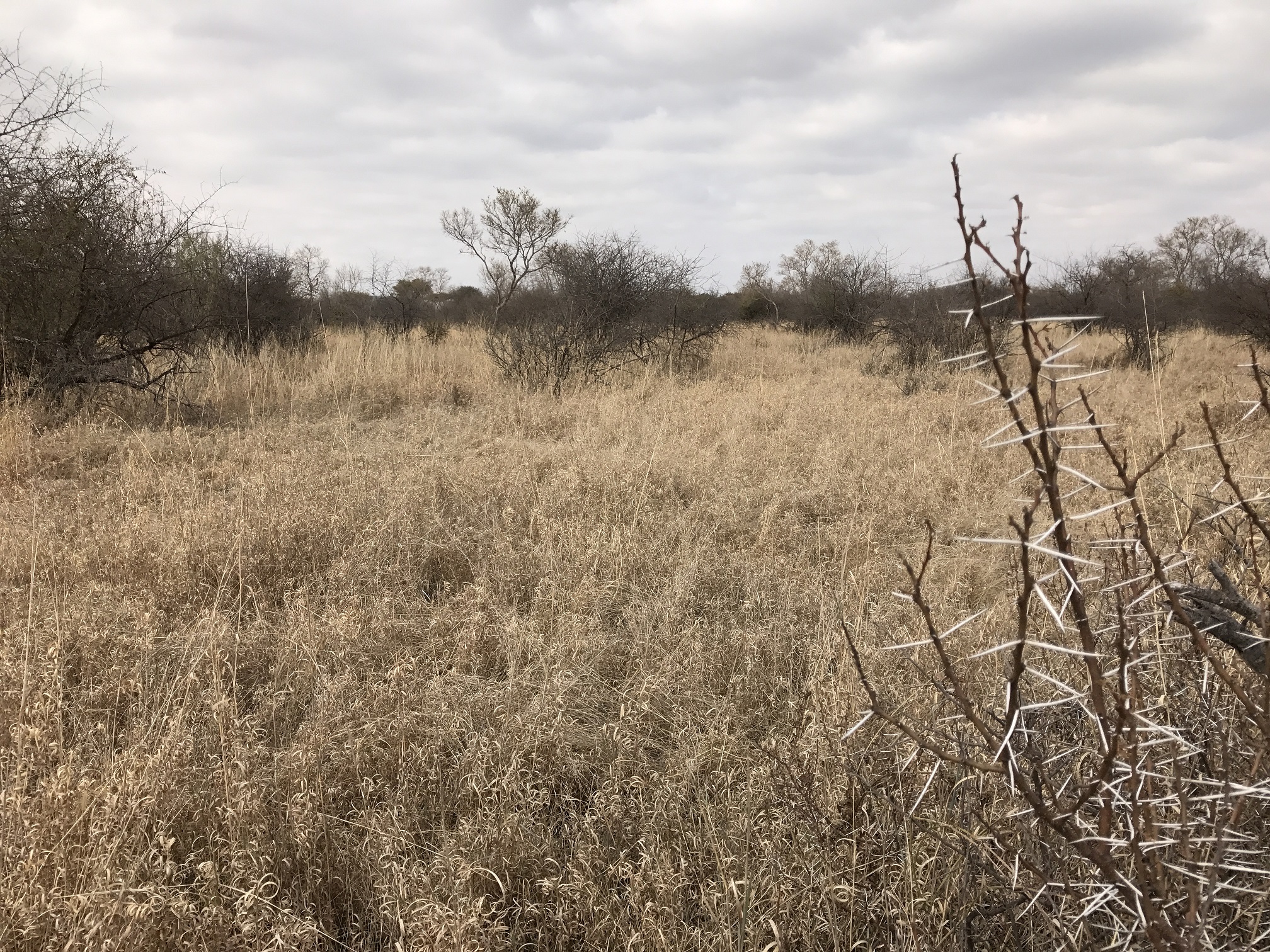
Height is a strategic advantage in pinpointing game. By the time we’d made it down and onto the flat veld, we found our perspective had disappeared with the altitude. We were now staring at a sea of thorn bush and although we’d identified a landmark or two, it was difficult to know exactly where the bull had wandered out of our sight.


Stephan sent one of the trackers up a fortuitously positioned windmill to see if he could spot the bull. Five minutes after scaling the rickety structure the tracker signaled that he’d spied our kudu. After scrambling down he excitedly relayed its location – only a few hundred yards distant among the scrub. A quick confab between the three of us to discuss tactics, and we were on the hunt.


From the direction we knew the bull to be heading, Stephan guessed that it was feeding towards a watering hole, so we set out on a trajectory that would intercept the bull along his path. Keeping the wind in our faces, we hunched over and began quickly duck-walking, always wary of the needle-sharp spines of the camel thorn and black thorn trees along the path. Eventually Stephan and the trackers got right down into a catcher’s-stance waddle. Too many years of basketball has left me with knees that have all the flexibility of rebar, so I was on my hands and knees, scurrying along behind as best as I could.


A hand raised is the universal sign that game has been spotted – at Stephan’s signal we all froze. Staring intently to where he pointed, I eventually made out the bull moving slowly through the dense cover, feeding as he went. He was headed toward a clearing, and I got into position to be ready for when he stepped out.


Breaking into the open, the bull did as he was hard-wired to do – stopping to check that the coast was clear. That hesitation was all I needed, and at the shot he was down in his tracks.


It’s always a bittersweet moment when you first approach a downed animal, and that feeling was only amplified when we realized what an ancient warrior this kudu truly was. In many places his hair was abnormally thin or worn away, and he had obvious cataracts in both eyes. His “good” horn was broken, battered and splintered, and stretched the tape to just shy of 54 inches. The wear on the stub side made it obvious he’d been handicapped for quite some time, likely from having performed double duty, given that the other horn was little more than an 18-inch remnant.


Stephan estimated the bull to be 13 years old, well past his prime and considerably older than the eight- and nine-year-old bulls that are typically taken. With his poor overall health and impairments, it was unlikely he’d have lived another season – more probably destined to become dinner for one of the local leopards.


Despite folks having asked several times why I’d willingly shoot a kudu with only one horn, when I look back on this hunt, it’s without a smidgen of hunter’s remorse. In fact, it is just the opposite. Among the many animals I’ve been fortunate to take over the years, this bull is among those I’m most proud of.


Rather than only evaluating physical attributes, age should be an important consideration when defining what constitutes a trophy. My one-horned kudu more than meets trophy standards by any measurement.

Biography

Ken Bailey is an outdoors writer from Canada. When not hunting big game or birds, or fly-fishing, he’s writing about his experiences. And when the bills need to be paid, he is a consultant in the wildlife conservation industry.

A Flowering Of Serpents

One of the first questions you hear, when you announce that you’re going to Africa, is a tremulous, “But aren’t you afraid of snakes?”


Answer: “Yep. Terrified! What of it?”


If I let my life-long dislike of reptiles deter me, I would not hunt in south Texas, I’d avoid Alabama, and Australia would be out of the question. For that matter, I wouldn’t live in Missouri, where we have copperheads, water moccasins, and the occasional rattler.


Every so often, I sit back and count on my fingers the number of times, during 14 or 15 trips to Africa, totalling more than three years of my life, that I have even seen a snake. I have yet to run out of fingers. Snakes there certainly are, but they just haven’t bothered me.


Now, stories about snakes? You done come to the right place, pal. Where do you want me to start? Oh, wait: First, a word of advice. If you are a herpetophobe, fearing snakes to an irrational degree, the first question you should ask a prospective professional hunter is how he feels about them. If his face lights up and he assures you that he loves snakes and plays with them every chance he gets, thank him politely, back away, and sign on with someone else. Trust me on that one. I speak from experience.


People who actually like snakes can’t fathom people who don’t, just as cat lovers can’t relate to the benighted few who find cats repellent. Fortunately, there aren’t that many snake lovers; unfortunately, most of them seem to be PHs.


One time in Botswana I was waist-deep in a hippo pool, which was home to (by actual count) 14 hippos and one large crocodile. We were hunting ducks and geese, and my guide would fire a shot over the reeds, and birds would flush. One duck came zipping by and I dropped it into the water a few yards behind me. When I went to retrieve it, I found a large python curled around it, contemplating duck recipes. With whoops of joy, my PH handed me his gun, grabbed the python by the tail, and hauled it ashore, yelling at me all the while to be sure to get the duck.


The python turned out to be a young one — only 12 feet long, but he looked bigger to me — and we “played” with it on the bank for an hour, then allowed it to slither back into the water, shaking its serpentine head in disbelief and making reptilian mutterings. I knew how it felt. We kept the duck, which I thought was a trifle unfair.


Another time, I was staying with a friend on the edge of the Okavango. He had a permanent tent camp, and I had a mattress on the floor of the cook tent. Cook tents generally contain mice, and mice attract snakes. The night we arrived, around dusk, Clint pulled into his usual parking spot. I opened the door and jumped out, looking down as I did at a cobra, right under my feet. You can, I found, change trajectory in mid-air, and my feet missed the cobra by at least a yard.


“Oh,” Clint said, “I forgot to tell you. I killed that snake this morning. Found it behind the cook tent. Sorry.”


It was dead, but still. I can’t say I slept all that well the first couple of nights, but then I settled in and all was fine. The memory receded.


My particular horror is the Mozambique spitting cobra, which rears up and lets fly a stream of venom, aimed at your eyes, and is reputed to be accurate from several yards out. Blindness does not appeal to me. A friend who has a game ranch outside Bulawayo had her buildings constructed around an inner courtyard, one of which contained the shower and another a privy. As is normal in Africa (don’t ask me why) the privy was at the far end of a narrow room, with a tiny window in the wall above. She went out in the dead of night to do what people do in the dead of night. The generator was not running, but there was a full moon, so she didn’t bother with a flashlight.


As she settled in, she felt a stream of cool liquid hit her thigh. A spitting cobra was in there with her, probably right beside her in the darkness. The room was illuminated only by thin moonlight through the high window. What did she do?


“I closed my eyes and waited,” she said. “Then I made a dash for the door. Don’t let anyone tell you you can’t run with your pants around your ankles.” The cobra also made its escape. The privy now has its very own flashlight, hanging outside the door.


Cobras are one thing. Mambas are another. Mambas make cobras seem almost friendly. Stuart Cloete, the great South African writer, wrote a blood-chilling novel called Mamba, which is about a love triangle, with the snake playing the same role it’s enjoyed since Genesis. Ever since reading that, 40 or 50 years ago, the mamba has haunted my dreams.


At the risk of overstating, they are reputed to be able to outrun a horse (if snakes can be said to run), outclimb a monkey, be extraordinarily deadly, and have the personality of a wolverine. There are black mambas and green mambas. The black is the more common, (and more aggressive) and is actually a dark brownish-grey.


The editor of one of the Big Three went to Botswana back in the early ‘90s. He was sleeping in his tent one night when something woke him up. He heard scurrying. A mouse. It scurried here. It scurried there. Eventually, he dropped back to sleep. In the morning, they went out hunting, and returned to camp for lunch. He walked into his tent and out through the back to the adjoining privy, which had the toilet on one side and the shower on the other. He glanced into the shower and there, halfway in through the drain hole, was the front half of a black mamba. At the sight of him, it reared up, but was unable to perform with mamba-like dexterity until it had pulled itself in through the drain, which was a tight fit. By the time it cleared the drain, our fearless editor was out through the front and calling for help.


The PH returned with some trackers and a shotgun, found the tent empty, and proceeded to beat the brush behind it. The mamba made tracks (so to speak) and got its head blown off.


Piecing it together, they concluded that the scurrying noises the editor heard the night before was a mouse, seeking to escape, while the mamba stalked it under the bed and over the wardrobe. This realization was too much. The editor was packed and heading for the airport before dark, and has never returned.


Another mamba story: I was in Tanzania on the edge of the Rift Valley, driving along a track past a Masai camp. We saw a mamba cross the track and go into a grain-storage hut through a crack in the wall. We stopped and advised the residents. Soon, a bunch of budding Masai morani, complete with spears and robes, had gathered around and were debating who was going to go in after it. Our trackers, both Masai themselves (and who insist on spelling it with one ‘a’) looked disgusted with the whole thing, and finally one climbed down, pulled aside the door frame, and went in. There was loud clattering as he beat his walking stick against the grain baskets. The mamba came out the way he went in, scattering the teenagers, while our other tracker nailed it. There then began the debate about who had panicked and run first, while we drove away.


Just so there is no mistake, yours truly would not have entered that hut for a 50-inch buffalo.


By scientific analysis, per gram of venom, the boomslang is (or was) reputed to be the deadliest snake in Africa, although I believe now some obscure adder from West Africa is considered deadlier. The boomslang (it means “tree snake” in Afrikaans) is a medium-sized green fellow with a shy and retiring nature. Not aggressive like the mamba (I guess you don’t need to be when you’re that well-armed), he is made less deadly by the fact that his fangs are in the back of his mouth, and it’s tough for him to get a good grip and inject much venom.


One time, staying on a farm outside Arusha, my PH was called to deal with “A snake! A snake!” in one of the store rooms. Having no idea what it might be, we grabbed a club and bucket and went to investigate. It turned out to be a baby boomslang, no more than eight or nine inches long, vivid green against the shavings on the floor. My PH was no snake lover, but he believed that all creatures have their place. We herded the little guy into the bucket, then released him in some brush on the edge of the farm.


I have other snake tales — cobras, mambas, puff adders — but we’ll save them for another time. Funny thing, though: Thinking about all this has made me realize that, much as I dislike snakes, Africa would not be the same without them. If only to terrorize the folks at home.

Biggest is Not Always Best – An African Lesson

Namibia: 2012


By Donald Roxby


I’ve made a number of African plains-game safaris over the years. After each trip, a short period of satisfaction is followed by a sudden longing to go back.


One evening as I watched a colorful sunset, I started daydreaming about the red sands of Africa and the many friends I’ve made there. I could almost feel the fingers of the Dark Continent reaching out to draw me back. I went inside and asked my wife Denise if she was ready to return. Her a nswer was immediate – she looked me in the eye and said, “Let’s start planning.”


This time, however, I wanted to take along some other family members and invited my stepson, Levi Hulsey, to come along as his college graduation gift. When I told my daughter Brandy, she decided to give her husband the safari as a wedding anniversary gift, and my son-in-law, Robert Smith, was added to the group. It would be their first safari, and I was sure it would be a great adventure for all.


I spoke with my friend, Johann Veldsman, the owner of Shona Hunting Adventures, and he promised to make the trip very special for Levi and Robert, who were both interested in taking large antelope trophies.


Upon arrival in Windhoek, we were met by apprentice PH Willie Ilse, and traveled to Shona’s Tualuka Safari Lodge, in Kaokoland in the Kunene Region, in north-western Namibia. The beautiful, five-star lodge offers hunting on 16,500 acres of privately owned land on the banks of the non-perennial Huab River.


As promised, Johann and his staff lead Robert and Levi to the gold-medal animals they desired: blue wildebeest, kudu, gemsbok, and a tremendous 14-ich warthog that Johann and Levi worked at for three days. Since I’d previously taken these animals, I focused on black wildebeest, impala and Cape eland. With our trophies in the salt, we all took a break from hunting and found ourselves talking about other hunting possibilities. Johann’s seven-year-old daughter Zoe was listening to the talks with interest.


Zoe is a lovely little girl who quickly wins the hearts of all the hunting clients. She was born in Swakopmund but moved to the family’s hunting camps in Kaokland shortly after her birth. The first time I met Zoe, she was very shy and elusive. But with some effort, we became friends and enjoyed sitting under a tent flap in the afternoons to talk to the birds. She knew them all by name and could mimic their every sound with precision. It was amazing to watch her do this.


Hunting was a big part of Zoe’s life, and her dad took her for small game with her little pink .22 caliber rifle. She was very familiar with safari routine and, without realizing it, was becoming Africa’s youngest PH in training. She’d already become the camp’s unofficial social director. She enjoyed being around the clients and kept them entertained when they were not hunting. She has a bubbly laugh and you could not help but love her.


Since the subject that evening was small game, I pulled Johann aside and suggested we allow Zoe to take Levi on a guided “small-game” hunt for dassies, which is the Afrikaans name for hyrax. There are hundreds of these squirrel-like creatures living in the rocky ridges surrounding Tualuka.


Johann thought it was a great idea, and Levi thought it would be fun. He was happy to help Zoe show off her hunting skills. When we asked Zoe if she’d like to guide a client for pay, she jumped at the chance. That evening Zoe took Levi aside and instructed him on shot placement, using a mounted dassie she’d shot herself.


In the morning she greeted her client and, with Dad in tow, started out on the great dassie hunt. She led Levi to a dry riverbed and pointed out a group of dassies sunning in the rocks. They moved in slowly, trying hard not to spook the wary critters, which always position themselves in a good vantage point high in the rocks. Dassies have keen eyesight, so hunting them can be very challenging.


The range was a little far, and Levi’s first shot with his .17 caliber rifle was a miss. One shot is all you get. At the first sign of danger, the dassies dash for the safety of the many cracks and crevices in the rocks where they hide.


With this group now hidden from view, Zoe led Levi to another kopje where she spotted more dassies. She moved in closer to this group of hyrax, put up the sticks, and pointed out the large male she wanted him to shoot. It all came together. The shot struck home and Zoe congratulated Levi, and then led him up the ridge to find the trophy. She was brimming with pride when they found the dassie dead on the rocks.


After supervising the photo shoot, they walked back to camp to settle the details of the hunt. Levi gave her US$20 for the hunt and a $5 tip for her services. She was all smiles, having successfully completed her first safari.


That little dassie may have been the smallest trophy taken on our hunt, but it is the first memory that comes to mind when I look back upon it. That day is burned into everyone’s mind, and it was a thrill for all of us to take part in what will probably lead to the development of another outstanding Namibian PH.


If you’re hunting Namibia, look up Zoe for a small-game hunt. She would love your business and will leave you with memories that will hang with you forever.

Bio

Don Roxby has over 50 years of hunting experience and has hunted extensively in the lower Untied States, Canada, and Alaska. In Africa, he enjoys hunting plains game..

Bushpigs By Moonlight

By Doctari


My book, “It Shouldn’t Happen,” contains four stories: Being Dumb, Even Dumber, Dumber Still, and Dumbest Yet. This incident also qualifies.


In the early 1980s my wife Catherine and I purchased Halstead, our Zimbabwean farm. With it came a small herd of six very wild and spookish sable antelope. Halstead lies in Mashonaland West, just outside the one-horse town of Karoi (now Chinoyi), and those of you who have ever driven from Harare, Zimbabwe’s capital, to either Lake Kariba or the nearby Zambezi Valley that lies beyond Makuti and Marongora will have passed through it. The area is described as miombo woodland and it is prime agricultural country with reliable rainfall, good soils, and an almost perfect climate.


Sable used to occur in this area naturally, and I made it my mission in life to protect the traumatized few that hid out in a remote and undisturbed area of Halstead farm. I never high-fenced Halstead simply because I couldn’t afford to in the kick-starting years of my farming career, but what I did manage to create, however, through careful management and the employment of three game scouts, was the right environment in which the sable could thrive – and this they did. Without fail their number doubled every two-and-a-half years, and by the time my world was turned on its head by Mugabe’s disastrous land reform program, there were at least 120 of these magnificent antelope on not only Halstead, but neighbouring farms as well.


I soon became convinced that Africa’s various wildlife species can in some way communicate with each other, because all of a sudden waterbuck, bushbuck, impala, even warthogs appeared in the wildlife haven I had created, which I referred to as my “game section.” Unfortunately Potamochoerus porcus, the bushpig, also flourished there, and they are the reason for this story.


In the late 1980s and early 1990s, Zimbabwe’s cattle industry was booming. The reason for this was the Lomé Convention – a treaty that granted cattle ranchers access to the lucrative European Economic Union export market. Deboned, vacuum-pack and chilled, Zimbabwean beef hindquarter cuts commanded a premium price on the EEU markets and this translated into good prices. Only the best quality beef was exported and this necessitated the pen finishing of young steers with high-energy, maize-based diets.


Like much of Zimbabwe’s higher rainfall areas, Karoi was also good for growing maize, and I took advantage of this so as to be able to finish for slaughter the offspring of my rapidly expanding beef herd. My cattle thrived on the maize I grew for them, but so did the bushpigs!


It’s amazing the knowledge that could be gathered at the local country club’s pub. One evening after a farmers’ meeting, I complained to Jack Waddle, a grizzled local farmer, about the damage bushpigs were causing to my maize crop. Over a couple of scotches he told me of a “plan” to alleviate my problem. He said he’d done it once and claimed it was “deadly.” Due to being both young and, in those long-ago days, foolish (and a few too many beers), I neglected to ask Jack why, if his plan was so “deadly,” it was not more commonly practiced. I also should have asked why he’d only used the plan once, but foolishly I didn’t…


The plan is as brilliant as it is simple. On a full-moon night (because any form of artificial light makes bushpigs very wary and this defeats the object), take a 44-gallon metal oil drum to where the bushpigs are causing havoc, and stand in it while clamping a domestic piglet between your legs. Squeeze the piglet enough to get it squealing nicely and the action will quickly be forthcoming. (Remember, this all took place well before predator-calling gadgets became available.)


To his credit, Jack did offer up a piece of very sound advice – and it was simply this: “Make bloody sure you dig the drum into the ground and fill it with the soil so removed – otherwise the bushpigs will knock it, and you over!”


Thanks to good Scottish Highlands genetics and the typical Zimbabwean “three Bs” diet – beef, biltong and beer – I soon realized there wouldn’t be enough room for both myself and a “Babe” in the oil drum, so I prevailed upon the services of my ever-faithful tracker, Special. He was slightly built and just the right size to fit into an oil drum along with Babe.


The plan was subsequently modified to use two oil drums. It just so happened there was, in one of my bushpig-damaged maize lands, an area about half the size of a basketball court that was stony. When preparing it for planting, we just ploughed around the stones; to mark the spot, a nice and big msasa tree had been left to grow there. This made the area easy to find at night, and I soon realized it would make a fine bushpig killing ground.


In the storeroom that secured all my safari equipment were two good, thick-metal oil drums usually used in my operation to heat bathwater during the winter hunting season. They were perfect for my plan, so I had them carried to the open stony area in my maize land. My labourer also cut all the grass there nice and short so the all-round visibility would be good.


It took some careful thought as to how best to position the oil drums, because the very last thing I wanted was to inadvertently shoot Special when the action got going. His drum was subsequently positioned behind the msasa tree, the trunk of which was thick enough to offer him good protection. Large stones and some strategically placed branches behind Special’s drum would also force the pigs to only approach from the front. The best position for my drum was a couple of paces off to the side so that I could get a clear, close-range view of any bushpigs that approached Special, but without me being able to see either him or his drum. Holes were dug and the drums duly buried to about a third of their length. Special’s was also wired to the tree for extra support – just as well that this precaution was taken!


My other profession, that of being the local veterinarian, made it easy for me to acquire a suckling-sized, just-ready-for-the-spit, domestic Babe, small enough for Special to carry and to fit into their drum together.


We chose the night for our “attack” carefully – the night after full moon so it would still be dark when we entered the field after sunset but with enough time to prepare ourselves before the moon rose. On a clear autumn night, the bright rising moon would provide enough light to see the end of my shotgun barrel and any bushpigs that Babe’s squeals would attract.


For the occasion. I armed myself with a Mossberg 12-gauge pump-action shotgun. With its magazine plug removed, it could be loaded with six shells. This number, plus one up the spout, would be plenty of very effective firepower, especially when stoked with Special SG buckshot.


To say that the plan worked would be an understatement! Two things really surprised me. The first was the level of noise that comes out of such a small bundle of bacon, ham and pork chops! No doubt, the amplifying effect of the empty metal drum had something to do with it, but WOW, what an ear-splitting racket Babe produced when dear old Special firmly squeezed her abdomen between his knobby knees! The second was the ferocity of several big bushpig sows and the protective boar that soon came running in, in response to Babe’s ear-numbing squeals.


It quickly became obvious why the oil drums were a necessity and why, indeed, they needed to be dug in and secured. In fact, so vicious were the attacks to Special’s drum, they dented it! A large, very angry bushpig is a fearsome creature. By moonlight, when it’s trying to climb into the drum you’re standing in, is something extremely intimidating.


Unless you’ve done it before, shooting at night, even with a shotgun and at close range, is something a lot easier said than done. I shoot a shotgun with both eyes open and at night, even in bright moonlight, the muzzle flash blinds you for a few seconds. In such situations you’re supposed to close your eyes the moment you pull the trigger, and I simply could not force myself to do this. Alternatively, you’re supposed to close your non-aiming eye the moment you pull the trigger, and then close your aiming eye and open the non-aiming one immediately afterwards, so you can still see what’s going on around you while your suddenly night-blinded aiming eye re-adjusts itself. (As a result of the muzzle flash, the pupil of the aiming eye quickly closes. This results in temporary night blindness. A few seconds are needed for it to open up again and for your night-vision to return.)


But unless you’re thoroughly practiced in this art – and an art it really is – because to be able to open and close your eyes alternatively, like a blinking railway-crossing warning sign, takes lots and lots of practice. I wasn’t, and in the heat of all that action I quickly became confused. Every shot I took, and it was many, was with both my eyes open, and this repeatedly night-blinded me.


To stand totally night-blind, with screaming pigs all around you, even banging into the drum you’re standing in, is most definitely not for the faint-hearted! In all honesty, it soon became very clear to me why you only do this “plan” once in your life. The action was fast and furious, and I can recall having to recharge the Mossberg’s magazine more than once. However unpleasant the experience might have been, as a population reduction exercise the occasion proved itself to be extremely effective.


Over an almost two-decade period, a lot of which was spent pursuing dangerous game in the Zambezi Valley, I never once had to question Special’s intestinal fortitude. Many was the time we’d together faced tense moments and yet, although he carried only a knife, ash-bag and the shooting sticks, while I was invariably armed with my .505 Gibbs, he never once displayed an ounce of fear. For this, I respect his courage and admire him greatly.


Special’s date with Babe in the drum that night was, I somehow suspect, different. Like myself, he too, was very obviously out of his comfort zone. At the conclusion of it all, at least a dozen bushpigs of different sizes littered the killing field; and despite the fact that he and his family were to gorge themselves on their meat for the next few weeks, Special absolutely refused to even consider doing such a stupid exercise again. I can’t say I blame him. I’d held the shotgun, and even I had been scared spit-less! Like those before me, I also only ever tried this foolish exercise once.


Bio

Kevin Robertson, a.k.a. “Doctari,” is the author of the well-known Safari Press published books, “The Perfect Shot,” “Africa’s Most Dangerous,” and “It Shouldn’t Happen.”


A Zimbabwe-licensed PH and wildlife veterinarian, Kevin spends many months each year in the mid-Zambezi Valley, and currently lives in Namibia.

Crossroads for Adventure

Botswana: 2011

The normal, routine patterns of daily life ended as we left Florida en route to Maun, to meet PH Clive Lennox for a 10-day elephant hunt on Kgori Safaris’ Kwatale NG 43 concession.


All my life I’d dreamed of a classic African elephant hunt. Now, the time had finally come. I’d spent several months convincing my wife, Denise, that she needed to experience the adventure with me, and she finally consented and became our photo- and videographer.


Jim van Rensburg and the Kgori Safaris’ staff brought a wonderfully elegant style and friendly attitude to their camp, which we shared with Texas hunter Ronnie Rod, who kept us laughing from daylight to dark.


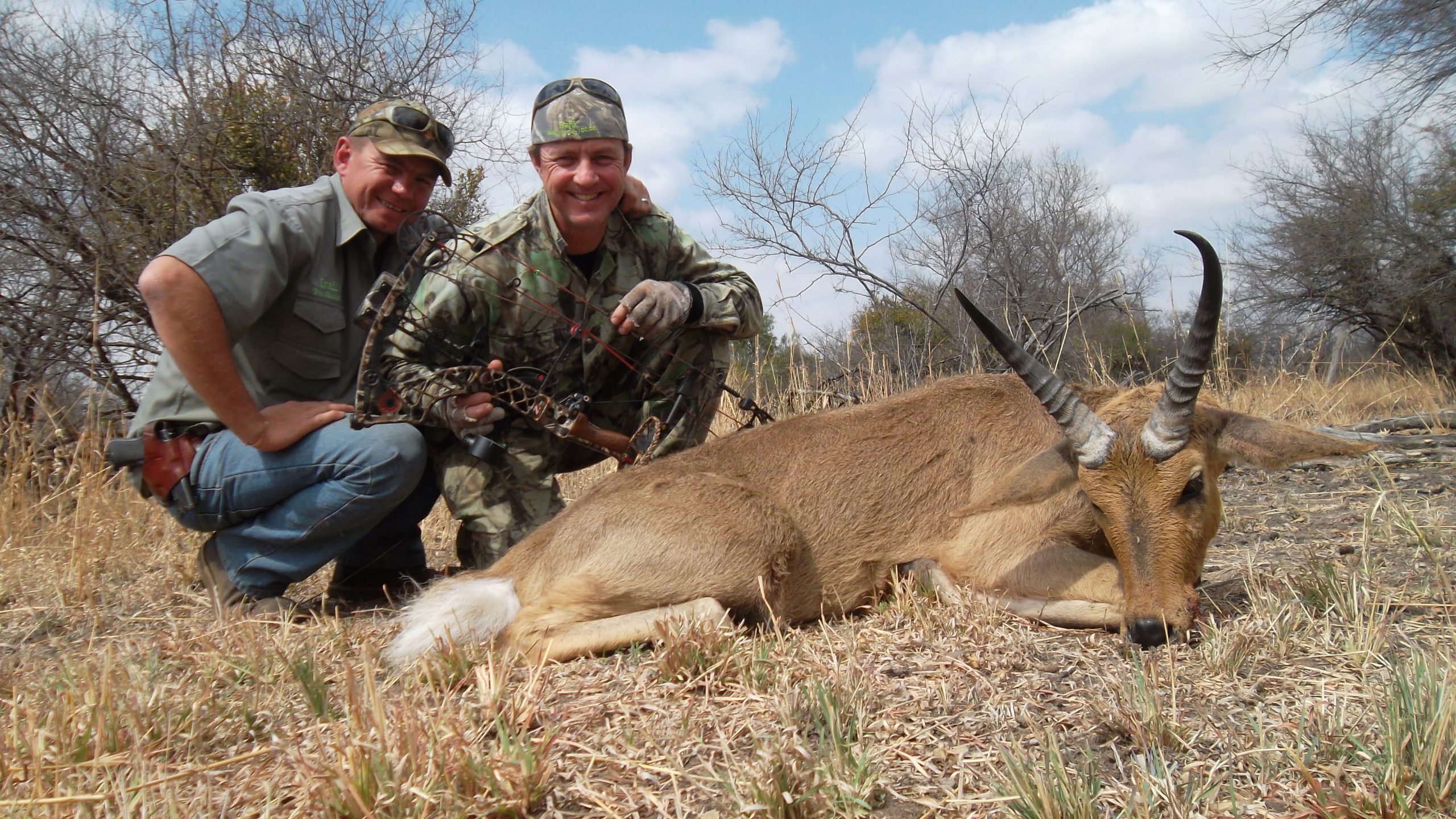
On Day One, we headed with Clive to our base camp, Tuskers, seeing giraffe, impala, kudu, eland, reedbuck, steenbok and zebra along the way. Elephant and their spoor were everywhere. At one waterhole a teenage bull was feeling his oats and ran after our truck. Along the way, Denise videotaped some good footage of different groups of elephant. As we were returning to camp we spotted a nice mature bull, but on closer inspection he had a broken tusk.


After a long day in the bush we arrived at camp, tired and hungry. After snacks around the fire, a four-course meal in the dining room, bed was a welcome sight for our tired bodies.


Day Two had the threat of an incoming front of rain. Clive had us on the trail by 6.30 a.m. and we visited one waterhole that had some decent tracks. Clive took note and then went to check as many areas as he could before the rain came. The morning rain was light, so it didn’t hurt our tracking.


After lunch under a shade tree and a 45-minute siesta, we started back on the trail at 3.00 p.m., looking for the track of the big bull. What a life!


About an hour later, we found a waterhole with steaming dung. Denise decided to stay on the truck working with the video, while Clive, the trackers, and I followed the hot trail. Once out of sight of the truck, the tracker climbed a tree for a better view of the situation. All of this took about 10 minutes. Meanwhile, the three bulls that we were tracking had circled back to the waterhole where Denise was sitting! She became more anxious by the moment as they advanced towards the truck. Quickly she reviewed her options: “Should l call for Clive and Roger”… “No, that might bring the elephants closer.” Just before she called out, she saw us reappear. We moved the truck, and she got some great footage of the elephants.


As we traveled, Laroto, the tracker spotted a group of elephant some distance away. Clive stopped the vehicle and sent the trackers to inspect the group. They returned wearing big smiles – there was a group of four bulls, and at least one was a good trophy


Now we were all starting to feel the excitement and anticipation. Quickly, we loaded our rifles (and cameras) and, with the wind in our faces, we took the track. After closing the gap, we checked the wind, then began glassing the four bulls feeding together. “Let’s get a bit closer,” said Clive.


Rodger convinced Denise to come along as the safari photographer and videographer and she was able to get some good photos and footage of different groups of elephants.


Now we were all in stealth mode – no spoken words and stepping only in each other’s tracks. After careful inspection, Clive whispered: “There’s the bull you want.” My mind was racing. Clive worked us into a better position. This bull was a giant! Twelve feet tall and weighing six tons.


I feel as though we’re in Jurassic Park and a dinosaur is bearing down on us. Time is slowing down. I can feel my heart pounding in my ears. I feel each breath. I find myself on the shooting sticks. Clive says: “Take him.” He has turned to face us and the wind swirls. He lifts his head to look at us as the trigger releases. He crumbles. Clive and I put in shots for assurance.


What a trophy! Congratulations continue all the way to camp.


Hunting elephant in Botswana is a special experience. During the day one hears a symphony of African birds and, at night, the call of lion. Experiencing life in the bush has a special intrinsic value that, unfortunately, words cannot describe.

Biography


Rodger and Denise Haag of Florida have been married for 32 years and have two daughters, Jennifer and Katie. Dr. Haag enjoys hunting and ranching.

White Rhinoceros – The Last Rung in My Big–Five Ladder

South Africa: 2007

For the past 45 minutes I’d crouched immobile behind a low thornbush on the edge of a 20–acre grass–covered meadow, watching five rhinos graze. Moving their enormous heads from side to side, they cut a swath through the field, ingesting an impressive amount of green groceries.

A slight wind was blowing in our direction; the quarry was completely unaware of our presence. When first spotted, they were approximately 70 yards off and had come no closer during their recent machinations. In the last three minutes, this situation changed. Two of the rhino, one with the largest horn, grazed in our direction moving from my left to right. The smaller one came to within 20 yards of us, while the larger was approximately 50 yards away.


For reasons known only to them, both rhino suddenly stopped not agitated, just frozen. The larger rhino was partially obscured by the closer. I held the dart gun on ‘ready.’ Carl had set the pressure for a distance of approximately 50 yards. Barry’s hands tightened on his .470 Krieghoff Classic double rifle just in case! Lady Luck smiled. After two to three minutes (it seemed a lot longer) the larger rhino walked forward, giving me an unobstructed view.


A moment of truth had arrived. I sighted the red dot on its right shoulder and squeezed the trigger. Following the whooshing sound as the dart flew, I could see the red tip impaled on the rhino’s shoulder. Startled by the sound, both rhino charged forward full speed luckily, not in our direction. They were joined by their companions and rapidly ran downhill. I breathed a sigh of relief and felt elated. Perhaps my final quest was over.


Six months prior this event, I had little interest in hunting a southern white rhinoceros. On two previous occasions I’d seen them in the wild and neither encounter had whetted my appetite to hunt these apparently docile behemoths. However, last fall I shot a very large male leopard in Namibia, and now had four of the African Big Five, all of record–book quality. I needed only a rhinoceros to complete SCI’s African Big Five Grand Slam.


The major impediment to my shooting a rhinoceros was the kill fee – at least $50,000… Out of the question. On the other hand, I could afford the substantially less cost of darting one of these ‘Pleistocene holdovers.’ Frank Cole of Cabela’s Outdoor Adventures arranged for me to hunt with Barry Burchell of Frontier Safaris. The hunt was to include darting a rhino, hunting caracal with Barry’s hounds, and introducing my daughter, Ruth Ann, to big–game hunting.


Accordingly, we arrived in Port Elizabeth in April after the obligatory 24–hour air travel. The facilities of the game ranch were very impressive. Approximately 50 miles inland from the Eastern Cape, the spectacular hilly terrain was sparsely covered with small bushes and short trees. The weather, early winter, was dry and the temperature ideal.


The first day, while getting over the jet lag, Ruth Ann practised shooting Barry’s Ruger Model 77 .270 calibre rifle. That afternoon she killed her first big–game trophy a very impressive Cape kudu bull.


The next morning, we drove 30 miles to the Lalibela Game Reserve through heavy fog and met PH Carl van Zyl, our primary guide. The veterinarian, a delightful individual, showed me the ins and outs of using his dart gun. This gun had a long, thin barrel and a red–dot sight. The maximum range was 50 yards. He made it very clear that, due to the parabolic trajectory of the dart, the precise distance to the quarry must to be known. (If the rhino was 20 yards away and the gun was set at 50 yards, the dart would go over its back. Conversely, if the rhino was 50 yards away and the gun was set at 20 yards, the dart would hit the dirt before reaching the rhino.) I practised several times, and managed to hit a small cardboard box.


We piled into a Land Cruiser and went hunting for rhino, first encountering a female rhino with a young calf. She didn’t seem too perturbed at our presence, but it was obvious she expected us to move on which we did. After about an hour, we found five grown rhinos in a grassy meadow and crawled slowly to the edge. One rhino had a trophy–quality large horn. Frankly, at that juncture, I could have borrowed Barry’s .470 Krieghoff and killed the rhino without further ado not a particularly challenging event, to say the least. However, since I was on a darting mission, the next 45 minutes were filled with excitement and anticipation as I sat still and waited…


After the rhinos had left the field, they soon disappeared from our view. Carl whistled for the crew to bring the vehicle and pick up Ruth Ann and the vet who’d hidden behind a tree about 75 yards behind us to watch the spectacle. All boarded, we followed the path made by the rhinos as they ran downhill into a ravine and spotted the darted rhino in thick bush – about 750 yards in all.


We gingerly approached the downed behemoth, but it became clear that the animal couldn’t move. Its respiration was shallow and rapid and its skin felt quite hot. The vet quickly began taking horn measurements, drawing blood samples, administering antibiotics, etc. The rest of the crew chopped down the nearby brush so that the rhino could be photographed. The dart was still in place; it had been driven in exactly perpendicular to the surface. This is important so that the sedating agent was injected directly into the muscle and not into the very thick skin.


After about 15 minutes, the dart was pulled out – we were ready to begin the final step. With all of us aboard, the vehicle was turned around and made ready to exit. The vet administered the antidote and hot–footed it back to the truck. The rhino seemed to shake itself somewhat and attempted to rise. We made a circle and returned higher up on the hill. By that time, approximately five minutes had elapsed. The rhino was up and walking around unsteadily, but headed in the direction of his departed buddies. Ten minutes later, we saw him grazing with the group as though nothing had happened.


Carl had told us that this was only the second rhino they’d darted, and that it had never been darted before. Also, they would not dart any animal more than once a year. He said that this darting episode had gone as smoothly as he’d experienced. (The next day, I received a certificate of the horn measurements for the SCI Record Book. A fibreglass replica of the horn using these measurements would be sent later.)


We drove back to Barry’s ranch. That afternoon, about 3 p.m., we rode in the high hills looking for smaller plains game. The scenery was absolutely spectacular, and we saw a number of different species. Just as the sun began to set, Barry decided to drive through an area of pines that looked much like Virginia spruce pine to look for a bushbuck with impressive horns.


Barry spotted the animal approximately 120 yards off. Ruth Ann put the rifle on the shooting sticks, but couldn’t see the bushbuck in spite of Barry’s directions. Finally, he said, “Do you see that brown rock?” She concurred. “Shoot the rock!” She did – and the bushbuck promptly fell.


We had an early start the next morning to hunt caracal. The hounds were turned out close to the lodge where two caracals had been seen crossing the road the day before. The handlers released the hounds and walked with them in a brush–covered valley while we remained on the crest of the hill watching their progress. After about 30 minutes, we heard the dogs strike. It soon became quite clear they’d jumped a predator. They ran in full cry for about 30 minutes, finally baying a caracal within about 300 yards of us. When we arrived at the tree, a large male clung to a branch that was densely covered by leaves. Although it was quite visible when I was close, from more than 10 feet away the cat was totally obscured by the foliage. This created a difficult situation because the rifle had a telescopic sight mounted close to the receiver. If I moved far enough away to see clearly through the telescope, the caracal was obscured by the leaves. At a short range, when the cat was visible, the scope couldn’t be focused. In desperation, I sighted down the left side of the barrel and guessed where the bullet should travel.


By sheer luck I killed the caracal. The cat fell out of the tree and was immediately retrieved by one of the handlers so that the hounds couldn’t tear the hide.


That afternoon, we drove to the edge of the Karoo dry–lands, approximately 75 miles north–west, where the terrain was flatter and the vegetation sparse – where Rush Ann completed her goal to acquire three antelope with her springbok. Barry told us that when springboks run a lot or are excited, the hairs on the back exude a particular odour much like cotton candy.


After a day of rest we began the tiring, boring long flight home. In the air, I relived the experience and mulled over the future. I’ve hunted four African countries and taken the Big Five. This safari clearly was not as high a level of excitement as I’d experienced before, but it certainly was far more of a challenge than killing the rhino would have been. I’m certain that our rhino was happier regarding the chosen alternative. In any case, I’ve now climbed the final rung in the African Big Five ladder.

Biography


Joseph C. Greenfield, Jr. is Professor of Medicine at Duke University. After stepping down as Chairman of the Department of Medicine, he hunted dangerous game on 12 safaris to four African. A number of these are chronicled in “Bwana Babu,” published in 2006 by Safari Press.

This will close in 2 seconds

Privacy Overview

This website uses cookies so that we can provide you with the best user experience possible. Cookie information is stored in your browser and performs functions such as recognising you when you return to our website and helping our team to understand which sections of the website you find most interesting and useful.