
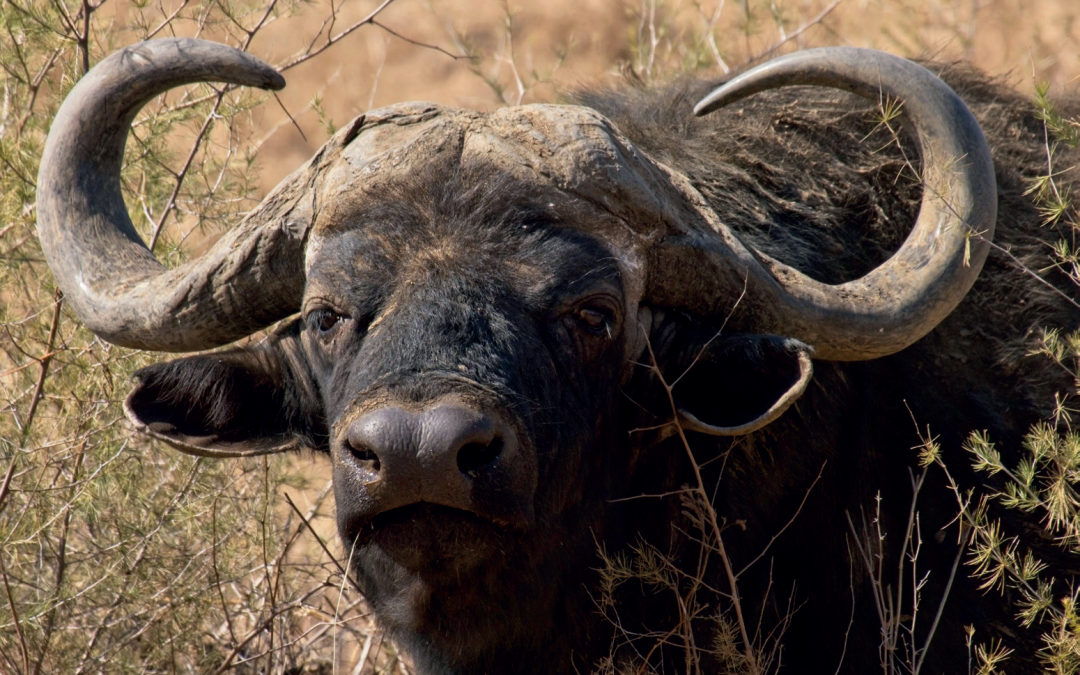
By Ken Moody
‘To take this old man into those reeds after those buffalo is a bad plan.’ I can still hear those words as clearly today as when they were first uttered so many months ago when my accompanying Zulu PH on this hunt, Musa, explained his trepidation in moving along the half-mile-long trek into the thick reeds which hid an unknown number of the black beasts we were pursuing. We could see with our binos the small flock of egrets which rode atop the backs of the buffalo, but we had no idea how many mature bulls were in the herd given the height and density of the reeds engulfing the landscape for miles in every direction along the river we were hunting. Musa was a cautious PH and prone to moving slowly while I have always been a bit of an aggressive hunter, quick to move in on our quarry when it’s buffalo we’re after. I knew the buffalo were there, and I wanted to get into the reeds after them, but Musa’s point did not fall on deaf ears. The client was older and very hard of hearing and maybe getting him into a tight spot with very limited visibility was not the best of plans. A cornered buffalo bull can quickly become agitated, and an agitated buffalo is not good under ideal conditions, let alone within the confines of those dense reeds. As Musa and I discussed an alternate plan, the decision was made for us as the wind shifted and blew our foul human scent in amongst the reeds and eventually to the buffalo.
Thundering from the cover of the reeds, we watched as a tremendous bull with accompanying cows moved away from the water’s edge and back towards the dense bush that surrounded the huge swath of reeds along the banks of the river. In a matter of minutes, they covered the long distance from the reeds to the bush and in a blink, they were gone from sight and any further attempt to stalk them. This hunt was not proving easy.
The above encounter occurred in the early morning on day six of our seven-day safari. We had hunted hard to this point, but the buffalo had proven to be both elusive and extremely wild. You could not make a mistake with these buffalo and hope to be successful. Every bit of skill and ability as an experienced buffalo hunter would need to be utilized to get close enough for a clean shot. We had two clients in camp hunting in two teams, both pursuing buffalo, and so far, we hadn’t got one of them onto the sticks. Time was running out and everyone knew it. On the way back to camp for lunch, I could see my client Barry was feeling a bit concerned as he too could count the days, we had been at it. Leaning over towards him, I alleviated his concerns a bit with some positive words and encouraged him not to give up. I’ve always believed that one attracts what they project. Projecting a positive, affirmative attitude will usually result in those receiving that projection feeling more positive and upbeat about the mission at hand. Negative energy is strong and to allow it to permeate within the team will never, ever result in a positive outcome. I reassured Barry that the opportunity would present itself and that he was a superb shot, so when the time came, we’d be celebrating a buff in the salt. After lunch, we were out and at it again.
The afternoon plan found us in higher elevations, looking for tracks and any other spoor that might indicate the presence of buffalo. Time and again we struck out on bagging a bull in these hills, so we decided to return to the river and reeds and search for some feeding buffalo as they moved towards the water. The hour was getting late, and the buffalo would be on the move. Patrolling slowly along the dusty trails that wove throughout the reedbeds, we were ever vigilant for any movement or sign of buffalo. Just before it became too dark to shoot and as we went around a bend in the road, Jabulani, our tracker, reached forward, took the shooting sticks from their resting place, and slipped silently off the back of the cruiser. Knowing what this meant, I signaled to Musa to stop the vehicle, which he did. Working within a team means knowing what to do and when to do it without having to say a word.
From previous experience, we knew that when Jabulani put his hands on the shooting sticks, he had spotted buffalo a few minutes earlier. He never alerted us when he saw them, preferring to keep us moving and away from the proximity of the buffalo as the sudden stop of a vehicle and movement from us would alert a suspicious bull. Jabulani was Zulu and one of the finest and smartest buffalo trackers I have ever worked with. Exiting the cruiser, I told Barry what was going on and that we would be quietly stalking back to where the buffalo was spotted. Quiet was called for now and only hand and arm signals would be used from this point forward. Creeping back along the route we had just taken, I followed Jabulani’s lead, with Barry on my heels. As we rounded the last bend, Jabulani pointed off to a small tree only about 50 yards from our location.
Scanning the area below the tree with my binos, I could see the old bull lying there completely unaware of our presence. Moving forward with the sticks, I placed them in position and motioned to Barry to put his rifle up and get ready. Whispering directly into his ear, I told him where the bull was in relation to the tree and for him to find it in his scope. Not to shoot, but just find it first before I gave him the shot placement. Struggling to find the buffalo in the growing darkness, Barry just looked at me and shook his head. He could not see the buffalo, which was just yards ahead facing us, laying down under that tree.
Once again, I instructed him to follow the trunk of the tree down to the ground and look to its right. There was a buffalo! Still, Barry could not see him. Finally, the buffalo sensed our presence and came to his feet in one fluid motion and in an instant, he was gone. I must admit that the frustration of the moment was nearly overwhelming, and I bit my tongue, turned, and walked away for a few paces. I glanced at Musa, who simply looked at me shaking his head. I have seen this affliction time and again as hunters not used to the bush seem to go ‘bush blind’ at the worst moments and not be able to see what the rest of us clearly can. Composing myself and regaining positivity, I told Barry, ‘no worries, tomorrow is another day. We will get your buffalo!’
We had taken Barry to the shooting range on the first day of the safari and his marksmanship skills were superb. I knew that we just needed to get him into position to see the right bull at the right time and he would finish this hunt with one deadly shot.
Realizing that Barry did not possess the best ‘bush eyes’, I figured that we really needed to get onto buffalo in the morning when there was ample light, as that would provide the best visibility for his seasoned eyes. So, on day seven of the seven-day safari, we set out with renewed confidence that success was just an opportunity away. Heading straight to the reeds, we began the morning as we had done every morning previous, glassing and looking for egrets. As we rounded a familiar bend, I saw the thin arm of Jabulani reaching for the sticks, and I knew that he had seen something that had eluded the rest of us.
With our routine now standardized, we exited the vehicle, took our positions, and followed Jabulani back down the winding two-track for about a quarter of a mile. As we moved off the bush trail and into the reeds, visibility took a turn for the worse. Fortunately, we had a good wind and as I strained to listen, I heard the distinct and unmistakable sound of buffalo feeding. Barry could hear nothing however, but I assured him that we were about to get into a lot of buffalo. Snaking our way deeper into the reeds and winding towards the river, we got our first glance at the herd about 300 yards in. There before us stood cows and calves but no visible bulls. As we crouched down and glassed, I prayed that the wind would hold steady, as we were only 30 to 40 yards away from the nearest buffalo. Finding a suitable bull in those tangles of reeds and amongst those cows and calves was impossible. We had a narrow field of view but could hear buffalo feeding all around us. At this stage, all we could do was sit and wait. If we pressed the herd, they would bolt and run, so waiting is exactly what we did.
About 15 minutes into our wait, an old cow caught sight of us, and the stare down began. Sitting motionless, it felt as if we were barely breathing as the old gal gazed and stared, willing us to move. Eventually, her actions were noticed by others in the herd and finally our presence was fully detected. In one swift snort and scoot, the little group in front of us trotted off towards the river, disappearing into the reeds. It was only good fortune that they did not smell us, as no alarm sound was uttered as the little group ran.
Standing up, we decided to pursue the herd a bit and see if we could get deeper into them. Just as we started to move, however, I heard more buffalo feeding coming from behind, where the original group we spotted had been standing. Raising my hand, I alerted our party to the sound and pointed to where it was coming from. We moved forward and set up the sticks facing a small gap in the reeds where I hoped the buffalo would move through. Magically, a few cows appeared at first and moved through the gap and towards the river. Then, there he was, a nice big-bodied bull following the cows. With Barry on the sticks, I let out a war whoop as the bull walked into the center of the gap. I have found that with buffalo, a loud, audible whoop will usually stop them, whereas a whistle might not be heard. The whoop stopped him broadside and as the crosshairs found the spot, a shot cracked off and the big bull sped away, not making it 100 yards before we heard the telltale death bellow of a dying buffalo. Our bull was on the ground! Barry was elated. We had hunted hard and fair and there before us lay the reward. As the word went out on the radio, our other team arrived to congratulate Barry and help load the buffalo.
Stephen, our other client, still hadn’t any opportunity and today was the last day of hunting. As we finished with the photos, his PH looked at me and said that he would carry on loading Barry’s buffalo and would I please take Stephen with me to find another bull. He knew that I had this area figured out, and that we were all there to do our best for our clients. As I had a good mojo, I agreed to this plan of action. In a flash, we loaded Stephen and his wife onto our cruiser and out we went for one last try at bagging a buffalo. We could not fail!
Working our way around the bends and narrows of the bush trails, we ran out of the reeds momentarily as we headed further down river. I am sure we had not been moving 10 or 15 minutes when I looked out onto the plain and spotted a decent sized herd of buffalo making their way from the river towards the dense bush behind us. Pointing them out to Jabulani, we continued driving for about a quarter mile before disembarking and heading back for the herd. The group of buffalo originally appeared to be all cows, but then we saw one outstanding bull in the mix as well. We wanted that bull.
Pressed for time and trying to beat the buffalo to the road before they crossed and got past us, we moved at a good pace to get back to the a where they were spotted. As we came around the last curve, we spotted the herd and headed out onto the fringe of the reeds in hopes of securing a good shooting position. The movement did not go unnoticed, however, and the buffalo quickly turned and sped away towards the river. Fortunately, they were moving over relatively open ground, so we could visually follow them all the way along their route as they ran into the reeds that were right along the water’s edge. At least we knew where they were.
Our final stalk of the safari began with a slow, half crouched steady march from the point where we were detected to that area where we had last seen the buffalo enter. If they ran from the reeds, we would likely see them as they were now between the river and us, in the only cover the immediate area offered. Slowly we progressed, trying to keep the fickle wind in our favor. Once we closed the gap to around 200 yards, we stopped and began to glass the reed patch for any sign. As if sent from the hunting gods, a lone egret flew down from the sky and landed on the back of one of the buffalo. Bingo! There they were. With the help of that one white bird, we could now just make out the horizontal lines of the backs of several buffalo as they milled around in that patch of reeds.
Fighting a poor wind, I looked at Stephen and asked him if he was confident in taking a running shot as we would probably be winded by this herd and the buffalo would have to run one way or the other to escape. Stephen affirmed that he was very confident in taking a moving shot if such a shot was presented. Musa and I then decided that we would manipulate this finicky wind in our favor to see if we could make the buffalo do what we wanted them to do, providing us with a shooting opportunity.
The plan was simple. Jabulani would circle to our left and arc out about a half mile or so moving towards the river so that the wind would carry his scent into the reeds and to the buffalo who, once spooked by this scent, would run out of the reeds directly in front of us providing an open shot of around 150 yards. This plan had to work! Inching forward, I moved Stephen into a good location and placed the sticks directly in front of him. He crouched behind the sticks, and I crouched behind him. I told him that we would both stand up at the same time when the time came and that he was to get onto the sticks and await my instructions. I would tell him which buffalo to shoot once I identified the bull in the group.
Jabulani had been gone for about half an hour when Musa and I noticed the herd had become suspicious of something. We could just see the very tops of their backs, but they were no longer milling around, they were standing perfectly still, indicating that something had their attention. A moment later, they began to move to their right, picking up speed as they headed from the safety of the reeds. I told Stephen to stand, and I stood up directly behind him. As he got his rifle in place, I told him that they would break out of cover right at the point where the reeds met the open plain to our right and that I would tell him which one to engage as they would be in a single file. Just as planned, the herd broke out from the reeds, running directly to our right. They had no clue that we were there waiting on that very thing to happen and as they ran out in single file; I told Stephen that the bull was the third buffalo in line.
Once he confirmed that he was on the bull, I let out a long, loud, and continuous war whoop, which caused the bull to stop in his tracks and look in our direction. That moment of hesitation was all that Stephen needed and the big .416 spoke once, striking the buffalo perfectly. On impact of the shot the buffalo began to run and I told Stephen to hit him again which he did in perfect fashion and then a third time, which caused this big, black train of a bull to nosedive into the earth, his huge body somersaulting over his head as he expired on the spot. It was over! We had done it.
Two buffalo for two clients on the last morning of the safari. We were all elated as we had hunted very hard to get to this point. All the shooting preparation by the clients and all the buffalo hunting knowledge that we possessed were needed to secure this positive outcome.
As important as this preparation and experience is, the projection and belief in that positive outcome is paramount. To be rewarded with success, you must want to be successful and project that positive attitude to everyone in your sphere of influence. You must believe it and make your clients believe that persistence and positivity will yield positive results. Never fall victim to a negative attitude and never, ever allow negativity into your hunting camp. I firmly believe that our great success on that last day was a result of the positivity we projected. We made our luck!
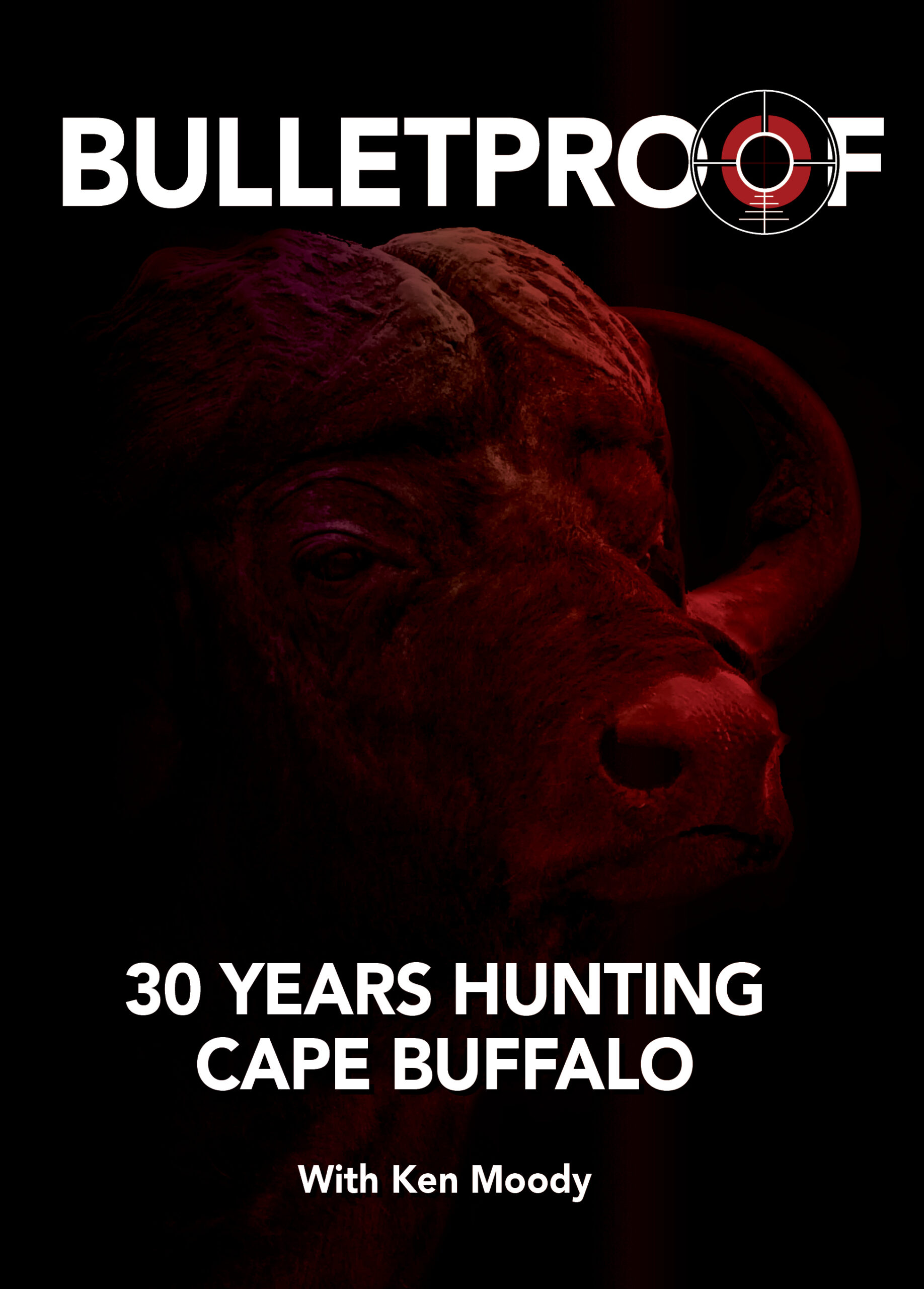
Bulletproof – 30 Years Hunting Cape Buffalo is a beautiful, full color, exciting read from Ken Moody. It contains good information regarding hunting cape buffalo and many adventure stories throughout its chapters.
“Thirty years of hunting ‘Black Death’ has provided me with many lessons and encounters and while I didn’t want to do an encyclopedia on the subject, I have created 136 pages of informative content that makes for an easy weekend read,” says Ken.
Purchase price is $25, which includes shipping to anywhere in the US. You can pay via Venmo at Ken Moody Safaris or PayPal @kenmoody111. Please provide your shipping details with the order. If you’d prefer to send a check, send $25 to:
Ken Moody Safaris
POB 1510
Jamestown, TN 38556