
By Terry Wieland
Across the Kalahari
Almost all of the really great hunting books are less about hunting than they are about journeys. Sir Samuel Baker’s Nile Tributaries of Abyssinia, Theodore Roosevelt’s African Game Trails, even Ruark’s Horn of the Hunter — are less about being there than getting there.
This element has been largely removed from both modern hunting, and modern hunting writing. Encounters with the TSA, late flights, cramped airline seats, and delays at Customs are hardly material for great literature. Even within a country of any size, such as Tanzania, most movement between hunting areas is now done by small plane. Gone are the long, hot, bumpy, dusty, interminable treks by Land Rover that see you pull out in the pre-dawn and only reach your new camp long after dark.
This may be more convenient, and it certainly saves money when a safari is costing you a few grand a day, but it also takes away that moment of sheer elation that only occurs when you round yet another bend in the dusty track and see the gleam of a campfire through the trees. All of today’s finely furnished camp huts and elaborate fire pits can never replace the welcoming magic of a small campfire in the bush.
In 2001, my pal Clint Gielink and I finally undertook a trip we’d been talking about for five years: We left Maun to traverse the Kalahari, with the ultimate goal of spending a night or two at Gemsbok National Park, near the South African border. This all came about because of my curiosity about a dot on the map of Botswana called “Lone Tree.” A map of Botswana is mostly blank space, but there was a line that connected Ghanzi to this dot, and this dot to the border post. What exactly, I wondered, was at that dot? Was there really a solitary tree standing in the middle of the Kalahari? We decided to find out.
Clint is South African by birth, but was transplanted to Botswana where he now runs a photo-safari outfit. This gave us access to a fully equipped Toyota Land Cruiser and such essentials of life as good sleeping bags for icy nights in the Kalahari. It may be desert, but you can see your breath in the morning chill. We didn’t bother with such amenities as a tent which, after sleeping under the stars, seems as confining as the 19th floor of the Hilton.
Aside from seeing Lone Tree, I also had a personal ambition to be the first person, at least as far as I knew, to grind my own coffee and make espresso to sip by the aforementioned tiny gleaming campfire. This may seem a tad esoteric, but coffee fanatics will understand. I’ll report on the results, and move on, very quickly: The electrical inverter in Clint’s Land Cruiser handled the grinder with no problem, but blew a gasket the second I turned on the coffee maker. Less than a day into the trip we were without electricity. Ah, well. Fortunately, I had my emergency supply of pre-ground coffee and a little drip device that could work with water heated in a pail over the fire, which we did henceforth. Clint, not much of a coffee drinker, was somewhat bemused by all this.
We left Maun on the fine paved road to Ghanzi, where we stocked up on the one absolute nutritional necessity: A goodly supply of mutton chops. We also filled every water container, topped up the petrol, checked the tires (four on the truck and four spares) and bought what vegetables were available, which wasn’t much. Some biltong and dry sausage rounded out the commissary.
Botswana halted sport hunting in the Kalahari in the late 1980s. Up until that time, safari outfits like Safari South maintained camps there for hunting desert game, and transported their clients from the Okavango to the Kalahari and back. There being little or no enforcement of the game laws, and none really being possible short of assigning a game scout to every safari, all kinds of abuse took place. It finally got so bad they shut it down, or at least that was the reason given. Aside from limiting the taking of such desert trophies as gemsbok, springbok, and various hartebeest, this ruling eliminated one of the most interesting side trips a hunter could make.
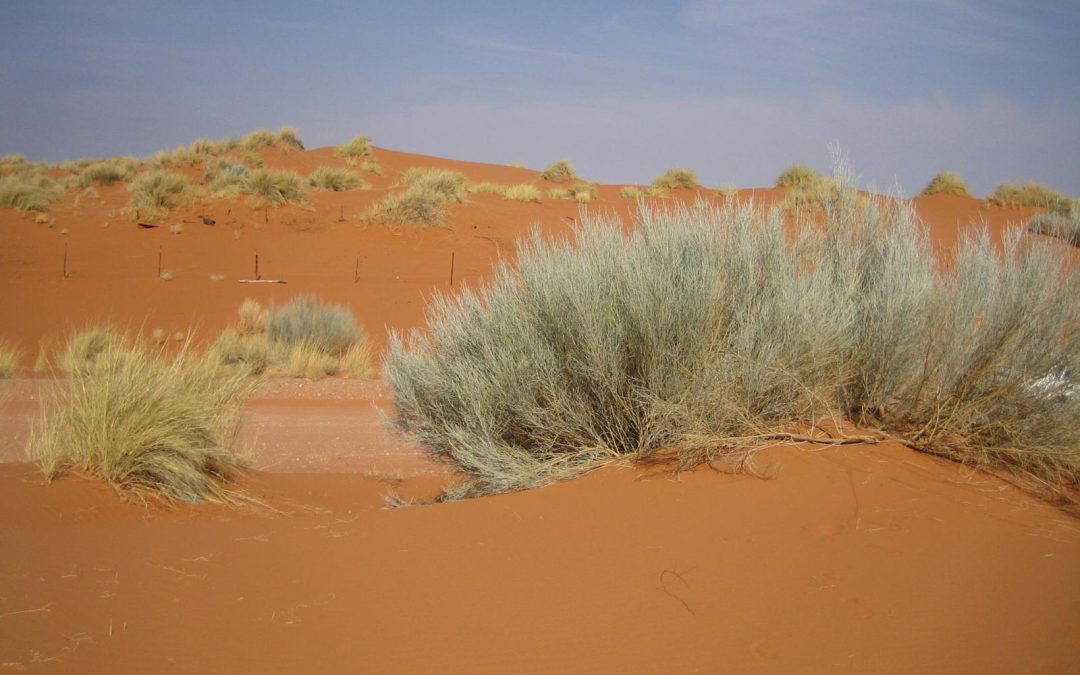
Although the Kalahari evokes images of sand dunes and salt pans, much of it has trees and rolling waves of grass. It would be going too far to call it scenic, since it’s so flat you can never see very far anyway, but it’s a place of great beauty in its own way. Scenery aside, you will never experience silence the way you will there. Lying in your sleeping bag, looking up at the night sky, is a dark-velvety panorama of the Milky Way that is possible these days in very few places on earth. With no air pollution, and no city lights to intrude, the vast Kalahari sky embraces you.
Each night, Clint would pull off the winding track through the sand, park under a convenient acacia, and set up camp. This consisted of laying out our bedrolls next to the Toyota, dragging some dead logs into place, and starting a small fire. The kettle would boil, we’d spread a little metal grill over the flames, and lay out some of our mutton chops and sausages. The smell of sizzling meat and acacia smoke was intoxicating. Later, I awakened during the night and listened, gazing up at the stars. All was….silence.
Then it was crawl out before dawn, stir last night’s coals into flame, and huddle by the fire in the winter chill, waiting for coffee. When the sun came up “like thunder…” we packed up, scattered the coals, and pulled back onto the track that wound — endlessly, it seemed, sometimes — through the Kalahari.
The trip was not without incident. At one point, we pulled into a tiny village and all the inhabitants turned out to see us. We stopped, conversed, with Clint doing the talking in his fluent Setswana. We politely partook of the precious water they offered before continuing on. Another time, we came upon a truck, broken down, with its three Tswana passengers wondering what to do. This was before cell phones. The three were all government officials on some sort of assignment in the interior. Clint, being a professional hunter, was also a very competent mechanic. It took him about an hour to get the vehicle running again, at which point we shook hands all around with big grins and protestations of undying gratitude and friendship. They headed north and we continued south.
When we reached the park gates, Clint submitted to the checking of permits, paying of fees, and such like, while I read the long list of park regulations posted on the wall. There was, I learned, a $10,000 fine for bringing firewood into the park, or for cutting your own firewood inside the park instead of using that which was provided, carefully cut to length and stacked. There was a fine for straying more than a few yards from the marked tracks and paths, or for pitching a tent anywhere except on the concrete pads provided in each (marked) campsite. We were assigned a campsite number, a map showing how to get there, and various other bits of paper essential to the modern experiencing of the great outdoors. All the time, running through my head, was the Five Man Electrical Band: “Sign, sign, everywhere a sign…”
After the wild Kalahari, prowling the park was like walking into the lobby of the Dorchester. Our campsite was on a slope overlooking a salt pan with a herd of resident gemsbok, standing around the piped-in water, chatting. We laid out lunch on the picnic table provided — sardines, crackers, smoked oysters, cheese, pickles — and munched in silence while we watched the gemsbok. It was all very nice, all very civilized, all very organized.
I looked at Clint. Clint looked at me. “Let’s get the hell out of here!”
In a matter of minutes, we were packed and driving out. The guard at the gate was puzzled as Clint handed in our paperwork and we churned through the sand back out into the uncivilized, unorganized, and thoroughly wonderful Kalahari. A troop of meercats, whose burrows opened out into the sides of the deep ruts, welcomed us back and watched us go. A lone hartebeest stared from under an acacia.
Clint and I suddenly broke into song: “Do this, don’t do that, can’t you read the sign?” It was one of those great moments.