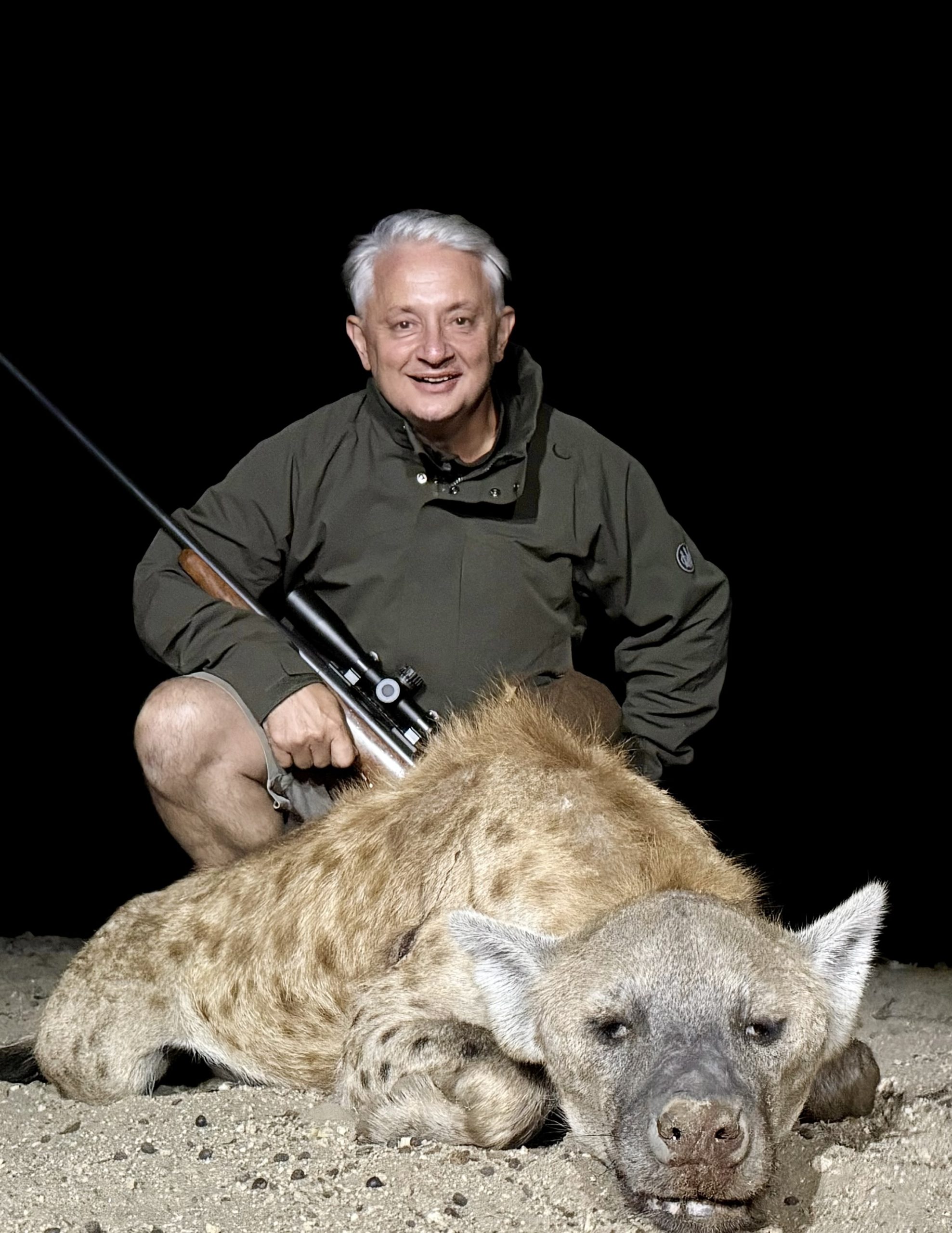
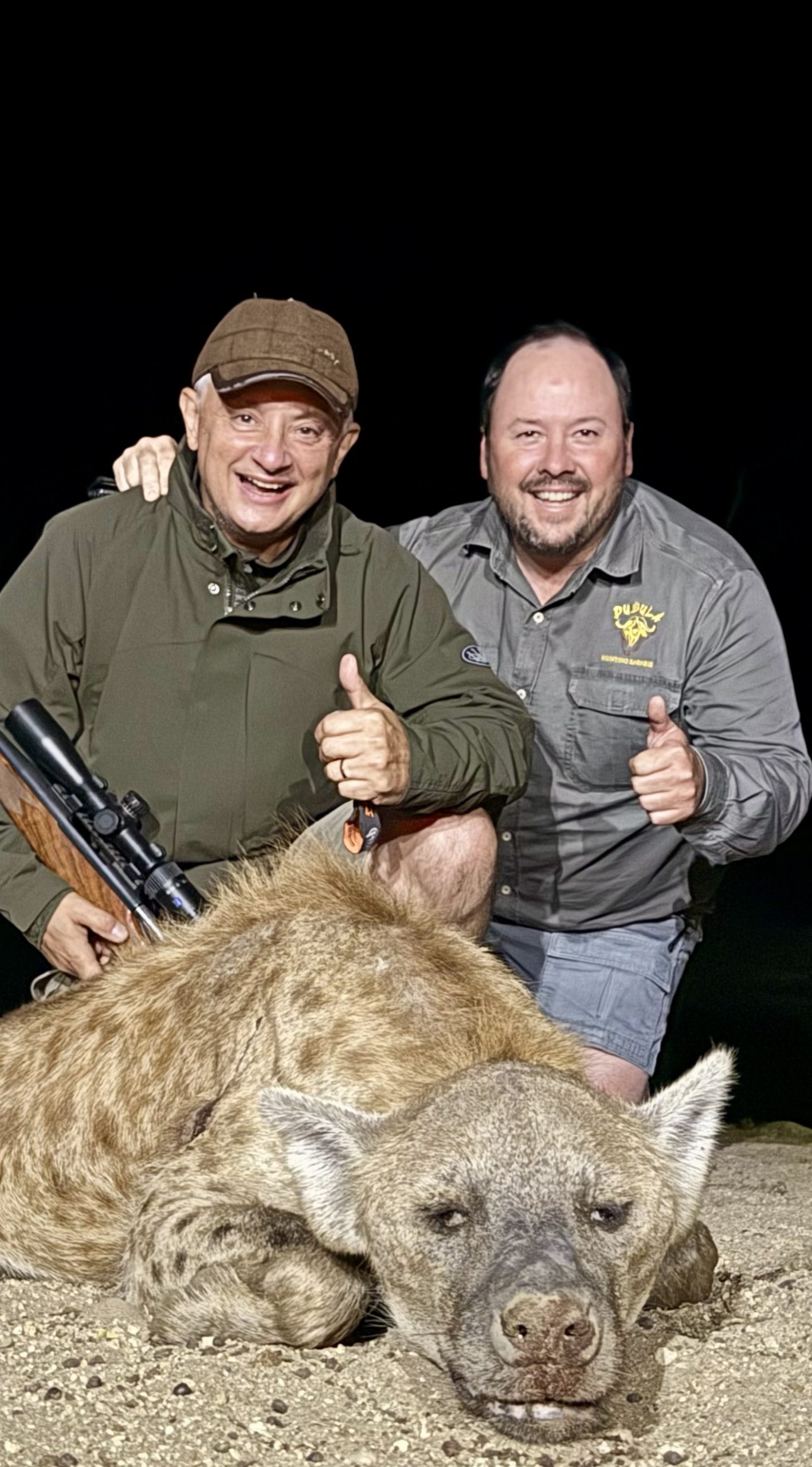
Hyena Hunting in Kruger – A Once-in-a-Lifetime Experience

By Alessandro Cabella


Hunting near Hoedspruit, deep in the greater Kruger area of South Africa, offers something that few places on Earth can match: untamed wilderness, raw unpredictability, and adrenaline-charged encounters with some of the world’s most elusive predators. After landing in Johannesburg, I was greeted by my longtime friend and professional hunter, Ryan Beattie, owner of Dubula Hunting Safaris. We loaded the gear, packed the rifles, and began the drive northeast—leaving behind the highways and entering the African lowveld where baobabs tower, the mopani trees stretch wide, and the wild begins to speak. The road to Hoedspruit isn’t just a drive—it’s a slow descent into another world. A world where time slows down, senses sharpen, and the unknown always seems just one rustle away.


Camp, Bait, and the Stillness of the Bush 

Our arrival at camp was greeted with warm hospitality, cold drinks, and a sense of readiness. The staff knew why we were there. And more importantly, so did the land. The baits had already been hung. The trail cams had shown promising activity—leopard, hyena, even a large crocodile crossing near one of the waterholes. The night shift of Africa was active. We planned to hunt from a blind, positioned near a bait site where hyena activity had been frequent. Hunting hyena is not for everyone—it requires patience, nerves of steel, and often takes place under cover of darkness, when the bush becomes a theater of shadows. That first

Gear & Hunt Details

Rifle: .300 Winchester Magnum

Ammunition: 180-grain soft point

Optics: Night vision-compatible scope with IR assist

Outfitter: Dubula Hunting Safaris

PH: Ryan Beattie

Location: Hoedspruit, Greater Kruger, South Africa

Species: Spotted Hyena (Crocuta crocuta)

Distance of Shot: Approx. 85 yards

Time: 11:30 p.m.

Conditions: Moonlit, dry season, high predator activity

Trophy Status: Largest hyena harvested in recent years; full-body mount commissioned

Display: Trophy donated to Dubula Hunting Safaris Lodge for display and conservation education

night, we settled into the blind at dusk. The air was still and heavy, but the bush was anything but quiet. Movement was constant. A leopard moved silently near the bait—unseen, but heard. Later, the unmistakable glide of a crocodile slipping into the shallows. Every creak of the branches or crack of grass heightened the tension. We sat in near-total darkness, rifles ready, eyes scanning, hearts pounding. No shot was fired that night, but the experience was unforgettable. It was a reminder that in Africa, success isn’t always measured in trigger pulls—but in proximity to the untouchable.


The Night It All Came Together 

The second night was different. The air carried a strange electric stillness. Ryan and I climbed back into the blind just before nightfall. The bait was refreshed, and game trails were promising. Still, nothing in Africa is guaranteed—especially when it comes to predators. Hours passed in silence. Then, at 11:30 p.m., I caught subtle movement in the shadows near the waterhole. It wasn’t the silent glide of a leopard this time—it was the low, slinking movement of a clan of hyenas, drawn by the scent of impala. Their arrival was fast and focused. These were no scavengers simply passing through—they were hunting, and they knew exactly what they wanted. In the darkness, with only the dim light of the moon and infrared assistance, I steadied my rifle — my trusted .300 Winchester Magnum. The moment came fast. A large hyena stepped into the clearing, eyes scanning, powerful jaws visible even in the low light. I had only a fraction of a second to act. Breathing steady, rifle locked in place, I squeezed the trigger. The sound cracked across the night air—and in an instant, it was done. The hyena dropped, clean and final. All around, the bush held its breath.


Predators in the Dark 

But the night was far from over. Just as the adrenaline from the shot began to subside, we heard the low growl of a leopard, still nearby. The crocodile had not moved far either. The hyenas that remained scattered into the brush, but the predators that had been watching never left. We sat in silence, processing what had just happened. Not just the shot—but the presence of three apex predators, all within yards of one another. This was pure Africa—not staged, not arranged, not controlled. Just raw nature, as it has always been. The moment was humbling. Not just for the trophy I had earned, but for the environment I had shared it with. Few hunters will ever take a shot under the eyes of a leopard and crocodile.

A Trophy Worthy of Legacy 

The following day, I received news that made the hunt even more extraordinary. I was informed—no later than yesterday—that the hyena I had harvested was the largest taken in the region in years, a true outlier in both size and age. A rare, once-in-a-generation trophy. Out of respect for such a remarkable animal, I made the decision to have it mounted in full body, so that its presence—and the story of this hunt—can be preserved in a way that honors it.

The mount has been donated to Ryan Beattie and Dubula Hunting Safaris, where it will be displayed at the lodge for all hunters to see. Not as a boast—but as a tribute to the bush, the animal, and the powerful connection that ethical hunting can create.


Final Thoughts 


Some hunts you remember. Others become part of who you are. This was one of those hunts. A powerful, unpredictable, deeply humbling experience—now immortalized not just in memory, but in legacy. Unforgettable.

In The Blood

By Ken Moody


There are myriad things that I love about Africa, but the one thing that I have a near obsession with is Cape Buffalo hunting. Yes, that old, ornery fella who would just as soon snap your neck as eat a bite has caused me many nervous moments. I have hunted hundreds of these beasts in Zimbabwe, Mozambique, and South Africa, and my thrill in pursuing them has never diminished. It’s in my blood. They are, in my opinion, the most dangerous game species to hunt.


Geoff was a repeat client of mine who had hunted with me in South Africa and now felt the desire to pursue buffalo. After a discussion of what we could provide, Geoff decided that the Omay in Zimbabwe was the place for him. Big and wild, the appeal of ‘real’ Africa was a temptation that he could not resist. I explained to him that the Omay buffalo were hunted relentlessly and only needed a hint of human proximity beforeracing away for miles. It would not be an easy hunt as the wildness of the  quarry, combined with the hazards of the terrain, made for difficulties. Difficulties that someone in Geoff’s state of physical readiness might prove impossible, as he was not a fit man.


Geoff and I discussed his fitness, and I urged him to choose another venue, but he was adamant. I relented with the understanding that he would get in shape and prepare for the rigors awaiting him. He was to walk, lose weight, and practice a lot with his rifle. He agreed to the terms, and it was with great anxiety that I met him upon arrival in the area. I was hoping for a slimmer version of the person I had known, so my heart sank when he appeared from the charter flight larger than when he had booked. “We’ve got to get this guy his buffalo in the first day or so or he’ll be too buggered to continue,” Franz, my PH whispered to me as Geoff was being greeted. I nodded in concurrence and off to camp we drove, a nervous pit beginning to develop in my gut.


After conferring with Franz, we decided that given Geoff’s physical state, our best bet was to stay aboard the cruiser as much as we could to minimize the stress on Geoff and allow him to only use his limited energy as needed. This was certainly not our normal mode of operation, but it was the best course of action given the circumstances.


For a few hours in the morning, we drove the various dirt roads of the Omay, hoping to spot buffalo close enough to allow for a short stalk. We needed a break and around 10am, we got one. Rounding a shallow curve, I looked off to my left and spotted a small group of buffalo heading for the low rise of a small hill. I peered through my binos and saw that they were meandering towards the mountains.


“Cows and calves,” I murmured to Franz, who also was in his glass confirming my spot. I suggested to Franz that we dismount and pursue the buff a bit so that Geoff might get a feel for how we hunt them. He agreed and as we closed the doors on the cruiser and looked up at Geoff, who was riding in the back with the trackers, we were greeted with a huge smile. “Did you see them?” he asked excitedly. “See what?” I grinned. Geoff chuckled as he knew we couldn’t have missed them. “It’s just a few cows, but we’re going to stretch our legs a bit and show you how we stalk into buffalo when a proper bull presents himself.”


Finding spoor, we took up the track. I walked behind Geoff to gauge his stamina and to see how quietly he could move. The trackers moved along at a nice pace, sneaking through the bush as we closed on the little herd. Geoff seemed to be moving ok, so we carried on. After a half mile or so, we approached the rise and slowed our movement as we crept closer to the peak. At the top, we peered over and not only saw the cows and calves previously spotted, but the herd of around 200 that they were trailing. Jackpot! The buffalo were all close together in a concealed valley, looking to bed. With a few nice bulls spotted, a first day opportunity might present itself.


“Let’s get to that mountain in the distance,” Franz whispered as he pointed north to the hilltops. “With this wind, they’ll likely move down this valley when they get up again to feed.” I concurred and nodded to Geoff as we all backtracked to the cruiser.


Once aboard, we quickly drove to the base of the mountains and climbed to the best vantage point. From there we could view the valley floor and see the little dark specs of buffalo below. We then rested while our trackers kept a close eye on the herd. It would be hours before they got to their feet again and when they did, we would move to intercept.


A tug on my shirt stirred my sleeping body and in moments, I was up, rubbing the fatigue from my eyes. Looking around, I could see Franz was also waking and Geoff was attempting to lace his boots. It was time to get into action. “They are moving down the valley towards that draw,” I said to Franz as I took the binos from my face. “Yes, and that’s perfect for us,” he replied. “That draw gets narrow and they’ll have to close up to funnel through it. We can set up along the edge and maybe get a bull as he moves through.” We headed back down the mountain, jumped in the cruiser, and moved towards an ambush position along that draw. We’d need a lot of luck, but at least we would be into them. Geoff was all smiles.


We made it into the draw but were startled to find that the buffalo had made it there much quicker than we thought they could. We could hear them walking and feeding, the noise of a buffalo herd on the move unmistakable. We moved deeper into the funnel and once buffalo were spotted, found a nice shooting lane, and got Geoff into position. Franz and I glassed the buffalo as they moved through the gap, but the speed of their movement was rapid, and no clear shot could be provided at this pace. We had to move.


Franz gathered the shooting sticks as I led Geoff back out to a trail that ran parallel to the draw. We then moved north along the trail to try to get in front of the herd, its pace unrelenting. Faster we marched until no sounds of buffalo could be distinguished from the normal sounds of the bush. At that stage, we hooked right and made our way out into the middle of the draw to find a secure shooting position and wait for the buffalo. We were in front of them now, and I could sense that Geoff was troubled. “What happens if they charge?” he asked, an anxious look upon his face. “What will we do?” “Don’t worry Geoff,” I said. “We’re positioned behind this mound of earth for a reason. It offers great cover to shoot from and if things get sticky, we’ll climb up it and be safe. You just concentrate on making the shot.” Geoff visually inspected his surroundings and felt better about the spot we’d placed him in. “Ok,” he said, “just tell me which one to shoot.”


“They’re coming. Looks like two good bulls in front,” Franz whispered. I could hear Geoff’s breathing increase with each step of the buffalo. When the bulls got into range, the one on the left turned broadside and fed away from the other. “Take a nice sight picture and shoot him,” Franz said, directing Geoff’s attention to the bull on the left. I quickly glanced at Geoff to check his posture and disposition. All looked good, his face in the scope, the rifle steady in the sticks.


BOOM went the shot! “Reload,” I said instinctively. As Franz and glassed to the front, the bulls were motionless, neither of them moving, both fully alert and staring in our direction. “Hit him again,” said Franz. BOOM came the second shot! The bulls bolted from the open draw and plunged deep into the bush, disappearing in seconds. Minutes passed and all was quiet, with nothing to indicate that the shots had been true. “How do you feel about your shots?” I asked Geoff, the emotional strain on him obvious. “I think they’re good. I shot him twice right in the middle.” I looked at Franz, who returned a stare of doubt. “What do you mean, in the middle? In the middle of the shoulder?” I inquired. “No, in the middle of the buffalo,” was the response. In the middle meant but one thing: gut shot. “Geoff, couldn’t you see the shoulder? He was perfectly broadside,” I asked. “Yes, I could see it, but I was afraid I’d miss so I shot for the middle to make sure I hit him.” I could see a nervous expression upon his face. The moment had been too big for him and as a result, he had simply fired for the biggest part of the animal he could see. It is a big moment with fears of what could happen dominating an otherwise clear head. The result here with Geoff was likely an angry buffalo, one which Franz and I would have to sort out.


With our trackers in the lead, we took the track in the waning hour of last light. We both knew if we didn’t find the buffalo quickly, we would have a long day come tomorrow. After a few hundred yards, and with light fading, we spotted a small drop of blood that had fallen from the beast upon a wilting leaf. I picked up the leaf and showed it to Geoff and explained that we would need to return at first light and begin what looked like a long, tiring track. I could see a look of sadness come across his face as we turned and began to backtrack to the cruiser, darkness now enveloping the bush. It would be a quiet trip back to camp.


At 6am we were back at the spoor, daylight just breaking through the trees above us. Our trackers moved with speed, the spoor indicating a track reduced to the normal gait of walking buffalo. Hours and miles passed with little sign. By 10am, Geoff began to suffer from his lack of fitness. He was hurting and our constant stops to allow him to recover were costing us valuable time. I pulled one of the trackers to carry Geoff’s rifle and stay with him if he lagged too far behind. We couldn’t leave him along the track, but we also couldn’t stop. A wounded buffalo must be found and dispatched. That is just the way of things.


At 11am, the two bulls separated, the wounded buffalo taking a more southerly direction. We stayed on the track as Geoff’s face continued to grimace. “We are on your buffalo, Geoff,” I said in my best reassuring voice. “I know this is hard and you’re hurting. We are all hurting, but this is the business of buffalo hunting. We must drive on.” Geoff took a drink from his quickly emptying water bottle and just shook his head. He was spent, but at least determined to try and push on. As the midday sun peaked, fresh blood appeared on the ground. We were close. While Franz and I were evaluating the spoor, Geoff spied a bit of blood off to the side of the track. “Here’s some blood!” he yelled. At the sound of Geoff’s thundering voice, the wounded buffalo, which had circled back on the track, emerged from a thicket, and moved with purpose towards us. Two shots from my double and two from Franz struck the buffalo and staggered the beast. We quickly reloaded as the buffalo fell to the ground, a bit of life still left in him. I moved to Geoff and directed him to the thrashing buffalo so that the finishing shots could be his. An inspection of the downed buffalo showed that Geoff had indeed hit the beast with both initial shots, the two holes in the abdomen of the bull just inches apart, right in the middle. For Franz and me, it was all just another day afield pursuing buffalo.

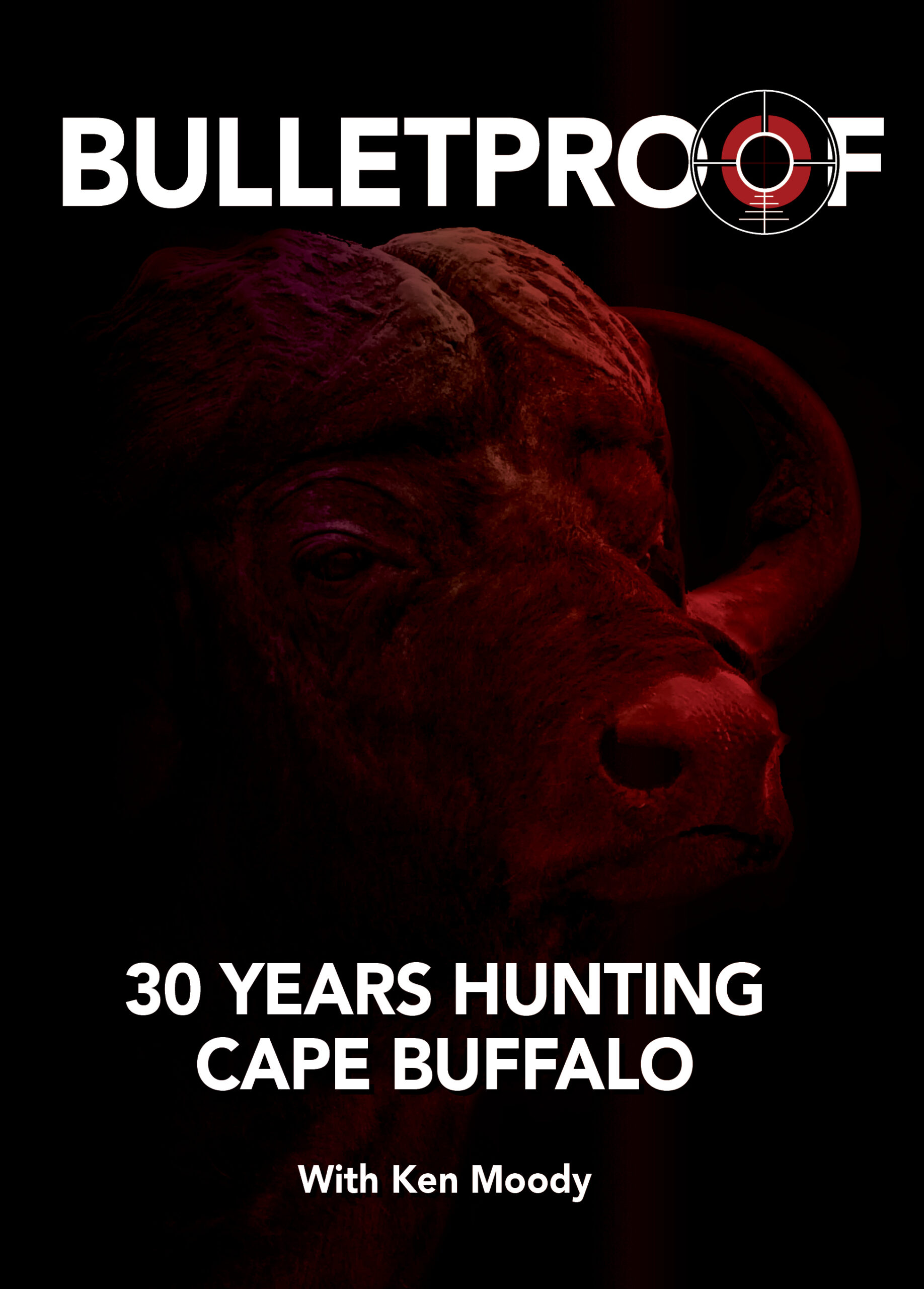
Bulletproof – 30 Years Hunting Cape Buffalo is a beautiful, full color, exciting read from Ken Moody. It contains good information regarding hunting cape buffalo and many adventure stories throughout its chapters.


“Thirty years of hunting ‘Black Death’ has provided me with many lessons and encounters and while I didn’t want to do an encyclopedia on the subject, I have created 136 pages of informative content that makes for an easy weekend read,” says Ken.


Purchase price is $25, which includes shipping to anywhere in the US. You can pay via Venmo at Ken Moody Safaris or PayPal @kenmoody111.  Please provide your shipping details with the order. If you’d prefer to send a check, send $25 to:
Ken Moody Safaris
POB 1510
Jamestown, TN 38556

Latest Information on Rhinos Has Been Published

African and Asian Rhinoceroses – Status, Conservation and Trade, 2025


Commissioned by the Secretariat of the Convention on International Trade

in Endangered Species of Wild Fauna and Flora (CITES)

Report prepared by the IUCN Species Survival Commission’s

African Rhino Specialist Group, Asian Rhino Specialist Groups and TRAFFIC

 Available at: https://cites.org/sites/default/files/documents/E-CoP20-084-A3.pdf


Some interesting data from the report, extracted by John Ledger


Trade dynamics

Illegal trade

  • Between 2021 and 2023, an estimated 676 – 853 rhino horns were sourced into the illegal trade annually, a decline from the 1,531 – 1,729 reported at CoP19. However, this reduction is partly attributable to methodological adjustments accounting for widespread dehorning (covering ~48% of the rhino population; Section 3.1.1.1), and should not be interpreted as a reduction in poaching. Without such adjustments, the estimated annual average would have been 1,160–1,289 horns, underscoring the need for caution when interpreting trends.


  • A total of 921 seizures were collected from the CITES Illegal Trade Database and TRAFFIC’s database to inform the analysis of Parties most impacted by illegal trade. Of these, 750 seizures reported quantities of rhino horn specimens and were included in analysis. Up to 2023, the estimated number of whole horns and total seized weight decreased by 81% and 77%, respectively, since their peak in 2019.


  • For the analysis of most affected Parties in this CoP period from 2021–2023, the seizures relating to rhino horn specimens totalled 1.8 tonnes (equivalent to approximately 716 whole horns1). The largest seizures were 160 kg by South Africa (en route to Malaysia) and 139 kg by Viet Nam (originating from South Africa).


  • South Africa remained the most affected Party, accounting for 66% of global seizure weight and 90% among African range States. Most seizures involving the Party were made by authorities in-country, with South Africa often representing the origin country on the illegal trade chain. The Party had the highest number of illegal trade links, with Malaysia representing the strongest-weight trade link followed by Viet Nam.


  • Malaysia and Viet Nam emerged as the second and third most affected Parties, respectively, with a large cumulative illegal horn weight in seizures involving the Parties, including large-scale seizures implicating the Parties as destination countries based on seizure reports, which does not necessarily indicate end-market demand.


  • Qatar and United Arab Emirates were the fourth and fifth most affected Parties, serving as transit hubs. Seizures involving the Parties from 2021 – 2023 were of large scale averaging an estimated weight of 26 kg, and each Party had only one seizure pass undetected. In addition to their illegal trade links with South Africa being the most prominent by seized weight, Angola was also noted as an illegal trade link.


  • A few patterns observed in the seizure data were of note: an emerging illegal trade link between Mongolia and South Africa in 2023 was highlighted as it was not previously observed in seizure data. Hong Kong Special Administrative Region (SAR) of China and mainland China as well as Mozambique were among the most affected in the last analysis to CoP19, whereas in the analysis conducted to prepare the report for the present meeting, the Parties appear to be less affected. Because of the lack of consistent reporting and bias-adjustment in the analysis, it is unclear if the observed decline is genuine, although a concurrent decline in implicating seizures may indicate support for a genuine decline in illegal rhino horn trade. This potential shift could be the result of effective enforcement and demand-reduction measures, but the limited resources available for the preparation of this report did not allow further exploration of these issues.


Legal trade: Africa


  • In total, 276 live African rhinos were traded during the reporting period since CoP19 (2022-2024). This comprised of six Eastern black (D. b. michaeli), 15 South-central black (D. b. minor) and 255 Southern white (C. s. simum) rhinos.


  • Black rhinos traded were solely for conservation purposes, with 12 to Mozambique, six to Chad and three to the United Republic of Tanzania exported by South Africa (18) and Kenya (3).


  • Fifty-seven Southern white rhinos (C. s. simum) were exported to Zambia, and 55 to the United States of America. The exporting countries were Namibia (107) and South Africa (5).


Hunting: Africa (bold text is my emphasis JL)


  • There were six black (D. bicornis) and 373 white rhino (C. simum) hunts in the reporting period (2022-2024). These took place in Namibia (6 South-western black rhinos – D. b. bicornis; 43 Southern white rhinos – C. s. simum); and South Africa (330 Southern white rhinos – C. s. simum).


  • Hunters of black rhino in Namibia originated from four countries, while hunters of white rhinos in Namibia and South Africa came from 11 and 32 countries respectively.


  • In Namibia, most hunters originated from the United States of America (44.9%), Spain (14.3%) and Hungary (10.2%), while in South Africa hunters originated from the United States of America (66.4%) and Hungary (6.4%).


  • Rhino hunting in Namibia and South Africa occurs at low levels relative to national populations (0.05% to 0.18% of black rhinos and 0.5% to 1.3% of white rhinos in Namibia hunted each year, while South Africa reported 0.79% to 0.91% of white rhinos hunted each year) and, while limited in scale, contributes measurable revenue that can support conservation when transparently reinvested (US$170,000 to S$250,000 per black rhino hunt; most recent for white rhino was US$88,208 per hunt in 2018).


  • Case studies show that well-regulated legal hunting can generate significant revenue—often surpassing eco-tourism—for community conservancies, reinforcing the shift toward participatory conservation models that prioritize fair socio-economic benefits for local communities as essential to long-term rhino conservation success.


  • In 2022, the World Bank launched the Wildlife Conservation Bond (Rhino Bond), mobilizing over $150 million USD to support black rhino conservation in South Africa. This results-based financing model—where investor returns depend on rhino population growth—set a precedent for linking biodiversity outcomes to financial incentives, despite initially slow uptake.


  • By the end of 2024, rhino conservation was increasingly seen as needing to generate revenue to cover costs and thus viewed as a trade-linked enterprise, whereby financial instruments, ecotourism, and community-based ventures transform wildlife protection into a valued land-use that also contributes to local development (Section 3.2.4).


  • Beyond ecological importance, rhino conservation increasingly shows economic value by boosting land worth, tourism, and related services.

Into The Thorns

Chapter Eight


Panthera Pardus


I cannot imagine that there has been as much confusion in early attempts at categorizing an animal as there appears to have been with the leopard! Body sizes, tail lengths and colouration have all been issued as “proof” of different types of these fascinating cats. In Guy Coheleach’s magnificent book ‘The Big Cats’, he mentions that in Imperial Rome, cheetahs at one time were known as ‘Panthera’ and leopards as ‘Pardus’ and were thought to be female and male respectively, of the same species! Clearly the Romans’ debaucherous parties and gargantuan consumption of the grape, dimmed their powers of observation. These folks even thought that a young male lion, still sporting his youth-spots, was a cross between a lion and old Pardus!


All reference books spend at least a page describing the leopard. “Short legs, spotted coat” etc, etc. Everyone reading this book will know what a leopard is so I can skip that part. But I can’t resist putting this down -from Richard D. Estes the Safari Companion – “The embodiment of feline beauty, power, and stealth”. My sentiments exactly!


Distribution

For the umpteenth time, I have to mention the leopard’s adaptability – his tolerance for an amazing variety of completely different terrains. Leopards are found throughout Asia Minor, India, South East Asia, north over theHimalayas, through Tibet, China and into Siberia. This carefully shaded map is interesting, but it’s just paper. Close your eyes and think again, about Tibet, about South East Asia, about Siberia. We are talking about towering, stark, snow-swept mountains – we are talking about thick dripping Cambodian jungles, bamboo-clicking Chinese wilderness – and the leopard is surviving today, in all of them, but without help, without a drastic change in how leopard populations are managed, the leopard will gradually disappear.


Like the other great cats, the leopard’s range has been drastically reduced by humans but not to the same degree as the lion, thanks to his versatility – his adaptability. The place where he has been dealt the biggest impact is in North Africa where he is just about extinct.


For many years Zimbabwe has enjoyed healthy leopard populations. These beautiful predators have survived throughout most of the country, from the towering misty peaks of the Nyanga Mountains in the eastern highlands, all the way to the flat dry thorn-land in the west on the Botswana border. But things have drastically changed in Zimbabwe in recent years. The leopard has been taken right to the brink of disaster, and drastic measures would be needed in order to halt its rapid slide into the endangered levels.


Social and Mating

Leopards are solitary creatures but there is still a loose association between leopard operating in the same areas. Females may well be related like a lion pride. Males should be unrelated as they move into and establish themselves in new areas. Although there is little frequent meeting and greeting between adult leopard, except during courtship and mating, there is no doubt that through scent marking and vocalisation, leopard keep in touch with each other, even if this is an opposing association. Basically, they only socialise with one another for the purposes of breeding and when a mother is caring for her cubs. They are territorial animals with large variations in the size of their home ranges. The size of these ranges is influenced and dictated by the scarcity or abundance of food and cover. These home ranges often overlap – I quote from Richard D. Estes – “Great differences in home range size, even in the same locale, demonstrated in Tsavo National Park, where ten radiocollared leopards that were tracked for three years lived in areas of 3.5 to 24 square miles. Their ranges overlapped by up to 70%; each leopard used only half its range at a time. Male ranges may overlap several female ranges. In Serengeti National Park an adult male and three females hunted the same three mile stretch of river, each independently”.


According to Guy Coheleach in “The Big Cats” – “females do not seem to defend a territory and thus may share overlapping ranges, while the males’ ranges do not overlap each other, suggesting that the males may be territorial”.


I have mentioned elsewhere that Graham and I carried out a detailed marking exercise on the 1:50 000 maps which we keep in both of our camps. This exercise lasted two years. Every time we identified a fresh leopard track, we marked it with a coloured pin on the map and marked down the information which was pertinent to that track. For example “21 June large male, going east”. “15 July, large female and one cub, crossing Simukwe from south to north”. After several months a definite pattern began to emerge, and after two seasons we had a pretty good idea as to the size of the home ranges of our cats.


Our information corresponded with what Coheleach had to say in that the males are definitely territorial. Our dominant male Matobo leopards held a definite home territory which they marked and defended, and this territory overlapped, or encompassed the territories of two, and sometimes three females.


Nearly every book I have read covering the leopards’ mating habits states that leopards mate and have cubs all year round. Estes – “Reproduction is unseasonal”. Coheleach – “Leopards do not breed in a particular season”. Our observations showed a different pattern. While I acknowledge that it is physically possible that Matobo leopards can come into oestrus, and breed at any time during the year, our cats definitely have a peak, or “more active” breeding season. It is a simple matter to detect when two leopards are mating. You see their spoor together on the dusty farm roads, riverbeds and game trails. We dread going up to an eaten bait and finding two sets of adult tracks – we are trying to take the male, and sexing leopard at a hundred yards is no easy thing. But when the cats are mating they are very active, covering a lot of ground, drawing new males in, and they are also very vocal at this time – which helps us decide where to place baits or look for tracks. Our Matobo leopards mate from May through July. Looking back over our records through the years, we note that we have had more successful leopard hunts in those months than at any other time during the year. Why would there be a peak in those months? My personal theory is as follows: The female conceives, let us say, in mid May, she is then pregnant for approximately ninety days. That means she gives birth about mid August. She nurses the cubs until they are about three months old when they are now big enough to start following her; they are big enough to start learning how to hunt. This puts the date at around the end of November. This is when life starts in the southern African bush. The rains come and the antelope drop their young. What better time to learn to hunt than when there are plenty of new babies around? Impala, duiker, kudu, all drop their young in November and December.


Nils Kure wrote a fascinating, complete study of leopards in the Mala Mala game reserve in South Africa called “Living with Leopards”. In this book, along with numerous outstanding photographs of leopards engaged in every one of life’s functions, he has a very detailed chapter on mating. He mentions that in all his observations he never saw a male initiate the act of mating, it was always the female. I found that fact interesting. Estes says that the female comes into oestrus for about seven days and this state will recur again after 25 to 58 days if the female does not conceive. Nils Kure’s observations at Mala Mala show that a mating pair are only together from 1 to 4 days. All of our observations at Marula suggested that mating cats usually spent about a week together.


I found one particular paragraph pertaining to mating leopards in Nils Kure’s book, particularly interesting. “It seems certain that a dominant male leopard controls the matings within his territory. In one instance, the Chellahanga female, who was with the Jakkalsdraai male at the time, left him in response to the Mlowathi males calling. She went far out of her territory and into that area where the Mlowathi male was making inroads on the Jakkalsdraai male’s territory”. So here we can see that a dominant male (the Mlowathi male) was able to call this “hot” female into his area.


The leopards gestation period is from 90 to 100 days and two cubs are usually born. I believe that in the Matobo, most of the time, both cubs will survive. This is due to an abundance of good safe cover, plenty of food, in the form of small antelope, monkeys and hyraxes all found in good numbers around the hills, and also, because of the absence of large numbers of other predators.


Sure, there are snakes, jackals and a few hyenas around, but there are no lions and large populations of hyena and wild dogs to threaten the cubs. We often come across a mother’s tracks followed by the smaller tracks of both her two growing cubs.


Leopards are weaned at about three months, but they still depend on their mother for food for more than a year. At about two years the mother will push the cubs out of her area if they have not already left of their own accord. They can now fend for themselves but they have to tread carefully and often wander long distances trying to find a new unoccupied home territory, but as mentioned previously, there appears to be a loose association between individuals, possibly even some tolerance of young males by their sire, during the break-away period.


The leopard is sexually mature at about 24 months old. The female can mate as soon as she is physically able, but the young male will usually have to wait until he has established his own territory, as a dominant male will kill him if he is found hanging around one of the receptive girlfriends.


The female leopard, barring a condition called ‘false oestrus’, will not come into season again until the second year. For example, if she fell pregnant in early May 2000, she will give birth in early August and will suckle her cubs until early November and then teaches them to hunt and look after themselves throughout 200l. By May 2002, she will be ready to fall pregnant once more.


Size of the Leopard

This is the part where most hunters perk up the interest level; and this is the subject that most of the “untruths” and exaggerations are woven around. But it works the other way too. A lot of reference books are too conservative in talking about leopard sizes. I think it can be summed up thus – most hunters’ accounts make the leopard bigger than it is, and most reference books make the leopard smaller than it is.


Tony De Almeida wrote a book called “Jaguar Hunting in the Mato Grosso and Bolivia”. Any hunter who loves to hunt the big cats should not be without this book. It is an exciting, accurate, no-frills account of hard hunting in rugged conditions.


Tony De Almeida hits the nail exactly on the head with these words – “The length of cats, measured in a straight line between pegs driven into the ground at the nose and the tip of the tail, is a subjective measurement, to say the least, since it is always taken by the shooter of the trophy himself, and, of course, once the animal is skinned, this measurement cannot be repeated. Actually, neither skull measurement nor length is the best indication of a cat’s actual size, although for reliable records, skull measurements must prevail. The best gauge of proportions of a cat is his weight. Here we run into trouble. Few guides or hunters carry scales into the field. Usually the weight of any animal is “estimated”. This euphemism signifying that no value at all can be attached to the figure given.


Years of talking to clients and hearing about the sizes and weights of animals they have shot have permitted us to classify them into two categories. In the first are those who make an honest attempt to correctly gauge the weights of their cats; they usually overestimate weights by 30 to 50 percent, depending on their previous experience in weighing animals. In the second category are those who are not concerned with a correct weight at all but who merely wish to impress their friends and the fellow members of the safari club back home; they overestimate weights by anything from a conservative 80 percent to as much as 200 percent. Most of these people, of course, realise  that they are talking rot but are forced into a vicious circle: Their estimations of weight are nothing more than a question of keeping up with Jones, whocame back from his African safari saying he shot a 350kg lion”.


Whilst I have never heard of a cat’s weight exaggerated by two hundred percent, I frequently hear exaggerations of around fifty percent. The euphoria and excitement that erupts when a nice leopard is taken, is understandable. When a nice male leopard is taken by an outfit that takes very few leopards, the event is cataclysmic. Couple that event with a few silvery-tongued loquacious PHs and voila! You have a 220-pound leopard!


When we bump into PHs from certain companies well known to us, it is standard procedure to be told by them at the Bulawayo airport that the safari has just produced a 200-pound cat. Graham and I look at each other immediately every time we hear these stories and usually he follows it up with some sarcastic comment like: “We need to move our operation from Marula to so and so’s area. The cats we’re shooting are just too small!”


Where do we start in tackling the truth of the leopard’s size?

Let’s kick off with what some of the boffins say:

2004 Carnivore Preservation Trust 85 – 125 pounds

Estes – The Safari Companion 77 – 143 pounds

Coheleach – The Big Cats 55 – 100 pounds

Encyclopaedia Zimbabwe (Quest Publishing) 134 pounds

Meinertzhagen (1938, avg of 6 mature males – Kenya) 138 pounds

Pienaar (1969) 129 pounds


Generally, not very impressive. But when talking about leopards, we are generalising, lumping many different groups, or subspecies, into one box, and that I believe (hunters’ exaggerations aside), is what creates these big discrepancies.


In the Chunya Game Management Area in southwestern Tanzania, I took the complete quota of five animals in 1996. All five leopards were fully mature males in their prime, or just past their prime. The biggest of these cats we estimated at 130 pounds. The other four were all around the 110 to 125 pound mark. From nose to tip of tail, only one was close to 7 feet, the others were all about six-and-a-half feet in length. The tails of these animals averaged 31 inches. Why are they so small there? I do not know. I killed four magnificent lions, all huge bodied, in the same area that year, so it wasn’t as if wildlife there was stunted. The buffalo were also giants. But I do not want to inadvertently give the impression that all Tanzania leopards are small. Tanzania is a big country. I have seen photographs of huge cats taken off Mount Meru’s slopes, and from the Lake Burigi area on the western border with Rwanda.


I have read several writings on the Cape leopard which frequents the Groot Swartberge and Nuweveld Mountains at Africa’s southern tip, and these cats are also small, a “big” male not much more than 100 pounds.


Even in Zimbabwe, leopards vary greatly in size and when I make that statement, I am comparing cats of the same sex and similar age. I have found the leopard in the Zambezi Valley are smaller than most other populations in the country. In my opinion, based on 27 years of hunting them, and on personal research, the biggest leopards in Zimbabwe are found in the south eastern Lowveld, the Matobo Hills and a belt of country stretching from Turk Mine, north of Bulawayo, westwards, to the Gwaai river in the Khami district. I have read in several places that leopards found in northern Iran are supposed to be the largest subspecies in the world. In Tony De Almeida ‘s book he says “D. Laylin, engaged in a program for trapping leopards in Iran and transferring them from one region to another, told me that the largest male they caught, weighed Just over 176 pounds”. I don’t know how many cats D. Laylin trapped, but I can say without hesitation, that if this 176 pounder was top of the pile, then Panthera pardus Matobo is the King – they are a lot bigger than the supposed largest subspecies – the Iranian cat.


I quote further from Tony de Almeida’s book.

“T. Sanchez-Arino and W. Bigi (personal communication) during 1983-84 weighed twelve male Leopards from the Loliondo region of Tanzania. Their average weight was 136.4 pounds (62 kilos) and the largest leopard of the twelve – scaled 173.8 pounds (79 kilos). Sanchez-Arino said that this was the biggest leopard he had ever seen, out of the nearly 130 shot by him or his clients in different parts of Africa over thirty-five years.”


The summary of these findings reveals two facts. One, that the 220-pound leopards one regularly hears about at the airport are mostly the figment of active imaginations, and two, there appears to be more large leopard, over 150 pounds, found in the Matobo Range than anywhere else.


Graham’s father, Bill Robertson, kept records of many of the male leopards which succumbed to his counter measures of traps and poison over the years. He found that most of the mature males were in the 140 to 150 pound range. Very few broke that barrier. Of course he was not trophy hunting, so if his actions accounted for a dozen or so cattle killers over a three or four year period, maybe only a few of these would be large mature males.


There are always exceptions, just like there are short and tall people, but we have found that the average size of what we call a “good” or “big” male leopard in the Matobo Hills has the following measurements-

Tip of nose to end of tail – 86″

Length of tail – 36″

Circumference at base of tail – 9″

Circumference of cat around stomach – 37″

Circumference of cat around chest – 35″

Circumference of neck – 23″

Circumference of head behind ears – 23″

Circumference of head in front of ears – 24″

Height at shoulder – 26″

Circumference of forearm – 12″

Weight -150 to 160 pounds


I once took a cat with a tail of 42″. In 2006 I took a beautiful heavy Tysonheaded cat with an unusually short tail of 31″. Quite a big variation.


The heaviest cat I have ever weighed was 187 pounds and that cat had nothing in its stomach. I have taken two others which I kick myself for having not weighed – both of these I believe could have gone to two hundred or very close to it. The cat that Graham took with Dan Dickey, which became the Zimbabwe record, weighed 196 pounds with just a little meat in its stomach.


Just because I have never seen, or weighed a 200-pound leopard, does not mean that they are not out there. Thousands of leopards have been taken over the years and I have no doubt that several of them weighed over 200 pounds, but these monsters are not nearly as common as all the stories would have us believe.


When we first started taking big leopard in 1987, a 16″ skull was quite a big deal. In fact I took one around 17″ with a hunter named Gene Yap, which went into the record books at about number ten or so. Now, twenty years later, that leopard has been pushed way down the rankings. 16″ is no longer the big deal it was in the 1980’s.


To measure a cat’s skull you have to boil, clean and dry the skull. Once this is done, you seat the lower jaw in its correct place and lay the cleaned skull on a flat surface. Using callipers, you then measure the length of the skull, and then you add that measurement to the width of the skull. These two measurements added together make the magic number.


Since those early days in the eighties, I have taken nine leopard with skulls  that measured over 17″. These were monsters. But those measurements paled when levelled against Graham’s 18 ½” giant. Graham told me that the head on that leopard appeared too big for the cat’s body, and looking at the photos, I believe he is correct. Of course that leopard is a beauty in anyone’s language but the head does look slightly out of proportion to the body. Point here, is you could have a 180-pound leopard with a 17-inch skull, and you could have a 180-pound leopard with a 16-inch skull. What makes these, or any leopard,  bigger or smaller than their relatives?


Firstly, I believe there has to be a correct ratio of leopard to habitat. Too few leopard, and you will eventually have too much interbreeding, stunting growth. Too many leopard, and the food supply will not be sufficient to grow big healthy cats. Secondly, I believe that the abundance and quality of foodstuffs can influence growth, and also, the degree of ease or difficulty in acquiring that food must also count.


Colouration

The second Matobo leopard I took, with a hunter from the east coast named Jerry Lee, back in 1985, had markings which were unfamiliar to me. Admittedly, at that time I had not examined many leopard skins but when I thought about the dead leopards I had seen up at the Landreys’ concession in Matetsi and the full-mounts I had stared at in Coffin Grey’s Taxidermy in Bulawayo, I realised that these markings on Jerry Lee’s cat were different. How strange that the first big male I ever took in the Matobo, this one of Jerry Lee’s, had the most clear pronounced example of what we would later know as “mountain type” colouring!


But the excitement of taking leopards, the excitement and hustle and bustle of the growing of our business, far overshadowed any interest I may have had in any differences in colouration in the cats we were taking. It was only when we returned to the Matobo, when we set up our camp on AJ Bradnick’s ranch and began to enjoy regular success on our leopard hunts, that we began to notice these variations. I collected up all the good clear photographs of leopard that we had scattered about and had many of them enlarged, laid them out side by side, and the differences in types of markings were as clear as day.


Excitedly, I rushed out and collected all the reference books I could find on leopard. Surely we had a “new” subspecies here? Of course it turned out that scientists had noted, and had been pondering over the differences in leopard markings for hundreds of years. An English naturalist, R. I. Pocock, produced many fascinating studies on the world’s wild cats between 1907 and 1932, and I found several essays on colouration variation attributed to him.


This comes from Coheleach – “In the African leopards, Pocock has found a clear correspondence between the principal colour variations and the specific environment. The leopards of the savanna or veld are yellowish tawny brown, and the leopards of the tropical rain forests are darker and duskier. On the basis of the geographical distribution of these colour variations, as well as overall size, Pocock has recognised a large number of subspecies – 11 subspecies of Asiatic leopards and 17 subspecies of African leopards. Recent lists, however, generally recognise fewer subspecies, many of which are still unverified because of the lack of sufficient material to assess the variation”.


This comes from Catfolk Species Accounts: Leopard (Panthera pardus) (Sub-Saharan Africa) “Coat colour and patterning are broadly associated with habitat type. Pocock (1932) found the following trends in colouration for leopards in Africa:

Savanna leopards – rufous to ochraceous in colour;

Desert leopard – pale cream to yellow-brown in colour, with those from

cooler regions being more grey;

Rainforest leopard – dark, deep gold in colour;

High mountain leopards – even darker in colour than 3.

So having digested all this, it was obvious to me that the beautifully marked cats we were seeing in the Matobo Hills had their colouring and rosette patterns adapted by evolution to suit their surroundings. Darker shadows and thick cover in the hills – as opposed to more open dry yellow grasslands. I carried out further investigation, harassing taxidermists and other professional hunters so I could compare and photograph as many different leopards skins as possible.


Like zebra, if you look carefully at leopard skins, they are all different. In Zimbabwe alone we notice variations in both “ground colour” and “rosette pattern” but basically it seems there are two main types. We called them “savannah colouring” and “mountain type colouring”. Savannah skins are a pale yellow with smaller rosettes. The savannah rosettes are mostly “broken” or “open” rosettes. Each rosette is made up of three to five separate dots, sometimes touching one another, sometimes not. These rosettes on savannah skins are more numerous than the rosettes on mountain type skins.


Mountain type skins are more colourful, more striking, and they resemble jaguar colouring in many instances. The background on these cats is usually a richer gold colour, often becoming a darker rufous ochre on the back. The rosettes are fewer and bigger. Also, rosettes which are “closed” are more numerous on these mountain type leopard. By “closed”, I mean that they form a complete circle, or ring of black, and often the fur inside this ring is of a slightly darker hue than the overall “base” or background colour of the cat. Another noticeable feature of these beautiful pelts is that they have more big, solid black markings than savannah skins, mostly along the spine and base of tail area, and on the stomach.


I have only ever found this “mountain type” colouring in the Matobo hills. I have found “savannah” skins on leopard I have taken in the south eastern Lowveld, Chewore in the Zambezi Valley, Matetsi near Victoria Falls, Mberengwa, Shangani, the Kariba Basin, Beitbridge, Nyamandhlovu and Lonely Mine. Further afield I have taken these cats in Northern Masailand near Lake Natron, southern Masailand at Talamai, the Chunya area in south western Tanzania, and in the Selous Game Reserve. They are far more common than the “mountain type” skins.


Not all Matobo cats have this mountain colouring though. About one third of the leopard we take in our Matobo areas are “savannah” cats, the rest sport the beautiful gold and black of the “mountain” type.


I was recently on safari in the Magudu area south of Pongola in northern KwaZuluNatal, not far from the Swaziland border. On that safari I had the opportunity to see a huge male leopard in the wild at about ten yards! He was a beauty, with a big flappy dewlap hanging from his thick neck. This big boy also had a very light coloured coat with small savannah rosettes.


This would be incomplete if I did not mention the black leopard. In “The Panthers and Ounces of Asia” Pocock 1930 – he states “The frequency with which the black variety of leopard occurs is quite different in Africa and Asia. The black form is common in southern India and frequent in Java and the southern parts of Malaysia. In contrast, it is infrequent in Africa, except in the Ethiopian highlands, where most individuals are melanistic”.


I once had the opportunity to see a melanistic leopard. It was in an enclosure in the Chipangali Wildlife Orphanage outside Bulawayo. This animal I think, had come from Ethiopia. It was beautiful and when it stood in the sunlight, we could see the rosette pattern underneath its black coat. Very unusual. I have only heard of one sighting of a wild black leopard in Zimbabwe and that was in the late 1980s in Chewore. One of the professional hunters there reported seeing a fairly small black leopard cross the road in the evening, in front of their Land Cruiser.


Populations and Home Ranges

The following factors all seem to influence the size of a leopard’s home range- availability of food, availability of good cover, persecution by man, and abundance of large predators, e.g. lion. But, the most important factor seems to be the leopard’s territorial requirements – which is not influenced so much by the food base, but by the number of females a male can cover. Our own private study was initiated for several reasons. With every year that passed, after the end of the Rhodesian war, commercial interest and participation in hunting safaris grew. When the economic meltdown became a new factor from about 1998 onward, many people including some farmers, had to shut down their businesses, they were simply not viable any longer. Many of these people then entered the safari industry. This growth in the industry led to the “opening up” of new areas, and this, coupled with the advent of hound hunting resulted in a surge of successful leopard hunts in the Matobo range. Several of us were concerned that too many leopard were being taken out of the district. The first hurdle in trying to find an answer was to try to establish how many leopard actually lived in this area.


I read everything I could get my hands on which covered leopard home ranges. But most studies I found had been carried out in the plains of East Africa – in very different country to the Matobo hills. Theodore Bailey carried out a very detailed study in the Kruger National Park in South Africa, and in that study (The African Leopard, 1993) he said – “the home ranges of adult male leopards varied between 16.4 and 96.1 sq kilometres and were much larger than adult females. Unlike females, adult males moved rapidly from one end of their range to the other in predictable patterns”.


Graham grew up on Garth Farm and I had hunted it for many years, so between us our knowledge of his twelve thousand acres was intimate. We already had a good idea of how many leopard lived on the farm but we decided to go ahead with the map marking project anyway.


Very quickly, we ran into problems. Unfortunately leopards don’t utilise our fences and maps to demarcate their home ranges! They use urine and a series of grunting calls, so inevitably, our cats’ areas encompassed other peoples’ properties as well. Obtaining permission to go onto these neighbouring properties was not difficult but our hunting operations did not take us onto these other farms regularly, so our information on leopard movements there was sketchy. However, we managed to convert our information into home range diagrams which we believed were fairly accurate.


Another problem was the identification of spoor. Different types of ground structures portray the same leopard track differently. Loose sand and mud cause the leopard’s foot to splay open, thereby exaggerating its size, so if one hunter saw a certain male’s track in loose sand in a dry riverbed, it would look different to the same leopard’s track seen by another hunter on a dry hard road. Furthermore, I might see a mature male track in a certain place, and later, at camp, ask Graham if he knows anything about that male. He may answer – “No, I didn’t see that male track, but I saw a female track near that place yesterday”.


So now we would be unsure, we wouldn’t know if the track we saw had been made by the same leopard, or by two different cats. To overcome this problem of track identification we decided to measure the tracks as accurately as possible. This worked perfectly. It not only helped us decide if we had seen the tracks of the same leopard but it became a way of “gauging” the size of a leopard and this helped us to decide whether to bait him, or if he had eaten a bait, whether we should sit for him or not. More of this measuring technique shortly.


After two years we were able to conclude the following information on Graham’s twelve thousand acres.

  • A big dominant male had a home area of about twelve thousand acres, two thirds of which fell on Graham’s property.
  • Another male, slightly smaller, had a home range to the west of Graham’s property and one third of that home range merged onto Graham’s ranch.
  • The big male’s area covered the territories of three females.
  • Two of the females were large and mature whilst the third appeared to be a younger animal.
  • One of the big females had a cub which occasionally followed her.
  • The females’ territories were about 3.5 thousand acres in extent. A few times a year, maybe three or four times, a giant male came right across the eastern half of the ranch in front of the camp to the Mangwe Pass and then would disappear again. We named him ‘Smiths Block’ after the ranch to the east of us where he appeared to have his home. Every year one, and sometimes two, unknown males would come onto the property for a few days. I felt certain that these incursions were the result of females coming into heat. In 2004 I took one of these trespassers very near to camp, and he was a beauty. This leopard is the one mentioned in “Last Day Plus One.”
  • We further concluded that in any seven days throughout the year, we could find the fresh tracks of five different leopards on Graham’s twelve thousand acres. Usually three female tracks and two male tracks. Even with this information it was impossible to extrapolate our findings to the leopard population in the district. Some areas, like private ranch land, where the farmers were resident and active in anti-poaching activities, we classed as “good” game and leopard areas. Other areas where poaching was a problem but good cover was evident and some small game still existed, we called “possible” areas, and then there were areas like sparsely populated communal lands where resident game had been poached out. These areas occasionally had transient leopards through them, and we branded these “poor” areas.


We lacked the time, drive, funding and co-operation to mount any more detailed studies on the leopard populations of western Matobo, but we’d made a start.


About twelve miles north of Garth Farm, towards Marula, is a ranch called Stone Hills. This was once an overgrazed cattle farm which was lovingly turned into a top game sanctuary by Richard and Bookey Peek. Richard has a degree in zoology and he served with the Rhodesian Department of Parks and Wildlife for fourteen years. He has also been the owner of the biggest taxidermy business in the country as well as the curator of mammals in the National Museum, so he is an authority on wildlife and wildlife management. Bookey is an accomplished travel writer and author and qualified lawyer who focused her energies and talents into learning about nature and developing Stone Hills into a veritable Eden.


Richard was interested and also concerned about the quota allocations and leopard populations in the district so Graham and I met with him. In his “take charge” fashion Richard drew up a plan for all of us in the district to submit various information covering leopard taken by our clients, like dates, sizes etc. I dug out all the information we had, right up to the end of 2001 and Richard entered all this on a huge map of the area. The land takeover programme accelerated in 2002. Suddenly everybody had far bigger concerns than the leopard population – like – “will my family have a home tomorrow?”


So unfortunately our whole programme went on hold. In a conservative bit of a “thumb suck” we laid guesses about our western Matobo leopard densities as follows.

Good areas – 12 000 acres would hold one dominant male. Three resident females. One cub. One “visiting male”.

Possible areas – 24 000 acres would hold one dominant male. Three resident females. One cub. One “visiting male”.

Poor areas – 60 000 to l 00 000 acres would hold one dominant male.

Three resident females. One cub. One “visiting male”.


Leopard Tracks

In order to differentiate between different leopards in our areas, we decided to measure their tracks. Graham, myself and the trackers agreed that we would not measure tracks found in mud or loose sand as these would give false, bigger measurements. Whenever possible we tried to follow or backtrack until we found spoor made in fine dust on a hard surface. Not too difficult on the network of game trails, footpaths and dirt roads on our areas. We made three measurements in inches, or eighths, and even sixteenths, of an inch. The first was from the top of the track, down longitudinally, to the bottom of the pad or “heel”. The second was the width, laterally across the widest part of the track – about the middle. The third was also a lateral measurement, this time the width of the heel, or pad at the bottom, or base of the track. We measured only a front foot track. The front feet of a predator, just like those of most other animals, are larger than the back feet. The leopard’s back feet are not only smaller than the front feet but are slightly more elongated, elliptical, than the ‘square’ looking track of the front foot, especially in females.


We found that big male leopards had tracks which measured about 4″ in length, 4″ in width and had a base measurement of 2″ to square a total of 10″. Of course leopards, like people, vary, and some left tracks for example – 4 2⁄8″, 4″, and 2 3⁄8″, for a total of 10 5⁄8″. We would be able to measure and recognize that track because of these small differences.


The biggest track I have ever seen squared 12 ¼”. I saw these on the main Mangwe-Thornville road twenty miles south of the Mangwe Pass near a big koppie called Ejime (African pronunciation of the name Jim) of course we  named this cat Big Jim but we never came to grips with him. We saw histracks for about five months and then no more. He must have died a natural death of snakebite, old age, or fighting. I would have loved to have seen that leopard. The whole project became very interesting when we started measuring the tracks of all the trophy cats that came back to camp. We would take the leopard’s foot before rigor mortis set in and push it down gently onto a hard, lightly-dusted surface. After a couple of seasons of doing this, the following were the conclusions we came to:

No cat whose front foot squared under 9 ½ inches , ever made what we called “big” – or “good” (140 – 150 pounds).

We would hunt a cat whose track measured 9 ¾ inches or more.

Some giant leopards – ‘supercats’ had feet that were, surprisingly, small for their size but these tracks were never less than 10 inches square.

Even though the above was true, we never found that a small leopard carried big feet, (10 inches square and over). In other words, a good size 10 inches track, in our experience, never ever produced an inferior cat, but an average track, of 9 ¾ inches to 10 inches, occasionally produced a giant leopard.


A big male Matobo leopard, when “strolling”, has a measurement of 37 inches between one front right track and the next front right track. The measurement between his right front track and left front track was 18 inches. The measurement between the front right track to the second front left track, is 59 inches.


When “strolling” or walking slowly, a leopard’s tracks are ‘evenly spread’ – all four foot tracks are almost equidistant from one another. When the cat picks up his pace – ‘on a mission’ we call it – then the back foot tracks lay on top of, or very close to, the front track. When a leopard breaks into a run his tracks will again become well spread out, equidistant, but obviously now there will be deeper rougher markings in the ground.


Like lions, big old male leopard often “scuff’ their front feet when walking, leaving a brushed mark in front of their track. Whether they do this only when they are tired, or when they are past a certain age or weight, I do not know.


Females do not do this. Really big old males both in lion and leopard also seem to grow a lot more “spare” hair on the tops of their front feet, and this thick hair is what makes the scuff marks.


The Leopard’s Call

The most commonly used description of the leopard’s call is “like sawing a piece of wood”. If you stood a big piece of plywood, about four feet by four feet in size, on its edge and you began to saw the top edge at right angles with a regular wood saw, you would indeed produce a sound very similar to that made by a leopard.


Like lions, tigers, and jaguars, leopards are classified as one of the ‘roaring’ cats because of their ability to push out this sawing noise. It is a primal, hair raising sensation if you are ever close to a calling leopard. The closer you are, the more deep and guttural, and boar-like, the sawing grunt sounds. It seems to emanate from a deep hollow chest, much bigger than that owned by the leopard.


Very little has been written about the leopard’s call. Some believe that the call may be a way of “spacing” their areas – letting other cats know that “this area is spoken for”. After all, these cats probably do not want to risk danger and mishap by fighting all the time. It makes sense that they regularly advertise their presence so they can avoid conflict with one another.

It also seems pretty obvious that, like most other wildlife, they have different calls to attract mates and to express irritation or anger. I have never heard a leopard call on his way in to the bait. I have, however, heard them calling – sometimes continuously – as they walk away from a bait once they have discovered our presence.


In our areas in the western Matobo, the leopards are more vocal in what we believe are the “mating months” of May, June and July and we hear them regularly from our mountain camp during that period.


The call is usually a series of these sawing grunts, numbering between twelve and sixteen ‘saws’, counting the “push” and the “pull” of the saw as two calls. The two strokes have a different tone, the indrawn breath being slightly less loud than the deeper “out” breath.


After reading Tony de Almeida’s Jaguar hunting book for the umpteenth time, I decided to try to call a leopard. In the Mato Grosso the hunters use a hollowed-out gourd called a cabaca to imitate the jaguar’s call. This gourd has two holes cut into it, one larger than the other. The caller blows into the smaller hole and the call is emitted from the larger one. I saw another apparatus in Mexico, also used to call Jaguars. This too was a gourd. It was about the size of a soccer ball with a circle cut out about eight inches in diameter. All the seeds and pith had been cleaned out through this hole. The hole was covered tightly with stretched, shaved goat skin, secured over the hole with tiny wooden pegs. The caller turns the gourd so that the skin is facing the ground. Out of the centre of the skin hangs a cord of plaited horse hair about sixteen inches long. This horse hair rope is liberally covered with resin. The caller grabs the gourd’s “handle” in one hand, and then holds the horse hair rope between the thumb and forefinger of the other hand, and squeezing this rope gently, he pulls his fingers quickly and firmly down, to the end of the rope. A jaguar-like grunt is emitted.


Jaguars can be called in with these devices. De Almeida wrote a whole fascinating chapter in his book about calling these beautiful beasts and it is exciting stuff.


Leopards and Jaguars are similar in so many ways. Surely I could do the same with our Matobo cats?


I found two large gourds in a curio shop at Victoria Falls and I carefully cut a ten inch diameter hole into one of them and cleaned it out. The tone of my voice is suitable for imitating the leopards call. I have coerced lions into answering me in the still pre-dawn. This can be done by imitating their lowing call into a five gallon bucket suspended from a low branch, with about two inches of water in the bottom of the bucket. This contraption creates a kind of resonating effect and produces a tone that travels for miles. I grunted experimentally into the gourd. To me it sounded perfect. I walked about five hundred yards away from camp and called again. The trackers said it sounded exactly like a leopard!


I decided to test the call whilst hunting leopard with Dan Greene. Just as the sun went down one evening Dan and I climbed a small koppie next to a bait that we had placed in the notorious spot on the Chavakadze river. We knew that a giant cat operated here but he had not been to his watering spot in a while. Maybe we could solicit a response from him if he was in that neck of the woods.


I called intermittently for about an hour. It sounded perfect. But there was no response except the impertinent questioning bark of a juvenile baboon a couple of hundred yards away. We packed up and drove back to camp. The following day at the end of our tiring bait run, we checked the Chavakadze bait. The bait was shredded! And there, in the soft wet sand of the Chavakadze were the huge tracks of my old adversary.


Had the gourd called him in? Was he on his way here anyway? There is no way of knowing. Dan and I sat that night but that crafty old campaigner never showed himself.


In the Pantanal and the Mato Grosso the jaguar hunters use dogs to bay the jaguar. A few jaguar were shot by Tony De Almeida’s clients after they had been called right up to the hunters, but usually the gourd was used to solicit an answer from the cats so the hunters knew where to unleash the dogs in the morning.


I tried several more times to cajole an answer from a leopard but did not succeed. Busy checking baits and reacting to eaten baits, I never really have a lot of opportunity to pursue this possibility. We are very successful with the baits, so there is no real reason to continue with the calling, except for my own interest.


All our African staff and some PH’s tell me that they can tell what sex a cat is by listening to its call, but I do not believe it. We have listened to a deep gruff grunting during the night and carefully pin-pointed its direction, and then in the morning have found the tracks of a female.


Maybe, with practice, someone could become skilled enough to differentiate between male and female calls, but in my opinion they would have to listen to a lot of calls and they would have to be able to positively identify the caller each time. Just about impossible.


Prior to experimenting with the gourd, I found a fairly poor recording of a leopard grunting. I taped this call to repeat continuously every ten minutes on a cassette tape. AJ had lost two calves to a leopard about a mile west of the prominent Dombolefu Hill, but we were not in the area at the time so I promised to try for that cat when we returned. When I packed the equipment for the next safari down at the Ingwezi, I included the leopard cassette and a player.


We placed the cassette player on top of a small koppie late in the evening and camouflaged it with some leafy bushes. Next we placed four baits in a semi circle around the koppie, all linked by a blood trail. We turned the player on, switched the cassette to play continuously and drove back to camp. We figured on getting a good two or three hours out of the battery at least.


I felt there was a good chance that if a leopard was within hearing distance he would come and investigate a call that he was unfamiliar with, and hopefully he would find one of our baits.


When we arrived back at the koppie the next morning, we saw fresh leopard tracks! These were on the road about two hundred yards from the caller. We found no tracks near the cassette player and none of the baits had been touched. Peter was sceptical that the caller had worked but I was convinced. Surely it was too much of a coincidence that these tracks turned up on this road the very night that we tried the call? I believe that the cat had come to investigate the new leopard, but was just too careful, too circumspect to come any closer. Maybe he was not a big dominant male and was scared to take a bait with another male calling so close by. Maybe at close range, to the leopard’s perfect hearing, the tape was just not convincing enough.


I have heard three reports which I believe are reliable, where hunters have called in a leopard with a predator call. A leopard is a super predator and an opportunist, and eats rabbits and small antelope – why would he not come to the bleating sounds of his prey in distress?


I have tried this several times but have not met with success. When calling in our areas with a rabbit call at night, we have found that jackal, genet and occasionally a pole cat, will come quickly and aggressively to the call. Cape wild cats, serval and caracals will come within about a hundred to two hundred yards, and then sit there, usually in cover. They are more careful. Maybe this is the same with leopards.


Of course, first of all you have to have a leopard within hearing range of the call, so it’s quite likely that on occasions when we have called, we have not actually been within range of a cat in the first place.


A few years ago Graham and I put the metal frames and mattresses in a tree so that a friend of ours from the States, John Strobel, could sit for a caracal. The caracal had been using a dirt road about half a mile south of the camp quite regularly. We positioned John about a hundred yards north of the road, on the edge of which we had secured a dead guinea fowl. The following morning we left camp early to go and see how John had fared. Half a mile west, downwind of where we had left John, I got out of the vehicle to open a gate. I noticed the fresh tracks of a female leopard following the road. We drove on. Two hundred yards further, we noticed that the tracks were now splayed, running. We thought no more of it and drove on to the tree hide. John had seen no caracal, or anything else during the night. We were loading the blankets and mattresses he was throwing down to us when he mentioned that he had blown his rabbit call for about half an hour at around five o’clock that morning. Immediately my mind went back to the splayed leopard track. Peter and I walked west, back along the road until we found where the cat had turned off the road. Peter followed the spoor. It stopped running and continued in a “walk mode” to a point where Peter indicated that the leopard had crouched down, facing the tree hide! John had called in a leopard without even knowing it!


Full Moon

As the moon becomes full, so leopard activity on and around baits slumps. Why?


Like ballistics, this one is for campfire debate. Of course there are plenty of theories. But theories are just opinions. But make no error, bait activity decreases when the moon is full. That is a fact, not an opinion. I have taken several leopard during full moon, and I know a few other professional hunters who have done the same. But these few incidents were definitely exceptions to the rule.


During the week building up to the full moon, not only are the baits not hit, but leopard tracks are simply not encountered as often as they are during the rest of the month.


We have puzzled long and hard over this one. Where do the cats go? Why do they walk all over the dry riverbeds, roads and pathways for three weeks, then suddenly vanish for one? I have heard several theories, but I believe that the real reason is probably a blend, or mixture of all of them.


Plainsgame animals increase their nocturnal activity during the full moon. Most wildlife books, including R.D. Estes, tells us this, and most hunters will know about the poor game viewing days when animals are lying down in daylight hours because they have been up all night feeding. Not only plains game animals are up and about during the bright moon. Even rock dassies, which are normally totally diurnal animals, are out of their protective cracks and crevices during full moon. And in the Matobo, leopard hunt dassies. So maybe the leopard tracks are not evident all over the savannah because their owners are amongst the koppies during the full moon. Maybe leopard are more successful at hunting antelope at night, when they are grazing, than when they are lying down in the open, alert, ready for attack. Perhaps they try harder to catch fresh game during this time of easier hunting and therefore ignore the smell of our baits.


Another thing that I’m certain comes into play with our Matobo cats ‒ and in fact any leopard that lives in an area where he is persecuted by man, is the feeling of exposure. Farm leopard are about 99% nocturnal. They have become this way because of human activity. Maybe, when the moon is full this feeling of exposure persists.


Several times I have been forced to sit in a blind next to a fortress koppie – our set-up has been dictated by a cattle killer who has dragged the calf into cover up against, or inside one of these horrible places. When this has happened during the full moon we have noticed something interesting. Imagine a range of fortress koppies, about a mile long and a thousand feet high, running north-south. A calf has been killed on the east side of these hills and dragged up and eaten at the base. Your blind is a hundred and twenty yards north of this calf, also on the east side. The wind is coming gently from the southeast. Except for the worrying fact that the leopard is probably lying up in the rocks watching you, it’s not a bad set up.


It is full moon. So the big orangeness of it climbs out of the horizon at about six thirty – leopard time, just as the sun has disappeared. But no cat comes. Within an hour the heavy moon is no longer orange, it is yellow, then it is white. At 10pm you can read your book, and you can see the face of your watch. It is very, very bright. Still no one comes to claim their dinner.


If you have not done this before, you give up and climb into your blankets, before long you are snoring nicely. No leopard will come. But we have done this before. Late, between 10pm and midnight, the moon sinks west behind the range. The heavy black shadow you’ve been waiting for sweeps over the bait, blind and the bush. It is bright as day on the west side of the range and it will remain so all night. But on your side, on the east, it is black. And the big, careful calf killer comes in.


This has happened to us several times. To me, it’s proof. The leopard has waited for darkness to hide him before he comes into the kill. Why? It can only be because he feels exposed in the bright moonlight.


Once the moon has reached full, it will rise above the eastern horizon about an hour later every day, and it is waning, becoming smaller each time it comes up. If we have hunters whose safari is not dictated by time off work, or other influencing factors, we advise them to try to arrive three or four days after the full moon, this ensures that their fourteen-day safari will enjoy pitch black nights and, theoretically, lots of leopard activity.


Another thing which seems to influence leopard activity in the Matobo hills is cold “guti” weather. When the guti rolls in, especially in the colder winter months, leopard activity increases. I can only guess at the reasons. Maybe the cats need the activity of the hunt, or the meat itself, to generate warmth in their bodies – maybe it is warmer than curling up into a ball way up in the rocks. Graham always expects bad news from the cattle herders immediately after or during guti weather as this is usually when calves disappear. Not only does this low murky drizzle prompt the leopards into activity, it seems  to embolden them into taking cattle during the daylight (albeit dim daylight) hours.


A Few Interesting Notes

Leopard and lion have ‘floating bones’. These bones (there are two of them) are situated on either side of the centre of the brisket, a couple of inches inside the flesh, – where the ‘collarbones’ would be if a cat had collarbones – and that’s exactly what they are. “Floating” bones are relic clavicles. Most walking mammals of reasonable size have lost the connection from the shoulder apparatus to sternum; therefore the use of the clavicle has fallen away and in many ‘advanced’ species is all but gone completely. Different carnivores show differing stages of this ‘left over’. In cats there is something more substantial although completely non functional. The added flexibility of not having a clavicle connection to the sternum allows for greater reach in fast moving animals and also a wider stretch and grasp needed for cats.


Mammals that have retained the clavicle are primates, some insectivores, bats and monotremes (platypus & echidna). Certainly for bats and primates one can see the use in retaining a brace for the flying and brachiating (swinging from limbs) locomotion. Next time you eat a roast chicken, grab the ‘wishbone’. If you cut this wishbone down the centre, where it joins, the two pieces will look a bit like a cat’s floating bones. I have seen some beautiful ladys’ jewellery fashioned out of these floating bones and the hunter should make a point of asking his guide to have themcleaned up and delivered to him.The unusual bones are also considered by hunters as lucky charms – a very good reason to make sure you keep them!


Like dogs, cats have five claws on the front feet, and four on the back feet. But that’s where similarities end. Dogs’ claws do not ‘retract’ – they are permanently on show, permanently in use – gripping the ground when running, scratching themselves, and so on – and because they are permanently in use, they are quite blunt. Grab Fluffy off the TV and give his tummy a hard tickle. You’ll see a very different set of claws. These are not running aids or flea scratchers. They are weapons. Cat’s claws are always sharp. They have to be – their main functions are snagging desperate fleeing prey, fighting, and climbing trees with more than double their own weight held firmly in the mouth.


The inside claw, which is higher up the front leg than the other four claws, is known as the “dew” claw. This claw is the biggest knife in the cat’s arsenal; it is a good third bigger than the rest of the claws, and in a big leopard, or a lion, that’s plenty big. These claws can be removed from the skin of the leopard trophy without damaging it in any way, and like the floating bones, they can be fashioned into unusual, beautiful jewellery.

Into the Thorns is now available at Good Books in the Woods

www.goodbooksinthewoods.com

jay@goodbooksinthewoods.com

Fascinating Fifties

A .505 Gibbs, built on a Granite Mountain magnum Mauser action.  The action and the .505 Gibbs seem made for each other, probably because they actually were, way back when.

By Terry Wieland


In 1972, up on the Tana River in Kenya, I ran into a white hunter by the name of David Thompson.  David was a thin little guy, going grey as might be expected of someone who made a living chasing mean stuff in the thornbush.  He was armed with a squat, heavy-looking bolt action rifle, devoid of bluing but also devoid of rust.  Obviously, a rifle that had been around, but was well cared for.


Naturally, I asked about it.  A .505 Gibbs, he told me.  Had it for years, he said, and it looked it.  The magnum Mauser action appeared to have seen service at Dunkirk, if not Stalingrad, and who knows what its history was.  In those days, anything hailing from Germany (including much of the French Foreign Legion) were a little cagey about discussing their past.


David handed me his rifle, and immediately I understood why Ernest Hemingway’s fictional hunter, Robert Wilson, described his own .505 Gibbs as “this damned cannon.”  It was a cannon, indeed.


Largely due to Hemingway, the .505 Gibbs enjoys a reputation that far outstrips its actual use in the field, or the number that were even built in its first 80 years.  Most estimates place the number of original .505s at no more than a hundred.  Comparable figures hold for the equally fearsome .500 Jeffery and .600 Nitro Express.


The .505 was introduced by George Gibbs in 1911, using a completely original case.  The .500 Jeffery, on the other hand, was an English rendering of the 12.5x70mm Schuler, which came along in the 1920s, designed specifically to function in a standard Mauser 98 military action.  On paper, the .500 Jeffery shades the .505 ballistically, and, until the .460 Weatherby arrived, was touted as the most powerful magazine-rifle cartridge in existence.

A .505 Gibbs with a proper 22-inch barrel, this one a custom Granite Mountain.  For reasons that escape me, it has become fashionable to fit .505 Gibbs rifles with 26-inch barrels.  This is totally unnecessary, ballistically, and makes the rifle very unwieldy.

That claim probably accounts for the fascination with it by American big-bore enthusiasts ever since the first edition of Cartridges of the World appeared in 1965.  For the record, the Jeffery (allegedly) uses a 535-grain bullet at 2,400 fps (6,800 ft.lbs.), while the .505 fires a 525-grain bullet (2,300 fps, 6,180 ft.lbs.)  Ten grains of bullet weight and 100 fps account for an additional 1,820 ft.lbs., which shows how velocity can skew perceived power.


Without getting into all the technical details, I personally believe the .505 is a much superior cartridge, simply because it is big and roomy, has a stout rim for extraction (the .500 Jeffery rim is rebated), has a neck twice as long to firmly hold big bullets under substantial recoil, and operates at lower pressures — always a big plus in hot climates, hunting dangerous game.


Obviously, most American enthusiasts do not agree.  After Norma introduced its African PH line a decade ago, .500 Jeffery outsold .505 Gibbs by a reported ratio of six to one.  The comparative ballistics for Norma ammunition are:  .500 Jeffery, 570-gr., 2,200 fps, 6,127 ft.lbs.; .505 Gibbs, 600-gr., 2,100 fps, 5,877 ft.lbs.


The Czech company, CZ, offers its big bolt action in both .500 Jeffery and .505 Gibbs, and since you are gaining nothing in action size or weight by going with the .500 Jeffery, I fail to see why anyone would take that over the .505, unless they are unduly impressed by paper ballistics.  In terms of deadliness, there is nothing to choose between them (assuming they deliver the claimed performance) but much to be said for the .505 in terms of a dependable, usable hunting rifle.


And what can you hunt with them?  In reality, they are elephant cartridges with some application for Cape buffalo under adverse circumstances.  For most of us, they are simply too much gun for everyday use hunting anything.  Having said that, some readers are sure to proclaim that it’s sure not too much gun for them.  That attitude goes a long way to accounting for the .500 Jeffery’s popularity.

The .505 Gibbs (left) is larger than the .500 Jeffery, which will fit (just!) into a standard military Mauser 98 action.  To make it fit, however, it has a rebated rim which can cause both feeding and extraction difficulties, and a neck that is really too short to grip a bullet under fearsome recoil.  On paper, however, the Jeffery shaded the Gibbs, ballistically.

Among The Masai

By Terry Wieland


Many and curious are the tales about the Masai that permeate the hunting literature of East Africa.  The Masai are, at one and the same time, the most recognizable of all African tribes, yet — by most outsiders — the least understood.


For my money, they are the most intriguing, the most contradictory in some ways, and the hardest to pigeon-hole.  If I were an anthropologist looking for an African tribe to study, I would choose the Masai.  And if I were in a tight spot and needed a good friend, I would also choose a Masai.


Hunting writers tend to dislike the Masai, partly because when the Masai move into an area with their cattle, the wild game moves out.  More than that, in the old days at least, they resisted any attempt to “civilize” them (all to the good, in my opinion) but also refused to become trackers, gun bearers, and general employees of the safari companies.  This may have been arrogance, or it may have been simple good sense.  In this regard, the Masai are like cats:  They believe that being a Masai is about as high as one can go, so why would any Masai change?  As a race, they don’t take orders well.  But then, neither do I.


After Tanganyika became independent in 1962, with the socialist-utopian-academic Julius Nyerere as president, one of his early decrees to modernize the country was a complete ban on the Masai being Masai.  He outlawed their distinctive dress (typically a red or red-plaid cloak) and prohibited the carrying of spears and short swords.  To Nyerere, the instantly recognizable Masai were, in fact, a symbol of African tribal backwardness.  After a few years, he reckoned, they would forget these outward symbols of Masai culture, wear pants, drink Fanta, and vote socialist.


Dr. Nyerere’s flirtation with African socialist paradise dragged on drearily until he shambled off into the sunset, to be replaced in the early 1990s by a new, capitalist government intent on emulating the states of eastern Europe that had discarded communism at the first opportunity.  Currency controls disappeared, new businesses sprang up.  Almost as an afterthought, restrictions on Masai customs were lifted.  Overnight, red cloaks blossomed like flame trees, with grinning Masai morani sporting spears, swords (simis), and similar weapons of intimate destruction.  Where they’d been hidden through all the years of prohibition, no one seemed to know.  It was not unlike the seeds of Czech or Polish nationalism, when you think about it.

The Masai dwell in the area of the Kenya-Tanzania border that includes Mount Kilimanjaro, Masai Mara, the Serengeti, and the Great Rift Valley.  Although current spelling is usually Maasai, with two ‘a’s, my friend Lekina, a Masai tracker, spells it with one ‘a’ and therefore so do I.  They are a semi-nomadic tribe for whom cattle are the center of life.


In 1993, hunting on Mount Longido, I had a glimpse of the true Masai character.  Longido, like Kilimanjaro, is a huge, extinct volcano in the Rift Valley.  We climbed up into the crater, where a few Masai families live in magnificent seclusion, and beyond that up into the rain forest of the high rim, there to hunt old, recalcitrant Cape buffalo, living out their brooding and solitary old age.


We were up the mountain for two days, then returned to our base camp.  The local Masai headman came to visit, and reported that three transient lions had killed one of the Masai cows. Two of his men were guarding the carcass, and he asked if we could take our truck and bring in what remained.  We agreed, and I was elected to ride shotgun up in the back, armed with a .458 Winchester.  It was already dark as we wended our way through the thornbush, with a Masai guide tapping left or right on the windshield.  It was a dark night — dark as only a night in Africa, complete with lions, can be.


As we reached a little clearing, our sweeping headlights caught the eyes of three lions in the bush, waiting and watching, and two young Masai tending a small fire.  We wrestled the carcass into the back, the Masai climbed in, and we left the lions to their hungry disappointment.  About halfway back, we came upon a young Masai herd boy, nine or ten years old, alone in the darkness with three donkeys, on his way to pick up the dead cow in the event that we, like so many mzungus, failed to keep our promise.  The sight of him there alone, armed with only a miniature spear, made me feel a little foolish with my .458.


These, I realized, were the real Masai — not the posers for tourist cameras, the beggars at border crossings, the spivs from the streets of Arusha.  Our young friend politely declined our offer of a ride.  He had to take the donkeys home.  They were his responsibility.


Twenty years later, I found myself in a small gathering that included one of my gun-writing acquaintances, a man who has been to Africa a few times, but never stayed long.  All he has seen — or cared to see, for that matter — was airports and safari camps.  Someone asked him about his most recent visit, and he took great redneck pleasure in recounting an anecdote about some Masai who, having some money, spent it on (of all the silly things!) a cell phone.


On the surface, this may seem of unlikely value.  But when you consider that Masai settlements are widespread, in inhospitable country, and that most communication is on foot, a scattering of cell phones is the best time-saving device yet created.  In fact, eminently sensible.  Of course, you have to know something about the Masai and their ways to appreciate this, but all Layne ever saw through his bred-in South Carolina bias were the flies and the cow dung.


This is where the contradictions come in.  In 2004, I was hunting Cape buffalo near Mount Burko.  Not needing the meat, we gave one bull to the local Masai.  In gratitude, the headman invited me to visit his establishment, where I met his senior wife and was invited — a great honor — to enter her house.  It was dark and cool, scrupulously clean and neat, and the lady was understandably proud of it.


Beside a nearby mud hut, there was parked a shiny Mercedes.  I asked who owned it.  A neighbor, I was told.  He had two sons.  One he was raising as a traditional Masai; the other worked in Arusha, having gone to school and qualified as an accountant.  Their father shrewdly deduced that having a foot in both camps would be a good idea.  My contemptuous South Carolina acquaintance, I should add, does not and never has owned a Mercedes-Benz, although I do believe he has a cell phone.


On that same trip, I met my Masai friend Lekina, a tracker who absolutely loves carrying and shooting double rifles.  He volunteered to carry my .500 Nitro Express, and wore it like a badge.  When we later spent an afternoon using up the spare ammunition, he was like a kid at a carnival.


Two years later, hunting with him again, he accorded me the honor of inviting me home to meet his two wives, one of whom had prepared some of the traditional Masai curdled-milk for me.  This strange concoction is mentioned in virtually every description of Masai life, and is usually described as a buttermilk-like beverage made from milk, wood ash, and cow’s urine.  The Masai men carry it with them in the long gourds that are as much part of their uniform as their spear.


Sitting in Lekina’s neat mud hut with its thatched roof, I remembered how I had discovered, on my first poverty-stricken trip to Africa in 1971, how mud and grass huts are far more sensible for the African climate than any conventional European house.  And yet, these are always mentioned to show how primitive African people are.  In reality, they are very comfortable.


As for the Masai buttermilk (for lack of a better term) it has a taste all its own, but not an unpleasant one.  I’m not sure I’d want to live on it, but if it would give me Lekina’s physique and stamina, I’d eat nothing else.

Ammo Spotlight: .404 Jeffery / 10,75 x 73mm

By Pierre van der Walt

Cartridge History

Generally known and popular under its British designation, this cartridge is also known in Germany as the 10,75x73mm. Although the cartridge is associated with the British gunmaking trade, the United States pioneered the .423″ bore with the little .44 Henry cartridge of 1873 and then abandoned the calibre. Things then went quiet on the .423″ bore front until the Austrian introduction of the 10,75x57mm Mannlicher-Schönauer in 1900; a cartridge that did not go far.


The British eventually popularised the .423″ bore when the famous William Jackman Jeffery Company introduced the .404 Jeffery in 1905. I know that some readers may have known this all along, but also that most readers will immediately sit upright and say: ‘Wrong! It was 1909!’


I first became aware of 1905 as the date of the .404’s birth when I was shown a photograph of an unusual cartridge. It all started when the South African collector Petr Skrela obtained a sample of a .450/400×3″ from George Black in Bloemfontein. The cartridge’s rim had been turned off to modify it to rimless, bolt action configuration. It turned out that the rifle for which the cartridge had been made was a magnum length bolt action Rigby; which action size Rigby started using in 1904 with Rigby rifle, serial number 2345. The question arose as to why Rigby had taken this unusual step.


The answer is; to compete with the .404 Jeffery, as Rigby did not have a competitive rimless bolt action cartridge at the time. To support this statement I need to backtrack a little. Jeffery had a specific method of referring to cartridges in his catalogues.


For example, even by 1910 he referred to the .450 No.2 as: ‘The New 1903 Model .450 No.2 Cordite Express Cartridge. On page 55 of the same 1910 catalogue he refers to the .404 as: ‘The New .404 Rifle, 1905 Model, Rimless Cartridge’. This was an early pointer to the correct birth date of the .404 Jeffery and the absence of a competitive cartridge which prompted Rigby’s behaviour.

More proof that the .404 Jeffery came about before 1909 comes from a letter from Burma, dated 31 July 1907, written by one Percy Smith, congratulating Jeffery on a delightful rifle. This letter can also be found in the Jeffery catalogue and is definite proof that rifles had been ordered, built, shipped to Burma, used and reported back on by 1907.


The final nail in the 1909 coffin however comes from a drawing named ‘Tracing 24’ dated 18 October 1905 depicting the .404 cartridge. Subsequently two other .404 drawings from 1907 (Kynoch AQ12/24) and 1908 (Eley 158) respectively have been found. There you have it!


Jeffery did not retain the .404 as a proprietary cartridge as many of its opposition did with cartridges they introduced. All gunmakers could chamber rifles for this cartridge, and most did, which naturally resulted in a fair degree of popularity and a hell of a lot of barrel dimension inconsistency.


About the .404’s popularity John Taylor wrote: ‘I can say at once that it is one of the most popular and most widely-used calibres throughout the big game hunting world. Altho I have only mentioned two firm’s names in connection with it, most gunsmiths, including the Germans, listed rifles of this calibre in their catalogues – which speaks for itself.’


The territories now known as Kenya, Tanzania, Zambia and Zimbabwe adopted the .404 Jeffery as an official game department standard issue chambering. The cartridge saw tremendous service in this role, acquitting itself magnificently. One can actually stop at that as it ends all arguments.

The hands and the 3½” long .404 Jeffery cartridge give perspective on a hippo’s thick skin.

Due to its base and rim diameter being unusual in the US, the cartridge lost popularity after World War II. The Americans could at the time still not unglue themselves from their limiting preoccupation with .30-06 and .375 cases, as the once mighty British sporting ammunition industry gradually collapsed and big bore ammunition production eventually terminated. Fortunately sufficient stocks of ammunition floated around until 1963 when Dynamit-Nobel commenced production again. This availability of cases kept the .404 going while other British cartridges faltered.


Several cartridge case manufacturers such as Bell, Hornady, Norma and Bertram eventually began manufacturing .404 Jeffery cases, and a wide range of ammunition can now once again be had. The long and the short of all this is that the case and cartridge were revived.


America eventually discovered the .404 case. Dakota Arms lead the way when Don Allen based most of the cartridges in his proprietary line-up on it. Then John Lazzeroni modified it to serve as a basis for some of his designs. Just before the turn of the century a really big name in the cartridge world also came under the .404 Jeffery case’s spell. Remington based its Ultra Mag and Short Ultra Mag cartridge ranges on it; albeit slightly shortened and with marginally rebated rim. Around the turn of the century Rick Jamison and other Americans began using it as a basis for their wildcats, commercial and proprietary cartridges in pursuit of the short-fat benchrest philosophy.


As a result of the US awakening to it, this sensible big bore case configuration now at least enjoys a new surge of popularity. One can only hope that the Yanks will discover the .404 cartridge itself as well. The .404 Jeffery is still very much in business in Africa where it has enjoyed uninterrupted adulation for over a hundred years and it is one of my favourites.


It took a while before the 6.5 Creedmoor captured the imagination of the American shooting fraternity, but when the 6,5mm penny finally dropped, it did so big time. Today the 6.5 Creedmoor is the best-selling long-range, match cartridge on the planet.


Characteristics

The first thing to come to grips with regarding the .404 Jeffery is that its groove diameter is .424″ and not .404″. At .412″ not even its bore diameter is .404″. Where the .404 designation comes from cannot even be guessed at, but I assume it has something to do with the .303. Fact is that it is of larger calibre than the famous .416 Rigby and not every hunter is aware of that.


In original cordite configuration the cartridge launched a 400-grain bullet at 2,125 fps from 28″ proof barrels. In actual hunting rifle configuration that probably meant around 2,050 fps. Yet it worked. Unlike humans that grow softer with each generation, African animals seem to grow tougher, because this moderate velocity load proved immensely effective in Africa at the time, whereas modern hunters scorn 2,125 fps of muzzle velocity in bolt action cartridges. Although Taylor mentions a number of reported instances of bullet failure (solids), he concludes that ‘I cannot see that the .404 would have become so popular if its slugs 

habitually behaved so badly.’ I think Taylor was just filling the page here like he did on occasion, as he was not so accommodating when he discussed the metric 10,75x68mm Mauser. At 2,125 fps even 4th Generation (full metal jacketed) solids fail more or less equally often or equally rarely in most large bores. Today there are excellent bullets for the .404 on the market and the modern hunter can rest assured that if he loads up with any quality bullet for this cartridge, he will be well equipped.


It was also available in 300-grain bullet configuration. Velocity with these hovered around 2,625 fps in proof barrels and around 2,550 fps in hunting rifles. As expected this pushed Green-Band velocity parameters and problems did occur with the original 4th Generation (jacketed soft point) 300-grain HV factory load, due to incorrect short range application, but none of the modern .404 bullets seem to suffer from this shortcoming; American bonded core bullets in particular. At a maximum average pressure of 52,938 psi (360 MPa) crusher, measured in terms of the CIP protocol, the .404 Jeffery’s prescribed pressures are moderate. It was a good idea in the days of heat sensitive Cordite, and it remains a good idea for dangerous game cartridges to this day, but it is not in line with modern trends. We must perhaps all sit down and develop reasonable pressures for modern propellants in classic cartridges. There are modern propellants that perform remarkably consistently despite surprising changes in the temperature and humidity. Examples are those propellants manufactured by Australian Defence Industries and distributed in the USA under the Hodgdon Extreme banner. It is better to consider most other propellants reasonably heat resistant, but not heat impervious. One should therefore not overdo any attempt at raising modern pressure specifications. Although the basic case has become sought after for its base and head dimensions, the shoulder and neck design of the .404 Jeffery case is antiquated. Its body is reasonably straight, but its neck is 147% of a calibre long and at 8º 30′ 32″ its shoulder angle is very shallow by modern standards. The long neck exhibits excellent bullet retention characteristics, but it could have been shorter and still performed the same.


The case can also be evaluated from another perspective. Firstly, it provides all the capacity needed to launch a 400-grain bullet at 2,300 fps from a 24″ (610mm) barrel, while maintaining moderate pressures. Secondly, this cartridge, with its Apollo rocket shape and absence of a belt, feeds like a hot knife through butter: much smoother and better than the various .416’s. Finally, does it not compromise magazine capacity to the extent the .416 Rigby and Weatherby Magnums do. During its heyday the .404 Jeffery was the large bore backbone of African hunting.


Much as the 9,3x62mm Mauser was the transition bore mainstay. These two cartridges attained their revered status because they worked so well. Field performance, much more than looks or purist technical requirements, is what counts when evaluating a cartridge. The .404 Jeffery is still delivering the goods consistently after a hundred and five years on the beat. That is what matters.

Performance Summary

Bullet Weight Velocity   Threshold Kinetic Energy Taylor KO Recoil 8lb Rifle
400-gr 2,375 fps  5,011 ft/lb  57.4  58.2 ft/lb
350-gr 2,525 fps  4,956 ft/lb 53.4 53.5 ft/lb
300-gr 2,700 fps 4,857 ft/lb 48.9 47.5 ft/lb
230-gr 2,975 fps 4,521 ft/lb 41.3 38.0 ft/lb
Averaged CSM  4,84 kg / 10.66 lb

Performance

The .404 was designed as a short-range cartridge for massive animals. So applied it shines on eland, giraffe, buffalo, hippo, rhino and elephant. On lion I prefer magnum (2,600fps – 3,00fps) velocity cartridges and the .404 Jeffery will do that with 300-grain bullets. My preference should not be interpreted as meaning that lower velocity combinations do not work on lion. They do. I just have my own preference based on my own reasons, but any bullet that expands quickly and massively yet holds together is decent cat medicine.


With a 400-grain round nose bullet loaded to 2,350 fps, the .404 Jeffery’s Green-Band stretches to about 85 yards, and with a spitzer to ±100 yards. Loaded to 2,600 fps, the 350-grain round nose bullet’s Green-Band extends to 160 yards, and the spitzer’s

to 225 yards. That more than suffices for any big and dangerous game hunting and any person who finds himself in need of longer range capability should engage in a lot of sharpening up of his field craft.


By large bore standards the .404 offers moderate recoil, smooth feeding and 4,700 ft/lb of kinetic energy. There are more specialised elephant stoppers which generate in excess of 5,000 ft/lb of energy, but there are few cartridges as versatile and easy to use as the .404 Jeffery. There is no visible difference between it and the .416 Rigby insofar as killing is concerned, but recorded statistics favour the .404 over the .416. Neither of course exhibits Taylor’s ‘paralyzing .375 effect from which nothing rises.’ The theory is that it does not penetrate as deep as the .416 Rigby. I have not conducted any statistically sound penetration comparisons, but in reality both cartridges offer all the penetration ever needed and any difference is unrelated to field requirements or results.


Much is always made about sectional density of a bullet. The popular conception being that the higher the sectional density, the better a bullet’s terminal stability. Generally sectional density exceeding .300 is considered excellent. A 400-grain .423″bullet has a sectional density of .319, while a similar .416 bullet has a sectional density of .330. Both fall in the excellent category.

The late Steve Lunceford on the left, and the author holding his .404 built on a double square bridge Mauser action. Steve ended the crop-raiding days of this big hippo bull near the confluence of the Limpopo and Magalakwena rivers. Author was there for the ride. Steve sadly died in an aircraft crash in 2011.

However, the popular sectional density perception is not supported by science. It should not be rejected, but it has more to do with weight retention than pure sectional density.


We have the right idea, we are just tagging it to the wrong definition. We all know that the longer a bullet is, the faster it must spin to remain stable in air. That does not change during the terminal phase, except that an animal’s body is at least 900 times denser than air. It is common knowledge that the denser the medium through which a bullet travels, the faster it must rotate to remain stable and head on.


Given the same mass and twist, a solid .423″ bullet (being shorter and having a lower sectional density than a .416″ bullet) should therefore be more stable than a .416’s during the terminal phase! It is also easier to bend a 6″ rod of a given diameter and material than a 3″ one. So, the longer a bullet is (all else being equal) the more prone it is to bending and losing terminal direction. That however is a separate discussion.


My intention is not to tote the .404 Jeffery as better than the .416’s, but merely to show that a great number of considerations used by hunters to pick one cartridge over the other are not particularly scientific, but merely the result of attempts at rationalization or susceptibility to propaganda. To understand terminal stability and penetration better, readers are advised to study the most authoritative publication ever on penetration, namely the book Bullet Penetration – Modelling the Dynamics and Incapacitation Resulting from Wound Trauma by Duncan MacPherson.


According to CIP specifications the .404 Jeffery is a tad shorter than the .375 H&H Magnum and countless standard length Mauser actions have been successfully converted to handle the .404, by stretching the magazine and doing some work on the rails and ramp. If you load the .404 to standard magnum length this  is not a problem, but a good case can be made for rather mating it to stretched actions.

Optics and Sighting

My .404 Jeffery is not scoped and until my eyesight began showing signs of ageing I believed that a dangerous game rifle should not really be scoped. That view is changing as quickly as my ability to see the front sight well.


My favourite iron sight on such a rifle looks like hell, but works extremely well. It consists of a pillar (Patridge) front sight and a large hole ghost ring rear sight on the bridge. Unlike an express sight it does not block the bottom half of the target, which I find increasingly bothersome as my three dimensional perception across the length of a rifle deteriorates. It offers virtual total visual perspective even for ageing eyes. The distance from bridge to front sight is about twice the distance from traditional rear sight to front sight and a lot of parallax is eliminated. It is fast and effective and it does not bother ageing eyes.


I admit to now finding low magnification, wide angle, wide field of view, large exit pupil, long eye relief riflescopes quite effective and with that bit of practice you need when dangerous game hunting, one can actually use a riflescope quite effectively. I have also fallen for electronic reflex sights.


For non dangerous game hunting a 1.5-5x, 2-6x or 2-7x riflescope with long (3.75″+) eye relief all work well on the .404. For dangerous game hunting the best option is a 1.1-4x and second best a 1.25-4x. Since the recoil of the Jeffery is not that bad, riflescopes generally last on these guns.

Collecting grass to hang over the lion bait so that the vultures do not get hold of the meat first.

With a riflescope the almost perfect zero is about 90 yards using a 400-gr round nose. It offers a 0.2″ point blank range from about 37-100 yards. Very good for bush hunting. Even at 150 yards it is still within 2.3″ of line of sight, but I have grown so accustomed to my 75-yard zero that I personally do not deviate from it any more.


Handloading

If you load the .404 Jeffery to the CIP specified 3.53″ (89,66mm), a 400-grain Barnes RN solid is seated about 0.74″ (18,8mm) deep into the case, and a Woodleigh 400-grain RN solid about 0.654″ (16,7mm), while calibre is only 0.423″ (10,74mm). Nothing (except magazine length and/or leade) compels anybody to compromise the .404 Jeffery’s combustion space by seating the bullet deeper than a calibre, just to conform to CIP overall cartridge length specs. Particularly because cartridge overall length is changed by handloaders for all sorts of reasons, including accuracy. You don’t have to stick to crimping grooves either, especially if you use a Lee factory crimp die sensibly. Changing overall cartridge length affects pressures and should not be engaged in by the inexperienced.

Actual Case Capacities

Case  Brand Case Mass Water Capacity
Norma  298.8 gr  113.4 gr
RWS   291.5 gr 114.3 gr

The .404 Jeffery is a natural to seat the bullet one calibre deep only. It compensates for the sloping shoulder and long neck and increases combustion space. If this approach is followed and the chamber leade is generous, the .404 Jeffery becomes longer than the .375 H&H Magnum and then it requires a magnum length action.


Modern propellants enable handloaders to increase velocities to around 2,350 fps with 400-grain bullets from long leade 24″ barrels without exceeding the original  pressure specification by much, or without

This custom .404 Jeffery on a Vektor Magnum Mauser action is one of the author’s favourite rifles. In patent applications William Jackman Jeffery did not describe himself as a gunmaker. His company did not manufacture rifles or guns. He purchased them from Birmingham gunmakers and sold these under the WJ Jeffery brand name. That is one of the reasons why he did not maintain proprietary rights to the cartridges introduced via his company.

approaching the higher pressure levels which are accepted as the norm for cartridges of late.


If one looks at the various handloading manuals, and also when you punch the dimensional, volumetric and weight data into the better internal ballistic programmes, it becomes obvious that the slower medium burning propellants between Hodgdon’s H-4895 and H-414 provide the best results with the 400-grain bullet. Once the slow burning propellant category is entered into, suitability fast deteriorates. Somchem S-355 and propellants in the IMR-4064 and IMR-4320 class work well in this cartridge.


Although a lot of RWS cases still float around, it ceased making .404 ammunition and components around 2000. At this stage Bertram, Horneber, Kynamco and Reed are the best options for cases. I use Norma cases. They offer great consistency.


Woodleigh makes the most popular .404 bullets, but Barnes, GS Custom, Rhino, Stewart, Swift and RWS also manufacture good stuff. I use Swift, Rhino and Stewart softs. Rhino bullets are not always the dimensionally most consistent and I find that irritating on the handloading side, but when you put bullet to flesh, they work.


When it was active, A-Square also offered .423″ bullets. According to my information A-Square monometal solids were actually conceived and patented by Eric Lutfy of the Thunderbird Cartridge Company in Phoenix, Arizona.


To my mind, the day of the round nose solid has come and gone. The new generation of large meplat solids such as the GS Custom and the North Fork have arrived. I don’t use anything else any more.

The one thing to bear in mind when handloading the .404 case is that it is big. It requires a full size press and proper case lubrication, or the cases get stuck in the dies. It is a candidate for premium quality case lubes such as Imperial Sizing Die Wax.


Due to the .404’s sloping shoulder, great care must be taken not to set the shoulders back. Fortunately it has a long neck and it is easy to only resize it partially.


As with all cartridges intended to be used on dangerous game, full-length resizing of hunting handloads is recommended. Due to the sloping shoulder the cartridge is a smooth feeder and very few problems in this regard are ever encountered on the .404.


Despite the fact that the long necks can fairly easily be buckled when crimps are applied, it is easy to handload.

.404 Jeffery / 10,75 x 73mm Load Data Summary

Bullet Weight Propellant Type Min Load Max Load Max Velocity Barrel Length Data Source
400-gr Bullets Accurate  AA-2520 80.0 gr 83.0 gr 2,456 fps www.loaddata.com.
Alliant Rel-15 76.0 gr 80.0 gr 2,379 fps 26.0” A-Square Any Shot You Want. 1996.
Alliant Rel-12 80.0 gr 83.0 gr 2,410 fps 23.6” N Harvey Reloading Manual. 8th Ed. 2005.
Hodgdon H-4350 83.0 gr 86.0 gr 2,221 fps 24.0” A-Square Any Shot You Want. 1996.
Mulwex AR-2209 76.0 gr 85.0 gr 2,450 fps 23.6” N Harvey Reloading Manual. 8th Ed. 2005.
Mulwex AR-2208 68.0 gr 71.0 gr 2,100 fps 26.0” ADI Handloaders Guide. 5th Ed. 2010.
Mulwex AR-2206 75.0 gr 79.0 gr 2,358 fps 23.6” N Harvey Reloading Manual. 8th Ed. 2005.
Norma MRP-2 96.4 gr 2,343 fps Norma Data Center. September 2010.
Norma N-204 89.0 gr 91.0 gr 2,304 fps 24.0” Ladeboken. 6th Ed. 2006.
Norma N-202 76.0 gr 78.0 gr 2,357 fps 24.0” Ladeboken. 6th Ed. 2006.
Norma N-201 71.0 gr 75.0 gr 2,283 fps 24.0” Ladeboken. 6th Ed. 2006.
Rottweil R-907 80.0 gr 84.5 gr 2,362 fps 23.6” RWS Wiederladen Handbuch. 1998.
Rottweil R-903 76.0 gr 81.5 gr 2,346 fps 23.6” RWS Wiederladen Handbuch. 1998.
IMR-4350 84.0 gr 87.0 gr 2,345 fps 23.6” N Harvey Reloading Manual. 8th Ed. 2005.
IMR-4064 76.0 gr 80.0 gr 2,337 fps 26.0” A-Square Any Shot You Want. 1996.
IMR-4895 80.0 gr 83.0 gr 2,420 fps 23.6” N Harvey Reloading Manual. 8th Ed. 2005.
IMR-3031 75.0 gr 79.0 gr 2,350 fps 23.6” N Harvey Reloading Manual. 8th Ed. 2005.
Somchem S-365 72.0 gr 80.0 gr 2,270 fps 24.0” Somchem Data Manual. 1997.
Somchem S-355 74.0 gr 78.0 gr 2,333 fps 25.0” Handload. Not pressure tested.
Vectan Tub-7000 78.7 gr 84.9 gr 2,313 fps 26.0” LHS Germany Data Center. August 2010.
Vectan Tub-Sp11 78.7 gr 81.8 gr 2,362 fps 26.0” LHS Germany Data Center. August 2010.
Vectan Tub-5000 79.0 gr 2,361 fps 24.0” Braceras. Manual De Recarga Armas. 2006.
Vectan Tub-Sp7 74.1 gr 80.2 gr 2,329 fps 26.0” LHS Germany Data Center. August 2010.
Vectan Tub-3000 75.0 gr 2,328 fps 24.0” Braceras. Manual De Recarga Armas. 2006.
Vihtavuori VN-160 90.0 gr 2,161 fps 24.0” Ladeboken. 6th Ed. 2006.
Vihtavuori VN-550 82.8 gr 2,323 fps 25.6” Deva Wiederladen. 5th Ed. 2005.
Vihtavuori VN-150 78.0 gr 80.0 gr 2,307 fps 24.0” Ladeboken. 6th Ed. 2006.
Vihtavuori VN-140 74.0 gr 76.0 gr 2,295 fps 24.0” Ladeboken. 6th Ed. 2006.
Vihtavuori VN-135 73.0 gr 75.0 gr 2,292 fps 24.0” Ladeboken. 6th Ed. 2006.
Winchester WW-748 88.0 gr 2,522 fps www.loaddata.com.
350-gr Bullets Accurate AA-2520 89.0 gr 2,602 fps www.loaddata.com.
Alliant Rel-15 86.0 gr 89.0 gr 2,630 fps 23.6” N Harvey Reloading Manual. 8th Ed. 2005.
Alliant Rel-12 85.0 gr 88.0 gr 2,570 fps 23.6” N Harvey Reloading Manual. 8th Ed. 2006.
Hodgdon H-4895 83.0 gr 87.0 gr 2,591 fps www.loaddata.com.
IMR-4064 85.0 gr 88.0 gr 2,600 fps 23.6” N Harvey Reloading Manual. 8th Ed. 2005.
IMR-4895 84.0 gr 88.0 gr 2,625 fps 23.6” N Harvey Reloading Manual. 8th Ed. 2005.
IMR-3031 75.0 gr 79.0 gr 2,350 fps 23.6” N Harvey Reloading Manual. 8th Ed. 2005.
Mulwex AR-2208 84.0 gr 87.0 gr 2,610 fps 23.6” N Harvey Reloading Manual. 8th Ed. 2005.
Mulwex AR-2206 83.0 gr 86.0 gr 2,600 fps 23.6” N Harvey Reloading Manual. 8th Ed. 2006.
Norma N-204 90.0 gr 2,438 fps 25.6” Deva Wiederladen. 5th Ed. 2005.
Rottweil R-907 85.0 gr 89.0 gr 2,510 fps 23.6” RWS Wiederladen Handbuch. 1998.
Rottweil R-903 85.0 gr 89.0 gr 2,510 fps 23.6” RWS Wiederladen Handbuch. 1998.
Somchem S-341 82.0 gr 86.0 gr 2,523 fps 24.0” Handload. Not pressure tested.
Somchem S-355 78.0 gr 82.5 gr 2,450 fps 24.0” Handload. Not pressure tested.
Vectan Tub-7000 82.6 gr 88.7 gr 2,493 fps 26.0” LHS Germany Data Center. August 2010.
Vectan Tub-Sp11 83.3 gr 89.5 gr 2,493 fps 26.0” LHS Germany Data Center. August 2010.
Vectan Tub-5000 81.0 gr 2,525 fps 24.0” Braceras. Manual De Recarga Armas. 2006.
Vectan Tub-Sp7 76.4 gr 82.6 gr 2,559 fps 26.0” LHS Germany Data Center. August 2010.
Vectan Tub-3000 78.0 gr 2,492 fps 24.0” Braceras. Manual De Recarga Armas. 2006.
Vihtavuori VN-150 80.0 gr 2,411 fps 25.6” Deva Wiederladen. 5th Ed. 2005.
Winchester WW-748 87.0 gr 91.0 gr 2,568 fps  www.loaddata.com.
300-gr Bullets Accurate AA-2520 85.0 gr 89.0 gr 2,789 fps  www.loaddata.com.
Alliant Rel-15 87.0 gr 91.0 gr 2,765 fps 23.6” N Harvey Reloading Manual. 8th Ed. 2005.
Hodgdon H-4895 85.0 gr 89.0 gr 2,729 fps www.loaddata.com.
IMR-4895 84.0 gr 87.0 gr 2,750 fps 23.6” N Harvey Reloading Manual. 8th Ed. 2005.
Mulwex AR-2208 86.0 gr 89.0 gr 2,730 fps 23.6” N Harvey Reloading Manual. 8th Ed. 2005.
Vectan Tub-5000 86.0 gr 2,755 fps 24.0” Braceras. Manual De Recarga Armas. 2006.


Bio

Pierre van der Walt grew up on a farm and began hunting from a very young age. He was just ten years old when he took part in his first lion hunt and captured a cub to keep as a pet. During the Angolan War, he served as a combat officer, and subsequently qualified as both a lawyer and a professional hunter. He published his first firearm article in 1992 and has since become Africa’s most prolific outdoor writer. In 2023, he was awarded the John T. Amber Literary Prize by the US publication Gun Digest for an article on the history and evolution of Czech hunting rifles. He has published four books that are internationally recognised as definitive works on hunting cartridges within the African context, and co-authored The Complete Professional Hunter’s Handbook, which is used as the official manual for professional hunter training in South Africa.

What was said about –


African Small Game Cartridges

African Small Game Cartridges is the third book in the author’s highly acclaimed series on hunting cartridges for Africa. Just like his previous two books (African Dangerous Game Cartridges and African Medium Game Cartridges), African Small Game Cartridges, is the most comprehensive ever discussion of the cartridges covered.


Like the previous books, it is destined to become yet another reference standard, which will serve the international and African hunting, shooting and reloading fraternities for decades. A generous part of African Small Game Cartridges is dedicated to relevant topics such as barrel life, understanding riflescopes, suppressors, and ballistic coefficients.


This coffee table quality reference work extends 480 pages with 350 excellent full colour images and countless performance tables of Africa’s 33 currently most popular .172, .224, 6mm, .257 and 6,5mm hunting cartridges. It takes readers on a grand tour of their history, specifica tions, design features, performance and field application, as well as the reloading quirks of each of these cartridges. African Small Game Cartridges provides unequalled data – around 7,200 loads for American, Australian, African, European and Scandinavian propellants.


International experts have made the following comments about this book


Johan van Wyk (Australia),Editor of SA Hunter magazine

Hunters and shooters are constantly bombarded by marketing onslaughts from all corners, each pretending to be punting the greatest cartridge or item. While progress cannot be halted, we need to sort the wheat from the chaff, especially for the more novice amongst us. With two authoritative books already under his belt, Pierre van der Walt is well qualified to not only steer the inexperienced in the right direction, but to also provide plenty of food for thought for the experienced. I unreservedly give African Small Game Cartridges the thumbs-up. It is well researched and a worthy addition to any shooter’s gunroom.


Mats Bergholm (Sweden) Weapon Systems Expert – Swedish Defence Materiel Administration (FMV)

Pierre van der Walt has done it yet again! His first book, African Dangerous Game Cartridges, is the definitive tome about calibers for Africa’s biggest and deadliest. This book, African Small Game Cartridges, Pierre’s third, is nothing short of a masterpiece. It covers the tiniest ‘African’ calibers, but it is as fascinating from a northern European perspective. The calibers presented also cover calibres used for northern European game hunting, from grouse to elk and non-Africa focused hunters world-wide will benefit equally from this book’s overabundance of information. It fits just as well as a coffee table book in a Swedish moose hunting lodge as it does at a game lodge on the banks of the Limpopo River.


Ira Larivers (Zimbabwe) Editor African Hunter Magazine

Unequalled! The subject matter in this book fills a gap in Africana and international literature. The fact that it was written by the master of the genre, Pierre van der Walt, makes it essential reading. Apart from crucial calibre choices, he also covers many other important topics. Everything is very well presented. It includes a detailed appraisal of the 33 Africa popular small game cartridges, plus some lesser-known gems such as the .224 African. African Small Game Cartridges offers unprecedented cutting-edge information and a myriad of high-quality photos in a lasting format. Don’t miss out.

Fire Power

By Ken Moody


Now that you’ve decided to hunt this menacing beast [the cape buffalo], let’s discuss what you’ll need to do the deed. There are scores of calibers and types of rifles one can use to cleanly dispatch a Cape Buffalo; single shots, bolt actions, double rifles, even lever actions can be utilized with calibers galore to satisfy the requirement of delivering adequate killing power, but unless you’re set on using grandpa’s old iron sighted Mauser, I’d suggest we look at the best client options. For me, I prefer to see a client arrive in camp with a well-used, bolt action rifle carrying a 1×4 power scope in a caliber that he/she can shoot accurately. While I believe a buffalo caliber should begin with a 4, the most common caliber used for buffalo hunting is the .375 H&H Magnum. In capable hands, the .375 can do the job and double as a good caliber for various plains game species as well. Its big brother, the .416 (Rigby or Remington), is what I’d consider the best client option when buffalo is the primary game to be hunted. Thousands of buffalo have been dropped with these two rounds and thousands more will be dispatched with ammo bearing a .375 or .416 headstamp.


Other calibers are certainly worthy of mention when it comes to hunting buff. The .404 Jeffrey is an old standard that still works and if you need your jawline re-aligned, the .505 Gibbs will help in that regard. For the client determined to hunt with the larger bores, a .458 Winchester Magnum is a good choice for close work, but if you can handle the recoil, the ultimate big bore bolt action caliber for hunting buffalo is, in my opinion, the .458 Lott. This caliber was designed specifically for buffalo hunting and remains atop the field of big bore stoppers in bolt action. Let’s discuss this caliber in a little more detail.


One cannot explain the genesis of the .458 Lott without first delving into its controversial predecessor, the .458 Winchester Magnum. Introduced to the hunting world in 1956 as a less expensive but equally powerful alternative to its high dollar double rifle brethren, the .458 WM in bolt action quickly gained worldwide acceptance and became the standard African dangerous game rifle/caliber combination. Now, professional hunters, game wardens, and the like could go a field with affordable solutions for nasty situations. In the early 1970s, however, problems with powder clumping and erratic powder burning began to surface due to the compressed ball powder being utilized by Winchester. To remedy the problem, Winchester simply reduced the pressure of the powder column, which, in turn, slowed the velocity of the caliber to around 1950 feet per second, a full 200 feet per second slower than the original design specs. Enter the .458 Lott.


After suffering injury during a 1959 Cape Buffalo hunt in Mozambique while using a .458 WM, Jack Lott surmised that something better must be made available. Beginning with standard .375 H & H Magnum brass, Lott married that existing brass with a .458 bullet, resized at the base to fit the .375 casing. Through the process of fireforming, the .458 Lott was born. Not only did Lott build a .458 that met the original performance intent of the Winchester Magnum, this new shoulder cannon exceeded it. Capable of firing 500 grain bullets at 2300 feet per second (at safe pressure levels), and yielding nearly 6000 pounds of energy, this new wildcat cartridge surpassed not only the old .458 WM but the .450 Nitro Express as well. When loaded with a 600-grain projectile, the Lott still speeds past the WM loaded with a 500 grainer in that it can attain a velocity of 2150 feet per second. All this extra performance does come at a price, however.


The felt recoil of the .458 Lott is substantial and easily more damaging than that of the WM.


If you are small in stature and lack the bulk to accept this punishing round, then I’d suggest a less aggressive caliber that you can shoot more accurately. It’s far more important to place your shots in the right spot than to flinch at anticipated recoil and miss the mark. Many an over-gunned client has suffered the consequences of poor shooting at dangerous animals. Once found only within the purview of the handloader, the cartridge became so popular over the years that now many factory-loaded options are available. Quality offerings from Federal, Hornady, Barnes, Nosler, Swift, etc. are available for those who do not wish to delve into the tedious, albeit rewarding, task of handloading. Find out what your rifle likes and feed it that! Just make sure it’s topped with superb, quality bullets. When hunting dangerous game, the two most important aspects to success are where you hit it and what you hit it with. The rest is just recovery. If you can handle it and shoot it accurately, then there’s no better cartridge for dispatching the big nasties than the .458 Lott. It’s not a long-range cartridge so your work will be close, but close is the goal and when things go bad, and sometimes they will, you’ll be confident knowing that you’ve armed yourself with the solution provided you can do your part. While the Lott is king, don’t be swayed against the Win Mag version as advances in powder have solved the old clumping issues and the newer .458 Winchester is now a sufficient buffalo caliber.


If your heart is set on hunting buffalo in the classis sense, with a double rifle, look at a caliber suited to the job and one that is not too clumsy in the bush. For client use, the perfect double rifle caliber is one of the .450/400s. These rifles are normally nimble in the hand, a pleasure to shoot, and devastating on buffalo provided good shot placement is realized. I’ve owned a .450/400 3” and loved shooting it, the mild recoil a bonus for long sessions on the range. Other classic double calibers include the .470 Nitro Express, the .500 Nitro, and the big hammer itself, the .600 Nitro Express. All these big bores will certainly make mince out of a buffalo, but double rifles are expensive and must be regulated to ensure both barrels strike in proximity to one another. While hunting with a double is something to romanticize about, one certainly isn’t required for client use. A good bolt action will work just fine. For the professional, however, a double rifle is a near necessity when facing a buffalo charge. There isn’t much time to cycle a bolt when Nyati comes calling.


Just as important as caliber is bullet type and weight. I have never advocated for a client to bring or use solids for hunting buffalo. Solids are for elephant, rhino, hippo, and backup work, not as a primary bullet type for client use on buffalo. They can over penetrate and can cause two or more buffalo to be struck with one shot. No, leave the solids to the professionals that are there to stop a charging buffalo, not the client who has little to no experience in such circumstances. A client should use softs on buffalo and my favorite is the Swift A Frame, a bullet simply designed to work. The A Frame delivers the goods, and equally as good, is the Barnes X or TSX. Rounding out the field are Trophy Bonded Bear Claws, Nosler Partitions, Accubonds, and even the Hornady DGX, which is tremendously better than previous Hornady offerings. The bullet is the most important aspect of the hunter’s arsenal and only quality, proven bullet designs will consistently bag a Cape Buffalo whose only reason for living at times is to torment and harass safari operators. Don’t skimp on bullets. Buy and use A Frames or other acceptable options and practice with them extensively.


Once you’ve settled on your rifle/ammo arsenal, go to the range and practice. Buffalo hunting is normally done in thick bush, so practice shooting from your knees, in the prone position, and from shooting sticks. Every professional in Africa has a pair of well-used shooting sticks and it is from these that you’ll most likely be shooting. While most are a tripod configuration, some professionals carry a bipod version with two long sticks that are separated and extended to cradle the client’s rifle. Practice with sticks so that when they’re dropped, you can mount them effortlessly. The time to bungle it up is not in the presence of your quarry. Save the screw ups for the range and practice until you can perform when needed. Also, you’ll not be entering into any long-range competitions while hunting, so practice at bush ranges. 50 to 100 yards is your likely firing distance, so become proficient at these so that you can mount the sticks, acquire your target, and get your shot off in an acceptable amount of time. Most opportunities are lost due to slow reaction times by the client or worse yet, cold triggers from a client who becomes a bit paralyzed when confronting a buffalo. Work these things out on the range and become an instinctive shooter so that when the time comes, you can do the job effectively.


And what about the client who doesn’t want to use a firearm to hunt the old dugga boy? Yes, believe it or not, there are many hunters who pursue Black Death with nothing more than a stick, string, broadhead, and good intentions. For the archery buff, pun intended, equipment choices can become a matter of life and death. Buffalo don’t like to be shot with arrows, so one must be sure to go afield with the proper rig to kill the beast.


Gone are the days of needing 100-pound bows and Herculean strength to draw it. Today, any good conventional compound bow drawing 70+ pounds can adequately kill a Cape Buffalo. Obviously, the greater poundage the better, but today’s bows are so much more efficient than those we used ‘back in the day’ that a 70 pound bow can do it. It’s the arrow that now matters and it must be of proper spine and weight. I highly recommend that the total arrow weight be no less than 950 grains and that the end of the arrow be collared to provide strength to that failure prone area where the broadhead screws into the arrow. Broadhead construction is crucial and cannot be anything other than a solid steel, two blade design. A Cape Buffalo is not the animal to try a stunt with, so leave the gimmicky heads at home and use trusted, proven heads like the original German Kinetics, Iron Will Buffalo Head, Grizzly Stik Heads, VPAs, etc.


A bow hunt for buffalo is already a dangerous proposition, so come prepared with the right gear. As with a rifle, practice, practice, practice. Draw and hold your bow for extended periods. Draw from your knees. Draw and move with your bow into a shooting position. Practice hitting a grapefruit sized target from 40 yards and closer until it’s second nature. Leave nothing to chance so that when opportunity is given, you’ll do your part. And don’t forget to pray, a lot!


Bulletproof – 30 Years Hunting Cape Buffalo is a beautiful, full color, exciting read from Ken Moody. It contains good information regarding hunting cape buffalo and many adventure stories throughout its chapters.


“Thirty years of hunting ‘Black Death’ has provided me with many lessons and encounters and while I didn’t want to do an encyclopedia on the subject, I have created 136 pages of informative content that makes for an easy weekend read,” says Ken.


Purchase price is $25, which includes shipping to anywhere in the US. You can pay via Venmo at Ken Moody Safaris or PayPal @kenmoody111.  Please provide your shipping details with the order. If you’d prefer to send a check, send $25 to:
Ken Moody Safaris
POB 1510
Jamestown, TN 38556

Wildlife Photographer: Cynthie Fisher

I was raised in downtown Denver, Colorado, with loving, fairly normal parents, who were a bit flummoxed with my preoccupation with all things animal. After college, I never lived anywhere that wasn’t out in the countryside, surrounded by wild lands and creatures. As far back as I can remember, tales, books and TV shows of Africa, its wild spaces and exotic species, featured large in all of my thoughts and dreams. When I graduated with a degree in zoology, my parents rewarded me with a trip, anywhere I wanted to go. Of course, I said AFRICA! Once there, roaming the Serengeti and observing the amazing animals I had spent all my life admiring, I felt like I was home.


I became a full-time artist, and while my career took me down the path of duck stamps and over 150 print editions of North American wildlife, my heart remained in Africa. It was ten years after that first trip until I returned, and I have come back almost every year since then, 25 trips so far. Hunting became a part of these journeys and introduced me to a large group of people who shared my love and admiration for Africa and her wildlife. I visit national parks and conservation areas on every trip, gathering the photographic reference I need for inspiration…these photos are from my latest trip to Kenya, South Africa, and Botswana. Look for these images reflected in my artwork to come!


cynthieart@gmail.com

www.fisherart.com

Summer, Sun & Safari – My First Trip to South Africa

By Zeke


Vibrant reds, oranges, and yellows. The black silhouettes of the acacia trees and giraffes. Perfect Lion King sunsets. One of the best experiences of my life was on my first trip to South Africa.


It all started a few years ago, when my dad suddenly became obsessed with cape buffalo. A few months of research, a connection with Dave Freeburn of Dave Freeburn Safaris and all of a sudden, there was a trip to Africa on the calendar for June of 2025. It didn’t even seem real to me when he told me. And then – he invited me! As long as I took care of half of the trophy fee of any animal(s) I hunted, he would take care of the rest. I decided to try for a gemsbok, with red hartebeest as first alternate. Uncle Mike and his son (Gabe) and step-son (Ethan) would also be coming.


As we settled into “camp” (using the term loosely; our accommodations were amazing), we spent some time to ensure we all passed the rifles test. Our hired rifle for plains game was a nice Berretta BRX1 straight-pull in .308 Win., shooting Sako 180gr Arrow tip II bullets. It was set up with a Sako suppressor and a Vortex 3×15 scope. Other than the straight-pull action, the rifle was very similar to what we were all used to with our rifles back home. After the Berretta test, Dad took on the test for the 500 Nitro. Dave was extremely generous and allowed Dad to hire his custom Verney Carron 500 Nitro for the buffalo hunt which was paired with Norma 570 grain solids and softs. Dad has always loved side by side shotguns for bird hunting back home and he fell in love with the gun instantly.


We woke up at 6:30 the next morning to eggs and bacon and packed our gear into the land cruiser. I could feel the cold crisp of the morning air in my face as we rode around checking the trail cameras and the water pans for signs of buffalo. We found some relatively fresh sign early on, but didn’t locate any tracks that made sense to follow just yet. There were some great animals on the trail cameras, though, and everyone was starting to get excited about what the coming days would bring.


As we were checking the last of the cameras in the afternoon, we saw some zebra pop out of the bush. Dave took Gabe to stalk them, but the stallion only provided a frontal shot at a bit farther than Gabe was comfortable taking. A bit later, we spotted a blesbok, which Ethan elected to try for. Ethan executed a great shot at the end of a nice stalk and got us on the board to wrap up our first day.

The next morning, as we were looking for fresh buffalo tracks and replacing trail cameras we came across a herd of red hartebeest. We tried three or four times, but there were a lot of animals in the herd and I just couldn’t get settled for a shot. This was my first try and turned out to be a good warmup on how to follow Dave on a stalk, but I was still a bit disappointed.


On the way to the next water pan – I couldn’t believe my luck to see gemsbok!!! I was determined to make up for not having success on the hartebeest, and off we went for a stalk. I could hear my heartbeat pounding as I anticipated making the shot. Dave set me up on the sticks and I awaited his instructions. While I was settling in on the herd, Dave spotted one off to the side so I shifted the gun and fired. I reloaded the rifle as I saw the herd running away. Dave caught a glimpse of it and saw it was not a fatal hit. After some failed attempts at tracking the wounded gemsbok we went to a nearby water hole hoping it would come in to drink, but we only saw a few warthogs.


With a few hours of daylight left, we tried to locate some buffalo that were spotted a few kilometers away. While searching, we were treated to our first sighting of giraffes of the trip. It felt so cool to see creatures with legs taller than me in the wild. And then on our way back to camp, we saw our first buffalo. It was a herd of young bulls, so we just watched in amazement at the sheer size of them.

By the time we got back to camp, I was feeling pretty low, and to be honest, I wasn’t sure I wanted to keep hunting. This was such a horrible way to start the trip. But Dad talked to me, and so did Dave, and after that we had some of Ethan’s blesbok for dinner. I went to bed after our wonderful dinner to try to sleep it off and I vowed to let the next day start fresh. 


For the next day, Uncle Mike declared that this was the day we needed to get Dad his buffalo and that “he had a plan”. “His” plan was for us to sit at the water hole that the buffalo were hitting in the day time (the “Secret Pan”) and just wait for one. We’d actually been talking about this plan the whole prior day, though, so there really wasn’t any debate. With the plan sorted, off we went to the Secret Pan. We set up with a breeze in our faces and waited. Not very long into our sit, however, both the wind shifted and the silence was broken (Uncle Mike sneezed). Even the birds went quiet… everyone seemed at once to silently acknowledge that we were busted.


As we looked around the waterhole, we saw some fresh leopard tracks. By the way of the tracks, Dave suspected that the leopard was on the way into water and either heard or smelled us as we were sitting there. Thinking about that was both scary and exciting, as we’d seen a nice tom on one of the trail cameras the first day, and it reminded me of hunting among cougars back home.


Dave then suggested we take a walk into the block, since it was still pretty early in the morning. We were quite the troop – Dave and the five of us. Both luckily and unluckily, the grass was very thick this year. The Limpopo had just come off record rainfall and everything was still very thick. So, while we indeed made some noise, visually, we were pretty well masked.


As we were starting our loop back, Dave suddenly dropped, and we did the same. Looking up, there they were, a bachelor herd of buffalo! I was suddenly a bit nervous being so close to such massive animals. The nearest bull was young and only half-tried to figure out what we were. As he sleepily moved to the back of the herd, Dave looked over the bulls. He suddenly became quite animated; he’d found one with a hard boss!! It was impossible to tell how wide he was in the thick grass, but with the binoculars at 30m, he was able to make out the bosses. Dad’s request for the hunt was a hard-bossed bull to be taken with the double rifle, and this looked like the opportunity he wanted.


Dave directed Dad to crawl forward into position for a shot. They stood up as the buffalo looked away and Dad took his time to get sorted. BOOM!!! The buffalo wheeled and BOOM! Dad reloaded as the bulls trotted by at 20m… BOOM! BOOM! Dad and Dave each put in an extra shot to ensure they turned the other way. When the grass settled, we collected ourselves from the excitement. And then – we heard it – the death bellow. Dave and Dad smiled and started tracking.

After what seemed like a forever but wasn’t very long at all, we spotted Dave walking towards us. We collected our things and followed Dave to Dad and the buffalo, half in disbelief of what just happened in front of us.


It was huge! After we got him into position Dave took some fantastic pictures, ensuring to get all of the right angles. When we got to the skinning shed, Dave measured the buffalo’s outside spread and he was roughly 45 ½ inches wide. Dad’s jaw about hit the ground when he heard the number – it was quite a bull.


With the buffalo in the salt and four more days to target plains game, we transitioned to a newly-renovated camp that Dave was excited about.


In no time at all upon our arrival, we spotted a herd of zebra. Dave took Gabe on a stalk and not long after we lost sight of them – POP!! A few zebra ran off but they kept looking back… After a few minutes, we heard a whistle signaling success. When we finally got the zebra out of the bush, two black rhinos came out of the bush in front of us at about 150m. It was so cool to see them on the ground and without a fence!!


After a short break at camp, we headed out to hunt some more. It wasn’t long before we located a group of impala rams. Dad told me to take one to help me recover from the rough day I had on Day 2, so we tried a stalk on the impala. Admittedly, I was nervous… I got set up and POP! I reloaded the rifle and got ready to follow-up, but there was no sign of a hit. Confused, I looked around desperately in search of an answer. In discussing it with Dad, we figured out that I had rested the barrel on the sticks, likely making my shot bounce the rifle high.

Frustrated, I resolved that I would get things sorted on the next opportunity. We found another herd of impala quickly and were able to try again, while my resolve was fresh. We stalked in as quiet as possible and I set up on the sticks. This time, I made sure the rifle was set correctly and that I was stable. I found the shoulder. I squeezed the trigger. POP!! WHOP!! I heard the bullet hit the ram. It ran off, but it was clear he was injured.


Doubt crept in instantly, though, and I started to think the worst had happened again… but as it ran behind a bush and didn’t come out, I started to allow myself to hope. As we approached, there he was, on the ground taking his final breath. He expired before I could finish him. I knelt over him and said a short prayer in appreciation. He was an average-sized impala, but he was old, and I am so very proud of him. I’ll be forever grateful to him for his role in helping me to overcome my initial adversity. 


After lunch we headed back out, and Dad confirmed to me that we were still looking for a redemption gemsbok, in addition to a blue wildebeest for each Uncle Mike and Dad. Not far from camp, something was spotted off in the distance. After some time I realized it was a lone gemsbok. I couldn’t believe it!! So, off we went to try a stalk on it. We moved into the bush and would peek out from the edges to keep an eye on it. As we were stalking, I felt ready and nervous at the same time. When we got close enough, we set up on the sticks, just barely poking out of the edge of the brush. The old gemsbok caught sight of us, but wasn’t very alarmed. After the past couple of days of ups and downs, I tried really hard to take my time to settle in. I found the shoulder. I squeezed the trigger. POP! WHOP!!! The shot felt really good! It sounded really good! The gemsbok wheeled and ran into the bush. I was hoping it was a good hit… praying it was a good hit, but this time, the doubt didn’t creep in… I was confident. We walked to the point where it ran into the bush and then Dave, Dad, and the game scout (Bussman) went in to track it, due to the density of the bush.

Not even a minute after they disappeared into the bush, we heard Dave calling us over. And as I stepped around a bush, I saw it there. My gemsbok. I was overwhelmed with joy that I had done it – I had successfully taken a gemsbok. I knelt down next to it and said a prayer. It is hard to put into words how happy I was to be able to accomplish my goal, especially considering what had happened earlier that trip. It was such a feeling of both joy and relief.


With a third animal on the day, we thanked Bussman and put the rifles away. For the rest of the afternoon, we were treated to viewing multiple groups of elephants and giraffes, as well as a few white rhino (including a calf estimated to be 10-14 days old). Such an amazing day.


Uncle Mike was up next and all eyes were looking for wildebeest now. Fairly early in the morning, we saw a nice bull and off Dave and Uncle Mike went. A few moments after they rounded a tree, POP! WHOP!! Success! He was a nice, old bull.

After Uncle Mike’s wildebeest, only Dad was still hunting. Over the course of the trip, Dave’s passion for finding exceptional impala and warthogs rubbed off on Dad, and we finished up the hunt looking for both while in search of a wildebeest to beat Uncle Mike’s. Dad connected on a great impala later that day, but was unlucky on warthog. That night, over dinner, we heard a leopard territorial call coming from the water hole behind camp which was really cool.


For the final day, Dad pulled me aside and told me we should spend some time looking for my wounded gemsbok, to make sure we gave it a final effort to find it. We looked and looked, but ultimately, we weren’t able to turn it up. We returned to camp with a few hours of daylight left, and Dave and Dad went back out on a last hunt, on which Dad was able to connect on a dandy blue wildebeest. A great end to a great hunt.


The next day, we left for home. I was sad to leave, but since Dad was already talking about a return trip, I let myself hope I’d be back and was able to leave with a smile, excited to return someday.

This will close in 2 seconds

Privacy Overview

This website uses cookies so that we can provide you with the best user experience possible. Cookie information is stored in your browser and performs functions such as recognising you when you return to our website and helping our team to understand which sections of the website you find most interesting and useful.