
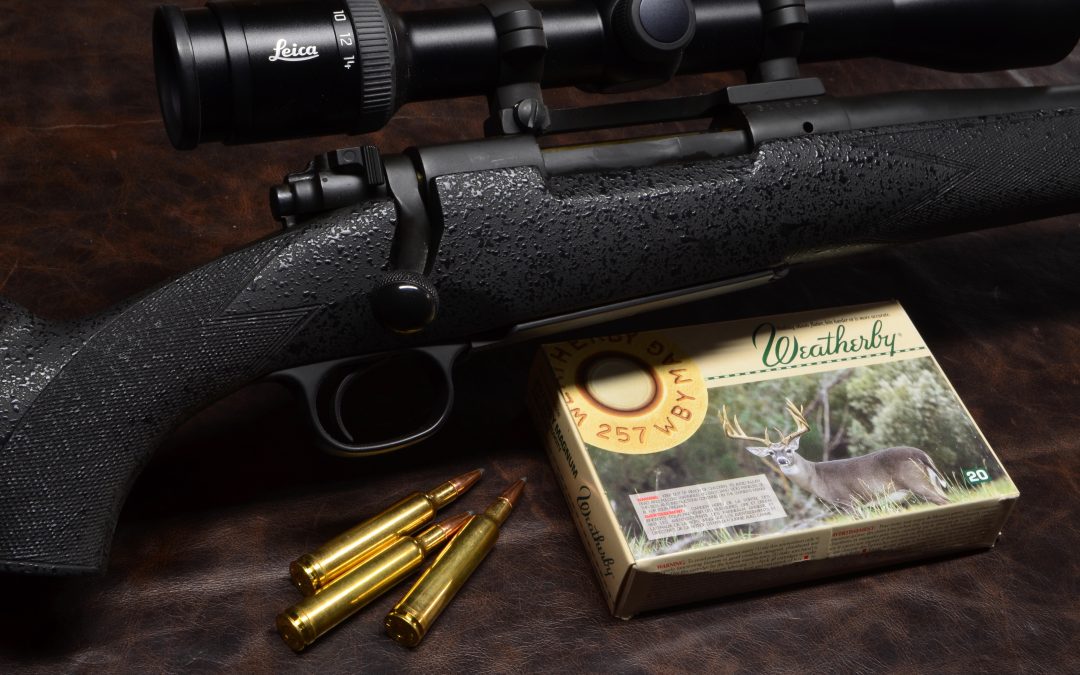
Kenny Jarrett built this .257 Weatherby Magnum on a post-’93 pre-’64 Winchester Model 70 action. It has a 26-inch barrel — critical for achieving magnum ballistics from a cartridge like the .257.
By Terry Wieland
Forty years ago, give or take an eon, basking in a reawakened passion for rifles after a long sojourn pursuing journalism to the ends of the earth, I was leafing through Cartridges of the World and came upon the .257 Weatherby.
When I was a teenager, the very name ‘Weatherby’ was magical, denoting sexy cartridges with double-radiused shoulders, and rifles out of the Arabian Nights, carried by princes hunting Marco Polo sheep. At least, that was the image, and something of that pixie dust lingered as my eye rested on the .257.
Five years later, I found myself in Montana with a safari-grade Weatherby Mark V — a lovely custom thing that, out of the box, grouped its first five shots of factory 100-grain into six-tenths of an inch. Its first shot at big game accounted for the prettiest pronghorn I’ve ever seen, before or since, and it began a short but memorable career as my primary rifle for everything up to zebra.
Along about that time, the first practical chronographs for everyday shooters came along, and I quickly learned to differentiate between the stuff I’d read in the past and what I could now see with my own eyes. Not that never the ‘twain did meet — there was some overlap — but considerable eye-opening did occur.
First, I learned that to get the most out of a cartridge like the .257 Weatherby, burning significant amounts of such as Norma’s MRP or, later, Reloder-22, you had to be using a 26-inch barrel. At that time, Mark Vs were still available with 24-inch barrels, but using one of those with a .257 Weatherby essentially gave you an extremely loud .25-06.
The other thing was that, marvellous as the cartridge was with 100-grain bullets, launching them at around 3,500 feet per second (fps), it was even better with something heavier.
Heading for Tanzania and Botswana in 1990, I prevailed upon my good friend, Jack Carter, to make some of his early Trophy Bonded Bear Claws in .257. These weighed 115 grains, I developed a gilt-edged load at an average of 3,387 fps, and the rifle acquitted itself in Africa like a pro.
The only problem was that, deadly as it might be on plains game like zebra and wildebeeste, it was too long, too heavy, and vastly too powerful for creeping around in the brush looking for duikers and such.
A divorce — no need to ask why — and a few other developments led to my parting with my beloved Mark V. For the next ten years or so, most of my hunting was done with a Dakota 76 .30-06 with a 23-inch barrel. This included hunting in, among other places, Botswana, South Africa, Texas, Colorado, Quebec, and Ontario, wherein I took everything from duikers to elk. Given the virtues of the Dakota, which were many, I didn’t miss the .257 Weatherby all that much, but I never got rid of a hankering for another. When Kenny Jarrett approached me with an offer to make one of his “beanfield” rifles, how could I refuse?
Thing was, Kenny liked to build rifles on Remington 700 actions, chambered for his own .300 Jarrett. Promotional puffery aside, the .300 Jarrett is a .300 Weatherby with sharp shoulders. No, said I, I want a .257 Weatherby. I also wanted it built on one of the then-new post-’93, pre-’64 Winchester Model 70 actions. Kenny was dismayed but cooperative.
The result was nothing like my beautiful custom Weatherby from years before, having an early Bell & Carlson fiberglass stock, circa 1996 and astonishingly homely, and an almost-Parkerized dull finish on the steel. But could it shoot? Man! It was, and is, a shootin’ machine. Long? Yes. Heavy? Yes. Does it demand a big, heavy, powerful scope? Yes. But with the right handloads it fulfills Kenny’s guarantee of three shots into a half inch, time after time.
Now, approaching 30 years later, that Jarrett — which was made to down whitetails at 400 yards plus, across a vast field of soybeans, hence the “beanfield” name — can still go shot for shot with any of the hotshot “long range” rifles I get sent to test, and usually beats them. But then, we’re talking a custom rifle with handloads versus factory (albeit expensive) rifles with factory (albeit premium) ammunition.
As for all the other cartridges available, new and old, magnum, non-magnum, and magnum in name only, I would still take the .257 Weatherby for animals at a distance. There’s not much it won’t do — with a 26-inch barrel, that is. That’s the caveat. It’s what makes a magnum a magnum.